

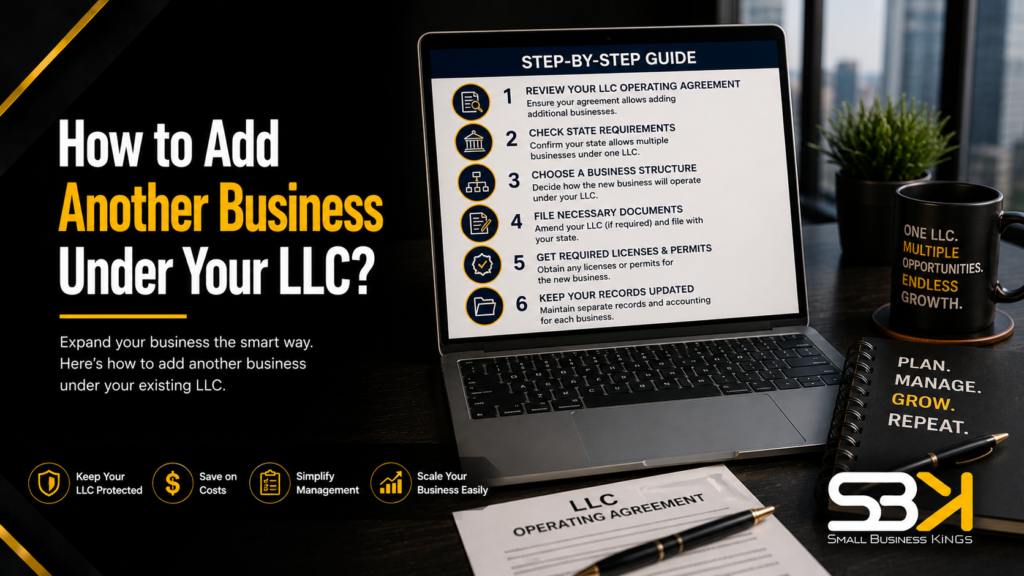
How to Add Another Business Under Your LLC?
You can add another business under your existing LLC by filing a DBA (“doing business as”) name, which lets your LLC operate a second brand without creating a new legal entity. If you’d rather keep the businesses legally separate, you can instead form a brand-new LLC and structure your original LLC as its owner, creating a parent-subsidiary relationship. Which route makes sense depends almost entirely on how much liability risk the new business carries relative to your existing one.
The Two Real Options, and Why They're Not Interchangeable
Every version of this decision comes down to one question: do you want the new business to share legal and financial exposure with your existing LLC, or do you want it walled off?
Automate & Scale Your Small Business
Replace 10+ costly subscriptions with 1 all-in-one CRM, Funnels & Marketing Engine.
A DBA keeps everything under one legal roof. It’s cheaper, faster, and easier to maintain, but it means your existing LLC and the new business line are, legally speaking, the same entity wearing two names. A lawsuit, unpaid debt, or contract dispute tied to either business puts the assets of both at risk.
A new, separate LLC — whether standalone or structured as a subsidiary of your original LLC — creates a real legal boundary. Each entity has its own liability shield, so trouble in one business generally doesn’t reach into the other’s assets. The tradeoff is more paperwork: separate formation filings, separate registered agent requirements in most states, separate annual reports, and in many cases a separate EIN and bank account.
Neither option is universally “better.” A single freelancer running a consulting side project and a light e-commerce shop probably doesn’t need two legal entities. A contractor adding a second business with employees, equipment, and its own liability exposure probably does.
Launch Your Business On Fast VPS Hosting
Secure, high-performance hosting designed for growth. Don't lose sales to slow site speed.
Option 1: File a DBA Under Your Existing LLC
This is the faster, lower-cost path, and it’s the right call when your businesses are closely related, carry similar (and manageable) risk levels, and you want simplified bookkeeping and a single tax filing.
Step-by-Step: Filing a DBA
- Check name availability. Search your state’s business name database (usually through the Secretary of State’s website) to confirm the name isn’t already in use or confusingly similar to an existing registered business.
- File the DBA registration. Depending on your state, this is filed with the Secretary of State, a county clerk, or both. Some states also require you to publish a notice of the new name in a local newspaper for a set period — this requirement varies significantly by state and county, so confirm the specific process where you’re registered.
- Pay the filing fee. Fees vary by state and change over time, so check your state’s current fee schedule directly rather than budgeting off a number you saw elsewhere.
- Clarify your EIN situation. A DBA is not a separate legal entity, so in most cases it does not get its own EIN — it operates under your existing LLC’s EIN. If your bank or a specific vendor requires documentation linking the DBA to your LLC’s EIN, your DBA registration certificate typically serves that purpose. Confirm directly with the IRS or your accountant if your situation involves anything unusual, like different ownership percentages tied to the new line of business.
- Open a separate bank account for the DBA. Even though it’s legally one entity, keeping the DBA’s income and expenses in a dedicated account makes bookkeeping dramatically easier and gives you a clean paper trail if you’re ever audited or need to unwind the arrangement later.
- Update contracts and customer-facing materials. Make sure invoices, contracts, and your website clearly reference the DBA name where appropriate, so there’s no confusion about which brand a customer is dealing with.
What a DBA Does — and Doesn't — Protect
Option 2: Form a Separate LLC (Standalone or Subsidiary)
If the new business carries meaningfully different risk — different customers, different liability exposure, physical products versus services, employees versus solo work — a separate LLC is usually worth the extra paperwork.
Standalone LLC
You form a completely independent LLC with its own Articles of Organization, its own EIN, its own operating agreement, and its own bank account. Neither LLC owns the other; you personally (or with co-owners) hold membership in both. This is the simplest version of “separate” and works well when the two businesses have nothing to do with each other.
Parent-Subsidiary Structure (Holding Company)
Instead of you personally owning both LLCs, your original LLC becomes the member (owner) of the new LLC. This is common when an established business wants to spin up a new venture using its own capital and reputation, or when an owner is planning to eventually sell one business line without disturbing the other.
How to set this up:
- Form the new LLC in the state where it will operate, listing your existing LLC (not you personally) as the member/owner in the Articles of Organization.
- Draft an operating agreement for the new LLC that reflects this ownership structure and spells out how it’s managed.
- Get a separate EIN for the new LLC — subsidiaries generally need their own, even though they’re owned by the parent.
- Open a dedicated bank account and keep the subsidiary’s finances completely separate from the parent’s, since commingling funds is one of the fastest ways to undermine the very liability protection you’re setting this structure up to get.
- Maintain separate books, contracts, and licenses for the subsidiary, treating it operationally as its own company even though ownership traces back to your original LLC.
A parent-subsidiary structure isolates each business’s liabilities from the other in most circumstances, but it doesn’t insulate you personally if you’ve personally guaranteed a loan or committed personal negligence tied to either business — the liability shield protects the entities from each other, not you from every possible claim.
Free Business Blueprint
Steal the roadmap smart entrepreneurs use to launch, grow, and scale their businesses while avoiding expensive mistakes.
Decision Framework: Which Route Fits Your Situation?
Run through these questions before you file anything:
| Question | Leans Toward DBA | Leans Toward Separate LLC |
|---|---|---|
| How related are the businesses? | Same customers, same industry, shared branding | Different industries, different customer bases |
| How much liability risk does the new business carry? | Low risk, service-based, no employees | Physical products, employees, higher lawsuit exposure |
| Will they operate in the same state? | Yes, no foreign qualification needed | Different state — separate LLC may need to register there anyway |
| Do you want to eventually sell one business separately? | Harder to separate later | Structured for clean separation from day one |
| How much ongoing admin can you handle? | Minimal — one entity, one filing | More — separate reports, fees, and records per entity |
| Do you want one simplified tax filing? | Yes, everything flows through one return | No, willing to manage (or elect) separate tax treatment |
If you answered “DBA” to most of these, start there — you can always convert to a separate LLC later if the business grows or its risk profile changes. If you answered “separate LLC” to more than one or two, especially the liability question, the extra paperwork upfront is usually worth it.
A Worked Example
Say you already run a landscaping LLC and want to add a second line of business selling and installing outdoor lighting fixtures.
- If you go the DBA route: You’d register something like “[Your LLC Name] DBA [New Lighting Business Name]” with your state, open a separate checking account for the lighting revenue and expenses, and continue filing one tax return for the combined business. This works well if the lighting work uses the same crew, insurance, and customer base as your existing landscaping clients.
- If you go the separate LLC route: You’d form a new LLC for the lighting business, decide whether you personally own it or your landscaping LLC owns it as a subsidiary, get it its own EIN and bank account, and maintain it as its own operating entity. This makes more sense if the lighting work involves different licensing requirements, a different insurance policy, or if you’re bringing on a business partner specifically for that venture who has no stake in the landscaping company.
The deciding factor isn’t the industry similarity alone — it’s whether a claim against one business could reasonably also threaten the other, and whether you want that risk contained.
Don't Skip: Licensing, Insurance, and Multi-State Rules
Whichever structure you choose, a few things apply regardless:
- Licensing and permits are typically required per business, not per LLC. Adding a DBA doesn’t exempt the new business line from needing its own applicable licenses, permits, or industry-specific certifications.
- Insurance should reflect actual risk, not legal structure. A DBA under a low-liability-shield structure benefits enormously from adequate general liability coverage, since the legal wall between businesses is thin to nonexistent. Talk to a commercial insurance agent about whether your existing policy covers the new business line or whether you need a separate policy or rider.
- Operating in a new state usually requires foreign qualification, regardless of whether you use a DBA or a new LLC. If the second business will be based in or regularly do business in a state other than where your LLC is formed, check that state’s Secretary of State requirements for registering as a foreign entity.
Getting the New Business Ready for Customers
Once you’ve settled the legal structure, the next practical step is making sure customers can actually find and do business with the new venture — especially if it’s operating under a different name than your original company. A DBA in particular needs its own clear online identity so customers aren’t confused about who they’re buying from. SBK works with Softangles for exactly this: they handle business website design and hosting, logo and brand/media design, and setting up a CRM and sales pipeline, so your new business line has a professional presence from day one instead of riding awkwardly on your original company’s branding.
Frequently Asked Questions
Does a DBA need its own EIN?
In most cases, no — a DBA is not a separate legal entity, so it operates under your existing LLC’s EIN. If your situation involves unusual circumstances, like different ownership arrangements for the new business line, confirm directly with the IRS or a tax professional.
Can I later convert a DBA into its own LLC?
Yes, this is common as a business line grows and its risk profile or ownership structure changes. You’d form a new LLC, transfer relevant contracts and assets to it, and stop operating that line under the DBA — a tax professional or attorney can help you handle the transition cleanly, including any tax consequences of moving assets between entities.
What happens to a DBA if the parent LLC is dissolved?
Since a DBA isn’t a separate legal entity, it generally can’t survive independently — if the LLC that holds the DBA registration is dissolved, the DBA typically ends with it. If you want the business to continue, you’d need to re-register it under a new or different entity.
Can one LLC own multiple other LLCs?
Yes — an LLC can serve as the member (owner) of any number of subsidiary LLCs, which is the basic structure behind most holding company setups. Each subsidiary still needs its own formation filing, EIN, and operating agreement, even though ownership traces back to the same parent.
Do I need a lawyer to set up a parent-subsidiary LLC structure?
It’s not always legally required, but the tax and liability implications of a holding company structure can get complicated quickly, especially once you involve multiple owners or plan to sell one business separately. Most business owners find it worth consulting an attorney or tax professional before finalizing this structure rather than after.
Launch Your Business On Fast VPS Hosting
Secure, high-performance hosting designed for growth. Don't lose sales to slow site speed.
Is a Series LLC a good alternative to a DBA or separate LLC?
It can be, but Series LLCs are only available in certain states and are treated differently by courts, banks, and tax authorities depending on jurisdiction. If your state allows them, it’s worth discussing with an attorney whether a Series LLC fits your situation better than a standard DBA or subsidiary structure.