

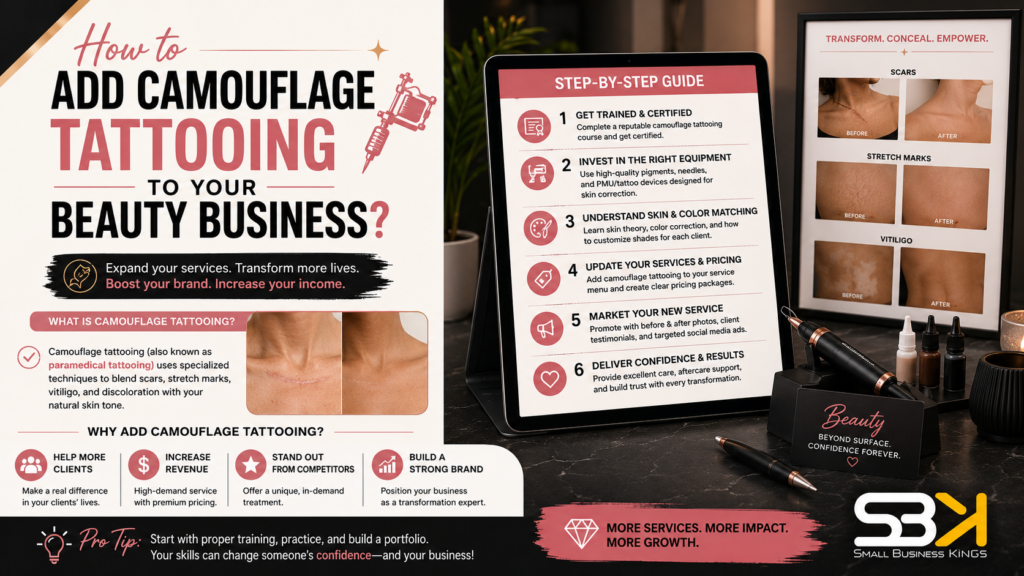
How to Add Camouflage Tattooing to Your Beauty Business?
Adding scar and stretch mark camouflage tattooing to an existing beauty business means investing in specialized paramedical training beyond standard cosmetic tattooing, meeting your state’s body art and health department licensing requirements, setting up a private treatment space, and carrying dedicated liability insurance before you touch a single client. Because you’re layering this onto a business you already run, the real work is less about starting from zero and more about deciding whether your space, staff, and existing client relationships can support a service this sensitive — and building the systems to do it properly.
What Makes This Different From Adding Any Other New Service
Camouflage tattooing isn’t like adding a new hair color technique or a new facial protocol. You’re working with a needle, permanent (or semi-permanent) pigment, and a client population that often includes people recovering from mastectomies, burns, self-harm, or other trauma. That combination changes what “readiness” actually means for your business:
Automate & Scale Your Small Business
Replace 10+ costly subscriptions with 1 all-in-one CRM, Funnels & Marketing Engine.
- The regulatory bar is higher. In most states, this work falls under body art or cosmetic tattoo regulation, which is a different licensing category than standard esthetics or cosmetology, even if you’re already a licensed esthetician.
- The emotional stakes are higher. A client coming in for a haircut wants to look better. A client coming in for scar camouflage is often trying to reclaim a part of their identity or body they feel disconnected from — the consultation process needs to reflect that.
- The technical margin for error is smaller. Matching pigment to skin tone on scar tissue, which heals and absorbs pigment differently than undamaged skin, requires training standard microblading or cosmetic tattoo courses don’t cover.
If you’re already running a beauty business, you likely have the operational infrastructure (a space, a booking system, existing clients, marketing channels) that a from-scratch practitioner doesn’t. Your job is to layer specialized capability onto that foundation, not build a business from nothing.
Step 1: Get the Right Training — Not Just Any Cosmetic Tattoo Course
Standard microblading or permanent makeup certification does not qualify you to perform scar or stretch mark camouflage. Look specifically for training that covers:
- Color theory as applied to damaged skin. Undertones, midtones, and overtones behave differently in scar tissue than in undamaged skin, and getting this wrong produces a camouflage result that looks worse than the scar itself.
- Scar physiology and wound healing. You need to understand how scar depth, age, and texture affect how pigment sits and heals — a scar that’s still actively remodeling (generally under a year old) typically isn’t a good candidate for camouflage work at all.
- Hands-on practical application, not just theory. Look for programs that include supervised practice on real or simulated scar tissue, not only lecture-based instruction.
When evaluating a training program, ask directly: how long has the instructor been practicing this specific specialty, are they still actively treating clients, what post-course support or mentorship is included, and can you speak with past students about their experience. A credential from a program that can’t answer these clearly is a red flag regardless of how polished its marketing looks.
Launch Your Business On Fast VPS Hosting
Secure, high-performance hosting designed for growth. Don't lose sales to slow site speed.
Step 2: Confirm Licensing and Regulatory Requirements for Your State
This is the step most likely to trip up an existing beauty business owner who assumes their current license already covers it. It usually doesn’t.
- Check whether your state requires a separate body art or cosmetic tattoo license. Requirements vary significantly by state and even by county — some states require registration with a medical board for certain paramedical procedures, while others regulate it purely through cosmetology boards. Confirm current requirements directly with your state’s Department of Health or Board of Cosmetology rather than assuming your existing license carries over.
- Get bloodborne pathogen certification if you don’t already have it. This is standard for any procedure involving needles and skin penetration, and many states require it as a condition of licensure.
- Verify your treatment space meets health department standards for this specific service, which may be stricter than standard esthetics room requirements — think sanitation protocols, sharps disposal, and surface materials.
- Confirm your existing business insurance doesn’t already exclude this work. Standard salon liability policies frequently carve out needle-based procedures entirely, so you’ll likely need a specific cosmetic tattoo or paramedical liability rider or standalone policy before you take your first client.
Because these requirements vary by state and change over time, treat any specific number or rule you find online as a starting point and verify directly with your state’s licensing board before you invest in training or space renovation.
Step 3: Decide How to Physically Integrate the Service Into Your Existing Space
This is where an existing business has real decisions to make that a startup guide won’t address, since a from-scratch practitioner is choosing a space for the first time rather than retrofitting one.
Option A: Convert an existing private room. If you already have a treatment room used for facials, waxing, or another private service, this is often the fastest path — but confirm it meets the sanitation and equipment standards required for body art work specifically, which may mean upgrading surfaces, lighting, or storage for sterile supplies.
Option B: Build out a new dedicated space. If your current layout doesn’t have anything private enough, budget for renovation. Clients undergoing this work need to feel genuinely private and unhurried — a room with thin walls next to a busy nail station undermines the experience regardless of your technical skill.
Option C: Rent time in a partner facility. Some practitioners start by renting space part-time in a medical spa or dermatology office that already meets a higher clinical standard, which can reduce upfront buildout cost while you validate demand.
Whichever route you choose, the space needs, at minimum: a comfortable, adjustable treatment chair or table, proper lighting for accurate color matching, sterile storage for pigments and needles, a sharps disposal system, and enough visual and acoustic privacy that a client discussing a mastectomy scar or self-harm history isn’t audible or visible from a waiting area.
Free Business Blueprint
Steal the roadmap smart entrepreneurs use to launch, grow, and scale their businesses while avoiding expensive mistakes.
Step 4: Build a Consultation and Intake Process That Matches the Sensitivity of the Work
A standard beauty service consultation form isn’t enough here. Build yours around three things:
- Medical history and candidacy screening. You need to know about the age and healing status of the scar, any relevant medical conditions (autoimmune conditions, keloid history, certain medications), and whether the area has been medically cleared for cosmetic work if it’s post-surgical.
- Realistic expectation-setting. This is not a decorative tattoo — the goal is reducing visibility, not eliminating a scar entirely, and clients need to understand that most treatment plans require multiple sessions spaced weeks apart to allow proper healing between visits.
- Photography and privacy consent, handled explicitly. Before-and-after photos are one of the most persuasive marketing tools for this service, but many clients are showing you deeply personal areas of their body and history. Get clear, written consent for how photos will be used (internal reference only, versus marketing, versus social media) before you take a single image, and never assume consent extends further than what was explicitly agreed to.
Step 5: Price the Service as Its Own Line, Not an Extension of Existing Menu Pricing
Camouflage tattooing typically commands a higher price point than standard cosmetic tattooing because of its specialized nature, but pricing it like a decorative service undersells the expertise involved. Common approaches:
- Flat-rate treatment plans that bundle the estimated number of sessions for a given scar size and type, adjusted after the initial consultation once you can assess the specific case.
- Per-session pricing for cases where session count is genuinely unpredictable until you see how the skin responds to the first treatment.
Whichever model you choose, be transparent about the fact that most clients need multiple sessions and that final results depend on individual healing — setting this expectation at the consultation, in writing, prevents disputes later.
How to Introduce This Service to Your Existing Client Base Without It Feeling Like an Upsell
This is a genuine risk for an established business that a from-scratch guide won’t address: existing clients may not immediately understand why their regular esthetician is now offering something that sounds medical or clinical, and a heavy-handed announcement can feel like a bait-and-switch.
- Lead with education, not promotion. A short explainer — what the service is, who it helps, why you pursued the training — builds credibility before you ever mention booking.
- Use real (consented) before-and-after results once you have them, rather than stock photos or generic marketing language, since this service sells almost entirely on visible proof of results.
- Let existing staff know how to answer questions accurately. If a client asks your receptionist or another technician about the new service, an uncertain or vague answer undermines trust faster than not offering it at all.
Why Your Business Might Not Be Showing Up
If you’ve done the basics and you’re still not appearing in Alexa results, the cause is almost always one of these:
- Inconsistent NAP across one or more directories — even a single mismatched digit or abbreviation can be enough.
- A missing directory entirely — no Yelp listing, for instance, leaves a real gap for Yelp-dependent categories like restaurants and retail.
- Duplicate listings on the same platform, often from a previous owner or an old auto-generated entry, which splits your reviews and confuses matching.
- No schema markup, leaving Alexa dependent entirely on third-party directory data with no direct source from your own site.
- A thin or stale review profile — few reviews, or none in the past several months, reads as an inactive or unreliable business.
- Outdated hours or contact information anywhere in the chain, which can cause Alexa to serve wrong information even if your business is otherwise well-optimized.
Work through this list in order — NAP and missing directories are usually the fastest fixes and the most common root cause.
Getting Found by the Right Clients Online
Once you’re trained, licensed, and set up to deliver this service safely, the next challenge is making sure people searching for it — often at a vulnerable, specific moment, like right after a mastectomy or years into hiding a scar — can actually find you. This is a service people research carefully before booking, so your website needs to clearly explain what you do, who you help, and show real results, not just list it as a menu item buried among facials and waxing. SBK works with Softangles for exactly this: they handle business website design and hosting, logo and brand/media design, and CRM/sales pipeline setup, so you have a dedicated, professional space to showcase this service and manage consultation requests without losing track of sensitive client inquiries in a general inbox.
A Worked Example: Adding Scar Camouflage to an Existing Esthetics Studio
Say you run a solo esthetics studio offering facials, waxing, and brow services, and you want to add scar camouflage as a new specialty.
- Research training first, before committing to space or equipment changes. Enroll in a program specifically focused on paramedical scar work, not a general permanent makeup course, and confirm it includes supervised hands-on practice.
- Check your state’s licensing requirements in parallel with training, since some states require documentation of program hours or a separate exam before you can legally advertise or perform the service.
- Assess your existing treatment room honestly. If it’s currently used for waxing, does it have the privacy, lighting, and sanitation setup this service needs, or does it need upgrading?
- Get a quote for a standalone cosmetic tattoo liability policy before you finish training, so there are no surprises about cost or coverage gaps once you’re ready to book clients.
- Build your intake form and consultation script before you take your first booking, including medical history questions and photo consent language.
- Soft-launch with a small number of clients, potentially at a reduced introductory rate in exchange for honest feedback and consented before-and-after documentation, before promoting the service widely.
This sequencing — training and licensing first, space and consultation process second, marketing last — prevents the common mistake of promoting a service before you’re actually ready to safely deliver it.
Comparing Space Integration Options
| Approach | Upfront Cost | Speed to Launch | Best For |
|---|---|---|---|
| Convert existing private room | Lower | Fastest | Businesses with an underused private room that meets or nearly meets standards |
| Build out new dedicated space | Higher | Slowest | Businesses without adequate existing privacy or sanitation setup |
| Rent time in a partner clinical facility | Moderate, ongoing | Moderate | Practitioners validating demand before committing to permanent space |
Exact costs vary significantly by location, existing space condition, and local code requirements, so get quotes specific to your situation rather than budgeting off a general figure.
Frequently Asked Questions
Can I add camouflage tattooing if I’m already a licensed esthetician?
Not automatically — most states treat body art and cosmetic tattoo work as a separate licensing category from general esthetics, even though the two are related fields. Confirm your specific state’s requirements with your Board of Cosmetology or Department of Health before assuming your existing license covers it.
How long does it typically take to go from deciding to add this service to seeing your first client?
This varies based on the training program length, how quickly you complete any required licensing steps, and whether your space needs renovation, but expect it to take longer than adding a typical new service given the training depth and regulatory steps involved. Building in time for supervised practice and licensing paperwork, rather than rushing to launch, protects both you and your clients.
Do I need separate insurance for camouflage tattooing, or does my salon policy cover it?
In most cases, standard salon liability insurance excludes needle-based procedures entirely, so you’ll likely need a dedicated cosmetic tattoo or paramedical liability policy or rider. Confirm this directly with your current insurance provider before assuming you’re covered.
What’s the difference between decorative cosmetic tattooing and paramedical scar camouflage training?
Decorative work (like microblading or lip blush) focuses on aesthetic enhancement of healthy skin, while paramedical scar camouflage requires understanding wound healing, scar physiology, and how damaged skin absorbs and holds pigment differently. The two require different training paths, and completing one doesn’t qualify you for the other.
How many sessions does scar or stretch mark camouflage typically require?
Most treatment plans involve multiple sessions, since pigment application and healing need to be assessed and adjusted between visits rather than completed in one sitting. The exact number depends on the size, age, and texture of the scar or stretch mark area, which is why an initial consultation and assessment should always precede any pricing commitment.
Launch Your Business On Fast VPS Hosting
Secure, high-performance hosting designed for growth. Don't lose sales to slow site speed.
Should I photograph clients for before-and-after marketing, and how do I handle consent?
Before-and-after photography is one of the most effective ways to market this service, but always get explicit, written consent that specifies exactly how photos will be used — internal reference only versus public marketing versus social media are meaningfully different permissions. Never assume consent for one use extends to another, especially given how personal and potentially medically sensitive these images often are.