

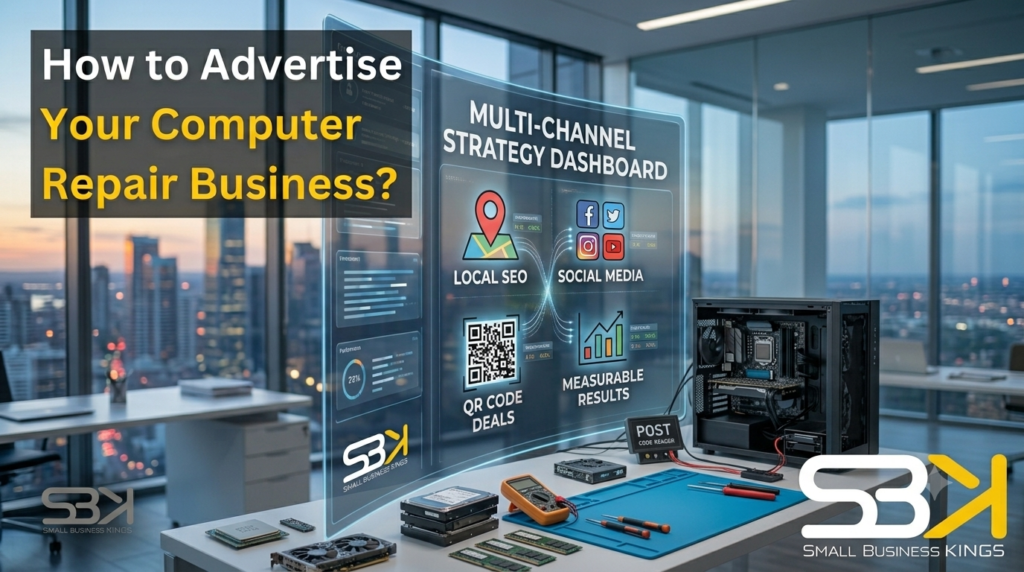
How to Advertise Your Computer Repair Business?
The most effective way to advertise a computer repair business is to build a strong local search presence first (Google Business Profile, reviews, a fast mobile-friendly website), then layer in targeted local ads, referral partnerships with other small businesses, and short-form video content that shows off your actual repair work. Because repair is a local, often urgent service, your marketing should prioritize channels that reach people at the moment they’re searching for help nearby — not broad brand-awareness campaigns.
Start by Knowing Exactly Who You're Advertising To
Before spending a dollar on ads or hours on content, get specific about who you’re trying to reach. “Anyone with a broken device” isn’t a target audience — it’s a lack of one.
Automate & Scale Your Small Business
Replace 10+ costly subscriptions with 1 all-in-one CRM, Funnels & Marketing Engine.
Define your ideal customer along a few dimensions:
- Geography. Repair is a catchment-area business — customers won’t drive far for a non-emergency repair, so your entire marketing strategy should be built around a realistic radius around your shop or service area, not a broad regional or national reach.
- Device and service focus. Are you known for phone screen repairs, data recovery, gaming PC builds, or small-business IT support? Trying to be everything to everyone in your marketing copy usually reads as generic and forgettable.
- Residential versus commercial. A homeowner with a cracked phone screen and a local accounting firm needing ongoing IT support are different customers with different buying triggers, different price sensitivity, and different channels where they can be reached.
This isn’t a one-time exercise — revisit it once you have a few months of actual customer data, since your real customer base often looks different from who you initially assumed you’d attract.
Build the Local Search Foundation First
Nearly every other tactic in this article works better once this foundation is in place, so do this before spending on ads.
Launch Your Business On Fast VPS Hosting
Secure, high-performance hosting designed for growth. Don't lose sales to slow site speed.
Claim and Fully Optimize Your Google Business Profile
This is free, and it’s the single highest-leverage thing a local repair business can do. At minimum:
- List every service you actually offer by name — virus removal, screen replacement, data recovery, hardware upgrades — since customers often search for the specific fix they need, not the generic category.
- Keep your hours, address, and phone number accurate and consistent with what appears on your website and any other directory listing.
- Add real photos of your shop, your team, and your work — generic stock photography does less for trust than an actual picture of your storefront or workbench.
Actively Collect Google Reviews
A profile with strong service details but no reviews still underperforms a competitor with a thinner profile and consistent positive reviews. Ask every satisfied customer directly, ideally right after you’ve handed back a successfully repaired device — that’s the moment goodwill is highest. A simple text or email with a direct review link removes friction; customers who intend to leave a review often don’t if it takes more than a click or two to find where.
Make Your Website Fast, Mobile-First, and Easy to Navigate
Most people searching for repair services on their phone, often standing in front of a broken device, will bounce from a slow or confusing site within seconds. At minimum:
- Confirm your site loads quickly and displays cleanly on a phone screen, not just a desktop browser.
- Structure your site around how customers actually think about your services — separate pages for different repair categories (phone repair, computer repair, business IT support) rather than one page trying to cover everything.
- Make your contact information and booking option visible without scrolling, since urgency is often the entire reason someone is looking you up in the first place.
Get Listed on Relevant Directories Beyond Google
Yelp matters in the US for consumer-facing repair services specifically, and industry-specific directories (device manufacturer “authorized service provider” listings, if applicable) can carry real weight for search visibility and customer trust simultaneously.
Understand Google's Ad Restrictions Before You Spend on PPC
This is a genuinely important point that’s easy to miss: Google restricts advertising for third-party technical support and repair services, treating this category with extra scrutiny due to a history of scam ads in the space. If you’re not an authorized service provider for a specific brand, getting your ad campaigns approved can take more effort and documentation than a typical local business category, and some ad accounts get flagged or rejected outright on the first attempt.
Before investing significant budget in Google Ads specifically:
- Check Google’s current advertising policies for technical support and repair services directly, since policy enforcement in this category tightens and loosens over time.
- If you’re an authorized service provider for a specific brand (a common example is an Apple Authorized Service Provider), that status can meaningfully ease approval, since it distinguishes you from unauthorized third-party repair operations Google is specifically trying to filter out.
- If your Google Ads account gets rejected, don’t assume advertising is off the table entirely — social advertising (Facebook, Instagram) doesn’t carry the same restriction and is often a more viable paid channel for this industry regardless.
Free Business Blueprint
Steal the roadmap smart entrepreneurs use to launch, grow, and scale their businesses while avoiding expensive mistakes.
Run Hyper-Local Paid Ads Where They'll Actually Convert
Given the Google Ads friction above, many repair businesses get more reliable results from social advertising, at least initially.
- Facebook and Instagram ads with tight geographic targeting. Narrow your radius to match your realistic catchment area rather than targeting broadly — a repair shop doesn’t benefit from impressions 40 miles away.
- Lead with a specific, low-friction offer, not a generic “we do repairs” message. A free diagnostic, a percentage off a first repair, or free device pickup for larger items all give someone a concrete reason to click now instead of bookmarking for later.
- Choose the right campaign goal. If your objective is generating calls or bookings rather than general brand awareness, select a conversion- or lead-generation-oriented campaign type rather than a reach or engagement-focused one, since the platform will optimize delivery differently based on that goal.
- Track what’s actually converting. Set up a way to know whether a call or booking came from a specific ad, not just how many people saw or clicked it — impressions and click-through rates don’t pay your rent if none of that traffic turns into repair jobs.
Lower the Barrier for First-Time Customers
A significant number of people delay getting a device repaired simply because they’re afraid of an inflated diagnostic fee or being upsold on unnecessary work. Addressing that hesitation directly is one of the more overlooked but effective tactics in this industry.
- Offer a free or low-cost diagnostic to get the device into your hands in the first place — this converts a hesitant lead into an actual customer relationship far more often than asking someone to commit to a repair sight-unseen.
- Be transparent about the actual problem and cost once you’ve diagnosed it. This is where trust either solidifies or breaks — customers who feel like they understand exactly what’s wrong and why the price is what it is are far more likely to approve the work and come back next time.
- Make your pricing philosophy visible on your website and Google profile, even if you don’t list exact prices for every repair. A short line like “free diagnostic, no obligation” removes a real psychological barrier before someone even calls.
Build Referral Partnerships With Other Local Businesses
This is one of the highest-return, lowest-cost channels available to a repair business, and it’s consistently under-utilized. Local businesses that rely on computers but don’t have in-house IT support are a natural, recurring source of both one-off and ongoing work.
Businesses worth reaching out to directly:
- Coworking spaces and small offices without dedicated IT staff
- Accounting and law firms, which depend heavily on functioning computers and tend to have urgent, high-value repair needs
- Local electronics retailers who sell devices but don’t offer in-house repair
- Real estate offices, medical practices, and other small professional service businesses
How to structure the partnership in practice:
- Approach the business directly, not through a cold email — a short in-person or phone conversation explaining what you do and offering a modest introductory rate for their team tends to land better than a generic pitch.
- Offer a clear incentive for sending business your way — a referral commission or a discount on their own future repairs both work, but be explicit about what you’re offering rather than leaving it vague.
- Provide something concrete they can hand to their own clients or employees, like a simple flyer or a direct contact card, so the referral has an easy next step instead of just a verbal recommendation that gets forgotten.
- Follow up periodically rather than treating it as a one-time conversation — relationships like this tend to fade without occasional reconnection, a check-in call, or a small thank-you gesture after a referral converts.
Use Content and Social Media to Build Local Authority
Content marketing works differently for a repair business than for most industries — you’re not trying to go viral, you’re trying to be the obvious local choice when someone’s device breaks.
- Short-form video is the highest-leverage content format right now. Before-and-after repair footage, quick device-care tips (“how to clean your charging port safely”), and short teardown clips all perform well on Instagram Reels, YouTube Shorts, and TikTok, and they showcase competence in a way text simply can’t.
- Answer real questions in local online spaces. Local Facebook groups and community forums often have people asking for a trustworthy repair recommendation — genuinely helpful, non-salesy answers in these spaces build organic word-of-mouth over time.
- Stay consistent rather than sporadic. A steady cadence of simple, useful posts outperforms occasional bursts of high-effort content followed by long silences, both for algorithmic visibility and for staying top-of-mind with your existing audience.
Comparing Your Main Advertising Channels
| Channel | Cost | Best For | Key Consideration |
|---|---|---|---|
| Google Business Profile + reviews | Free | Local discovery, trust-building | Requires ongoing review requests and profile accuracy |
| Google Ads | Paid, budget-flexible | High-intent “near me” searches | Subject to Google’s third-party repair ad restrictions |
| Facebook/Instagram ads | Paid, budget-flexible | Geographically targeted awareness and offers | Works well with a specific, low-friction offer |
| Referral partnerships | Low cost, time investment | Recurring B2B work, high-trust leads | Requires ongoing relationship maintenance, not a one-time pitch |
| Short-form video/social content | Free (time investment) | Building local authority and shareability | Requires consistency over virality |
A Worked Example: A New Independent Phone and Computer Repair Shop
Say you’ve just opened a single-location shop offering phone and computer repair, with a modest marketing budget and no existing customer base yet.
- Week 1: Claim and fully complete your Google Business Profile, listing every specific service you offer. Build a simple, fast, mobile-friendly website with separate pages for phone repair, computer repair, and (if relevant) small-business IT support.
- Week 2: Reach out directly to three or four nearby small businesses — a coworking space, an accounting firm, an electronics retailer — offering a modest introductory discount in exchange for referrals to their staff or clients.
- Week 3: Start posting two to three short videos a week — a quick before-and-after of a screen repair, a 15-second tip on protecting a phone battery — on whichever platform your target customers actually use.
- Week 4: Launch a small, tightly geo-targeted Facebook/Instagram ad campaign offering a free diagnostic, tracking calls and bookings so you know whether the spend is converting before increasing the budget.
- Ongoing: After every completed repair, send a direct review request. Once you’ve built a track record and a review base, revisit whether Google Ads makes sense given the platform’s stricter approval process for repair services.
This sequencing prioritizes free, foundational work first, then layers in low-cost relationship-building, and only adds paid spend once you have a way to measure whether it’s actually working.
Setting Up the Digital Side So You're Not Losing Leads
- All of the tactics above depend on customers being able to find you, trust you, and actually reach you once they’re interested — a slow website, an inconsistent Google listing, or no simple way to track incoming leads undermines everything else on this list. If you’re setting up your online presence for the first time, or your current site isn’t converting the traffic you’re already getting, it’s worth getting this foundation built properly rather than patching it together. SBK works with Softangles for exactly this: they handle business website design and hosting, logo and brand/media design, and CRM/sales pipeline setup, so incoming leads from your Google profile, referrals, and ads actually land somewhere organized instead of getting lost in a shared inbox or missed call.
Frequently Asked Questions
How do I ask customers for reviews without it feeling awkward?
Ask right after you’ve successfully completed the repair and handed the device back, when satisfaction is highest, and send a direct link that takes them straight to the review form rather than making them search for it. A short, casual message — thanking them for their business and asking if they’d share a quick review — tends to convert better than a formal request.
Is Google Ads worth it for a small computer repair shop?
It can be, but confirm your ability to get ads approved first, since Google applies extra scrutiny to third-party technical support and repair advertising. Many repair businesses find Facebook and Instagram ads more reliable to launch quickly, and worth testing before committing significant budget to Google Ads specifically.
How much should I spend on advertising when I’m just starting out?
There’s no universal figure, since it depends on your local market, competition, and how much organic traction you can build through Google Business Profile and referrals first. A reasonable approach is starting with the free channels (profile optimization, reviews, referral outreach) before committing meaningful ad spend, then scaling paid budget only once you can track which channel is actually converting into paying jobs.
What’s the difference between organic and paid marketing for a repair business?
Organic marketing includes free channels like your Google Business Profile, reviews, social media content, and word-of-mouth — it takes longer to build but costs no direct ad spend. Paid marketing (Google Ads, Facebook/Instagram ads) can generate faster visibility but requires ongoing budget and, for Google Ads specifically, navigating stricter approval requirements for repair-related advertising.
How do I set up a referral partnership with another local business?
Approach the business directly with a specific, concrete offer — a referral commission or a discount on their own future service — rather than a vague request to “send business my way.” Give them something tangible, like a flyer or direct contact card, to pass along, and follow up periodically so the relationship doesn’t fade after the first conversation.
Launch Your Business On Fast VPS Hosting
Secure, high-performance hosting designed for growth. Don't lose sales to slow site speed.
Should I focus more on social media or local SEO first?
Local SEO (Google Business Profile, reviews, a fast mobile-friendly website) should come first, since it’s free, has lasting value, and captures people who are already actively searching for repair services nearby. Social media and content build awareness and trust over time, but they work best as a complement to a strong local search foundation, not a replacement for it.