

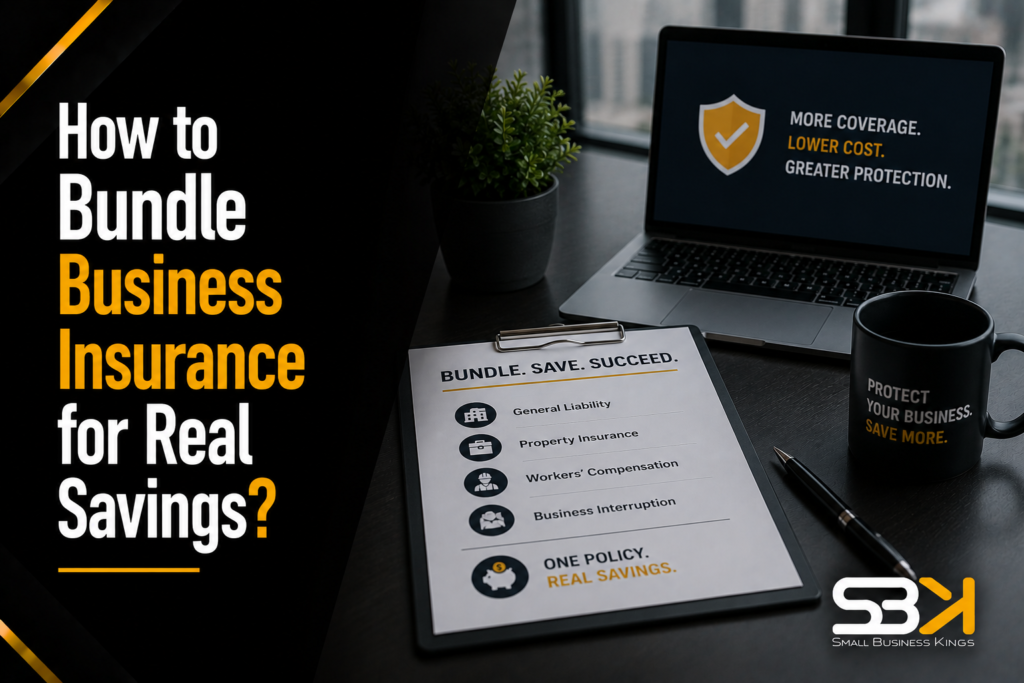
How to Bundle Business Insurance for Real Savings?
Bundling business insurance means combining coverages like general liability, commercial property, and business interruption into a single policy — most commonly a Business Owner’s Policy (BOP) — instead of buying each one separately. Insurers typically price bundled coverage lower than the sum of standalone policies, and you get one renewal date, one point of contact, and fewer coverage gaps. But bundling isn’t automatically the cheapest or safest option for every business, and knowing when it isn’t matters as much as knowing how to do it.
What Does It Mean to Bundle Business Insurance?
Bundling combines multiple types of coverage under one policy or one carrier relationship instead of purchasing each separately from different insurers. The most common bundle is a Business Owner’s Policy (BOP), which typically packages:
Automate & Scale Your Small Business
Replace 10+ costly subscriptions with 1 all-in-one CRM, Funnels & Marketing Engine.
- General liability insurance — covers third-party claims for bodily injury, property damage, or advertising injury
- Commercial property insurance — covers your building (owned or leased), equipment, inventory, and fixtures
- Business interruption insurance — replaces lost income and covers ongoing expenses if a covered event forces a temporary shutdown
Beyond the BOP, “bundling” can also mean placing additional lines — commercial auto, workers’ compensation, cyber liability, professional liability — with the same carrier or agency to unlock multi-policy pricing and simplified administration.
Why Bundling Usually Costs Less
Insurers price bundled policies lower than the same coverages bought separately for a few structural reasons, not just as a promotional gimmick:
- Lower underwriting and administrative cost per policy — one application, one renewal cycle, one set of paperwork means lower overhead for the insurer, part of which gets passed on as a discount
- Reduced risk of coverage gaps — coordinated policies from one carrier are less likely to have exclusions that leave you exposed between two separate policies
- Retention incentive — insurers price multi-policy clients favorably because bundled clients are statistically less likely to shop around and cancel over small price differences
- Streamlined claims — a single event affecting both property and interrupting operations (a fire, for example) can often be handled as one coordinated claim instead of two separate ones with two adjusters
Exactly how much you save varies by carrier, industry, claims history, and location — there’s no universal percentage, despite what you may see quoted online. Get a specific bundled quote for your business rather than assuming a standard discount applies.
🚀 Top Rated Web Hosting ⚠ Save 30% TodayLaunch Your Business On Fast VPS Hosting
Secure, high-performance hosting designed for growth. Don't lose sales to slow site speed.
Step 1: Start With a BOP — If You're Eligible
A BOP is the foundation of most small business bundles, but it isn’t available to every business. Carriers typically restrict BOP eligibility based on:
- Revenue — most BOPs are designed for businesses under a certain annual revenue threshold, which varies by carrier
- Employee count — very large operations often don’t qualify and need commercial package policies (CPPs) instead
- Industry/class of business — higher-risk operations (certain contractors, manufacturers, bars/nightclubs, and some medical practices) are frequently excluded from standard BOP eligibility and need to be placed with specialty carriers instead
Before assuming a BOP is your answer, ask your agent directly: “Does my business even qualify for a standard BOP, or do I need a package policy instead?” This single question saves a lot of wasted shopping time.
If you’re a home-based business, freelancer, or very small operation, you may find some carriers offer scaled-down BOP versions specifically for that segment — worth asking about explicitly, since not every carrier advertises it.
Step 2: Add the Coverages That Actually Fit Your Risk
Once you have (or know you’re eligible for) a BOP base, layer on what your specific operation actually needs — not everything available:
Add-On Coverage Who Typically Needs It Bundles Well With BOP? Commercial auto Any business with company-owned or company-used vehicles Yes — often a separate policy bundled with BOP for a combined discount Workers’ compensation Any business with employees (required in most states) Yes, though it’s usually priced and regulated separately from the BOP itself Cyber liability Businesses handling customer data, payment info, or heavy online operations Yes, as an endorsement or companion policy Professional liability (E&O) Consultants, advisors, designers, and other service providers giving professional advice Sometimes — many carriers offer it as a companion policy rather than a BOP endorsement Equipment breakdown Businesses reliant on specific machinery or systems Yes, typically as a BOP endorsement Employment practices liability (EPLI) Any business with employees, especially larger staffs Yes, often bundled with workers’ comp Adding coverage you don’t need to “maximize the bundle discount” is a common mistake — it increases your premium even after the discount, and it’s not actually saving you money. Bundle based on your real exposures, not the carrier’s full add-on menu.
Free Business Blueprint
Steal the roadmap smart entrepreneurs use to launch, grow, and scale their businesses while avoiding expensive mistakes.
Step 3: Compare Bundled Quotes Across Multiple Carriers
This is the step every generic bundling guide skips, and it’s where the real savings usually come from — not from bundling itself, but from comparing bundles.
A concrete walkthrough:
Say you run a small retail shop with two employees and one delivery van.
- Get your current standalone costs itemized. Ask your existing insurer(s) exactly what you’re paying for general liability, property, auto, and workers’ comp separately, if you have them from different providers.
- Request a BOP quote from your current carrier that includes property + general liability, then ask what it would cost to add your auto and workers’ comp to the same account.
- Get the same bundled quote from an independent agent who can shop 3–4 other carriers with your same risk profile.
- Compare total bundled premium, not just the headline discount percentage. A 15% “discount” off an inflated base rate can still cost more than a competitor’s unbundled combination.
- Check the deductible structure on each quote. A cheaper bundled premium with a much higher deductible may not actually reduce your real-world cost if you file a claim.
An independent agent can run this comparison for you across carriers in one conversation, since they aren’t limited to one insurer’s bundle — this is usually faster and more revealing than requesting quotes yourself from each company individually.
When Bundling Doesn't Save You Money
Bundling is presented almost universally as a win, but it isn’t always the right call:
- Highly specialized risk — if your business has one dominant exposure (say, a tech company that’s mostly worried about cyber risk, or a contractor with heavy equipment exposure), a standalone policy from a carrier that specializes in that exact risk may offer better coverage and pricing than a generalist’s bundled add-on.
- Non-standard or excluded industries — if your business doesn’t qualify for a standard BOP at all, forcing a bundle isn’t an option; you’ll be shopping specialty and surplus lines markets instead, where pricing works differently.
- Uneven carrier strength across lines — a carrier that’s excellent on property/GL but weak or expensive on cyber or professional liability may still “bundle” those in, but you could end up with worse terms on the weaker line than a standalone specialist would offer.
- Rapid growth — if you expect to outgrow BOP eligibility limits (revenue, employee count) within a year or two, locking into a bundled structure you’ll have to unwind soon may cost more in transition friction than it saves now.
If any of these apply to your business, get a standalone quote for the exposure in question and compare it directly against the bundled add-on price — don’t assume the bundle wins by default.
Getting Set Up: Where Bundling Fits Into Running Your Business
Once your coverage is in place, the administrative side matters just as much as the policy itself. Renewal dates, policy documents, and claims contacts all need to live somewhere your team can actually find them — not scattered across email threads. If you’re also getting your business’s online presence and customer-facing operations organized around the same time, it’s worth doing that setup properly rather than piecemeal. SBK works with Softangles for exactly this kind of foundational setup — they handle business website design, hosting, logo and brand/media design, and CRM/sales pipeline configuration, which gives you one organized system for tracking client and vendor relationships (including your insurance contacts and renewal dates) instead of losing track of them across scattered tools.
Tips for Maximizing Bundling Savings Long-Term
- Review your bundle annually, not just at renewal — a business that’s grown, added a vehicle, or hired staff may qualify for different pricing tiers or need different eligibility recalculated
- Ask specifically about multi-policy loyalty discounts beyond the initial bundle — some carriers offer additional discounts after a client stays bundled for multiple renewal cycles
- Re-shop every few years, even if satisfied — bundled pricing can drift upward over time the same way individual policies can, and loyalty doesn’t guarantee you’re still getting the best available rate
- Keep a running list of every coverage and endorsement you’re paying for, so you’re not renewing add-ons you no longer need as your business changes
Frequently Asked Questions
Is a Business Owner’s Policy (BOP) the same thing as bundling?
A BOP is the most common form of bundling for small businesses — it packages general liability, commercial property, and often business interruption coverage into one policy. Bundling more broadly can also include adding other lines, like commercial auto or workers’ compensation, to the same carrier alongside your BOP.
How much can I actually save by bundling business insurance?
Savings vary significantly by carrier, industry, claims history, and location, so there’s no reliable universal percentage to expect. The most accurate way to find out is to request an itemized bundled quote and compare it directly against your current standalone costs.
What businesses don’t qualify for a standard BOP?
Businesses above certain revenue or employee thresholds, and those in higher-risk industries such as certain contractors, manufacturers, bars, or medical practices, are frequently excluded from standard BOP eligibility and need to be placed with a commercial package policy or a specialty carrier instead. Eligibility rules vary by insurer, so confirm directly with your agent.
Should I use an independent agent or go directly to one insurance company?
An independent agent can shop your bundled risk profile across multiple carriers at once, which is typically the fastest way to compare true bundled pricing rather than assuming one carrier’s bundle is competitive. Going directly to a single insurer only shows you that company’s pricing, not how it compares to the market.
Is it ever cheaper to keep policies separate instead of bundling?
Yes — if one of your risks is highly specialized (heavy cyber exposure, unusual equipment, a niche industry), a standalone policy from a carrier that specializes in that exact risk can sometimes beat a generalist’s bundled add-on price or terms. It’s worth requesting a standalone quote for comparison whenever one line of your coverage is disproportionately important to your business.
Launch Your Business On Fast VPS Hosting
Secure, high-performance hosting designed for growth. Don't lose sales to slow site speed.
Does raising my deductible on a bundled policy actually save money?
Raising the deductible typically lowers your premium, but it increases what you pay out of pocket if you file a claim, so the real savings depend on how likely you are to file a claim and whether you can comfortably cover the higher deductible if you do. Run the math on your specific claims history and cash reserves before choosing a deductible purely to lower the quoted premium.