

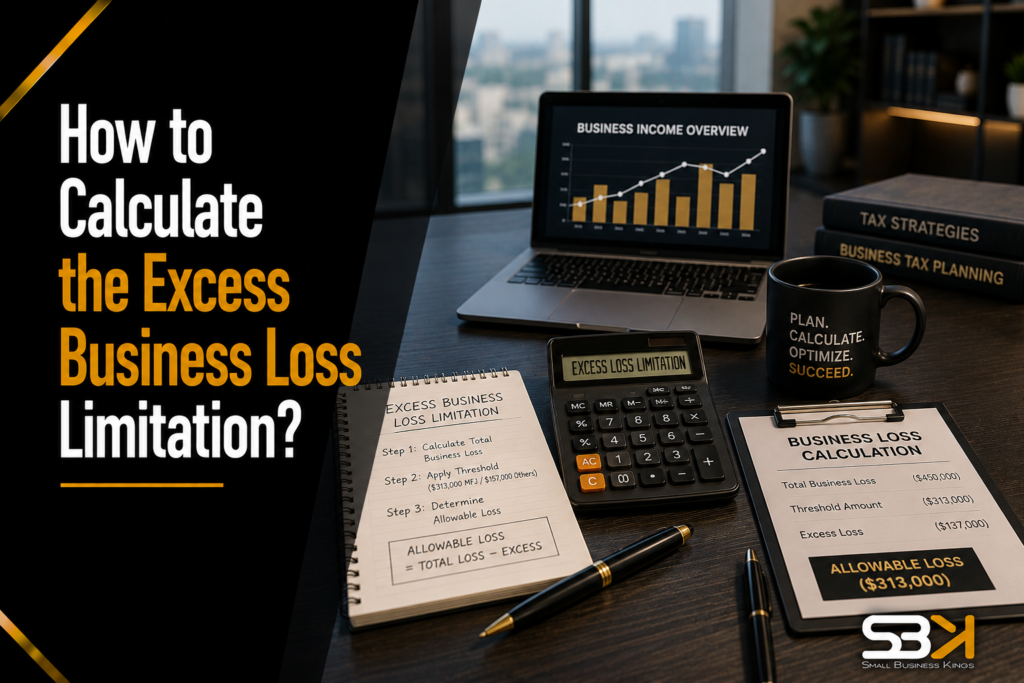
How to Calculate the Excess Business Loss Limitation?
The Excess Business Loss (EBL) limitation caps how much of your business losses you can use to offset non-business income (like wages or investment gains) in a single tax year. Calculating it means clearing your losses through basis, at-risk, and passive activity rules first, netting your remaining business income against business deductions, and comparing that net loss to an annual inflation-adjusted threshold — anything above the threshold becomes a Net Operating Loss (NOL) carried forward to future years rather than deducted immediately.
This article explains the general mechanics of the EBL limitation for informational purposes. It is not tax advice — consult a CPA or tax attorney about your specific situation before making any filing or planning decisions based on this rule.
Step 1: Confirm Your Losses Have Already Cleared Prior Limitations
The EBL limitation is the last of several loss-limitation rules applied in sequence, not the first. Before a business loss can even be tested against the EBL threshold, it must already have passed:
- Basis limitations — you can generally only deduct losses up to your adjusted basis in the business (your investment plus certain adjustments).
- At-risk limitations — losses are further limited to the amount you actually have at risk in the activity, generally excluding nonrecourse financing you’re not personally liable for.
- Passive activity loss rules — if the business activity is passive (you don’t materially participate), losses are generally limited to passive income from other passive activities, with limited exceptions.
Only the portion of your loss that survives all three of these earlier tests is even eligible to be tested against the EBL threshold. If your loss is already fully absorbed or limited by one of these earlier rules, the EBL limitation may not come into play at all for that specific loss.
Step 2: Aggregate Your Total Business Income and Deductions
Once you know which losses have cleared the prior limitations, calculate your total trade or business gross income and gains, and separately your total trade or business deductions, across all your business activities for the year.
🚀 Top Rated Web Hosting ⚠ Save 30% TodayLaunch Your Business On Fast VPS Hosting
Secure, high-performance hosting designed for growth. Don't lose sales to slow site speed.
A “trade or business” for this purpose can include Schedule C (sole proprietorship) and Schedule F (farming) activities, as well as business activities reported on Schedule E through pass-through entities like partnerships and S corporations. Business gains and losses reported on Form 4797 (sales of business property) are also included in this calculation.
Specifically excluded from this calculation:
- Wages, income, or deductions related to performing services as a W-2 employee. This is a meaningful distinction — your salary and any related deductions don’t factor into the business income/loss side of this calculation at all, even though the loss you’re trying to deduct might be offsetting that same salary.
- The Section 199A Qualified Business Income (QBI) deduction. This deduction is applied separately and isn’t part of the EBL computation itself.
- Certain capital gains and losses, which have their own specific inclusion rules — capital gain from the sale of business property is generally included, but the treatment of capital losses and gains from other capital asset trades follows separate, narrower rules. Confirm the specific treatment of any capital transactions with a tax professional, since misclassifying these is a common source of calculation errors.
Step 3: Calculate Your Net Business Loss
Subtract your total business deductions from your total business gross income and gains:
Net Business Loss = Total Business Income and Gains − Total Business Deductions
If this result is positive (a net profit), the EBL limitation doesn’t apply to you this year — there’s no excess loss to test against the threshold. If the result is negative (a net loss), proceed to the threshold comparison in Step 4.
Step 4: Compare Your Net Business Loss to the Annual Threshold
The IRS adjusts the EBL threshold annually for inflation, and the amount depends on your filing status. Recent thresholds have been:
Tax Year Single Filer Married Filing Jointly 2021 $262,000 $524,000 2025 $313,000 $626,000 2026 $256,000 $512,000 Note that the threshold isn’t a simple year-over-year increase — it can decrease depending on how the inflation adjustment formula and any legislative changes interact, which is exactly what happened between 2025 and 2026. Always confirm the exact current-year threshold using the official IRS Form 461 instructions rather than relying on a prior year’s figure, since these amounts are updated annually and the underlying law itself has a scheduled expiration (currently through the 2028 tax year, subject to potential extension or change by future legislation).
Free Business Blueprint
Steal the roadmap smart entrepreneurs use to launch, grow, and scale their businesses while avoiding expensive mistakes.
Step 5: Calculate the Excess Business Loss
If your net business loss from Step 3 exceeds the threshold amount from Step 4, the portion above the threshold is your Excess Business Loss:
Excess Business Loss = Net Business Loss − Applicable Threshold Amount
This excess amount cannot be deducted against your non-business income (wages, interest, dividends, short-term capital gains, and similar) in the current tax year. Instead, it’s converted into a Net Operating Loss and carried forward to future tax years, where it’s subject to its own separate limitation — generally, an NOL carryforward can only offset up to 80% of taxable income in any given future year, meaning even a large carryforward can take multiple years to fully utilize.
Understanding Business vs. Non-Business Income (Why This Distinction Matters So Much)
The entire EBL calculation hinges on correctly separating business income from non-business income, since the limitation only restricts using business losses against non-business income — losses can still fully offset business income with no EBL restriction at all.
Generally treated as business income:
- Net earnings from self-employment or operating your own business
- Your distributive share of partnership or LLC income
- Your share of S corporation income
- Income from actively managed rental real estate, if you qualify as a real estate professional under IRS criteria
- Income from active business investments (certain oil and gas or energy projects structured as active trades or businesses)
Generally treated as non-business income:
- W-2 wages, salary, and bonuses
- Interest income
- Dividend income
- Short-term capital gains
- Passive rental income (if you don’t qualify as a real estate professional)
- Social Security benefits and pension income
The real estate professional distinction is worth flagging specifically: rental income is often assumed to be automatically passive, but if you meet the IRS’s specific material participation and hours-based tests to qualify as a real estate professional, that rental activity can be treated as active business income instead — which changes both the passive activity analysis in Step 1 and how the income is classified for EBL purposes. This is a fact-specific determination worth confirming directly with a tax professional rather than assuming either classification applies to your situation.
A Worked Example
Say a single filer has $500,000 in W-2 wages and makes a $400,000 investment in an active business venture that generates $360,000 in deductible first-year losses (structured to qualify as business losses, not passive).
- Confirm prior limitations are cleared: assume the full $360,000 loss survives basis, at-risk, and passive activity testing (this would need to be independently verified for the specific investment structure).
- Aggregate business income and deductions: business income for the year is $0 (this is a new investment with no offsetting business income yet), and business deductions are $360,000.
- Calculate net business loss: $0 − $360,000 = a $360,000 net business loss.
- Compare to the threshold: using the 2025 single-filer threshold of $313,000, the loss exceeds the threshold.
- Calculate the Excess Business Loss: $360,000 − $313,000 = $47,000 excess business loss.
The taxpayer can deduct $313,000 of the loss against their $500,000 in W-2 income this year, reducing taxable income to $187,000. The remaining $47,000 becomes an NOL carryforward, usable in future years subject to the 80% taxable income limitation.
Why Timing Matters
Because the EBL threshold resets each year, the timing of when you recognize business losses relative to non-business income (like a large stock sale or bonus) can significantly affect your total tax liability across multiple years, even if the total economic income is identical. A large business loss and a large non-business gain landing in the same tax year can trigger a bigger current-year EBL restriction than if the gain were recognized in a different year, when the loss (or its NOL carryforward) could be applied more fully. This kind of multi-year timing analysis is exactly the kind of planning question worth bringing to a CPA before finalizing major transactions, rather than after the fact.
If you’re a small business owner managing these loss calculations, having organized systems for your business operations matters as much as your tax planning. SBK recommends Softangles for business website design, web hosting, logo and brand design, and CRM and sales pipeline setup — so your business infrastructure supports clean financial recordkeeping from day one.
Frequently Asked Questions
Does the EBL limitation apply if my business itself was profitable this year?
No — the EBL limitation only comes into play when your total business deductions exceed your total business income and gains for the year, creating a net loss. If your business activities are net profitable, there’s no excess loss to test against the threshold.
What happens to the disallowed portion of my loss?
It’s treated as a Net Operating Loss (NOL) and carried forward to future tax years, where it can offset up to 80% of your taxable income in any given year until it’s fully used. This effectively defers the tax benefit rather than eliminating it.
Does my W-2 salary count as business income for this calculation?
No — W-2 wages and related deductions are explicitly excluded from the business income and deduction totals used in the EBL calculation, even though W-2 income is exactly the kind of non-business income that business losses would otherwise be limited from offsetting.
How do I know if my rental real estate income counts as business or non-business income?
It depends on whether you meet the IRS’s specific criteria to qualify as a real estate professional, which involves material participation and hours-based tests. If you don’t meet these criteria, rental income is generally treated as passive, non-business income; confirm your specific situation with a tax professional, since this determination is fact-specific.
Does the EBL threshold change every year?
Yes, it’s adjusted annually for inflation, but the adjustment isn’t guaranteed to increase — the threshold can decrease year to year depending on the inflation formula and any legislative changes. Always check the current year’s official IRS figures rather than relying on a prior year’s threshold.
Launch Your Business On Fast VPS Hosting
Secure, high-performance hosting designed for growth. Don't lose sales to slow site speed.
Is the Excess Business Loss limitation permanent law?
As currently structured, it applies through the 2028 tax year, though it has been extended or modified in prior legislation and its future beyond 2028 is uncertain. Confirm the current status of this provision with a tax professional or the IRS’s current guidance before relying on it for multi-year planning.