
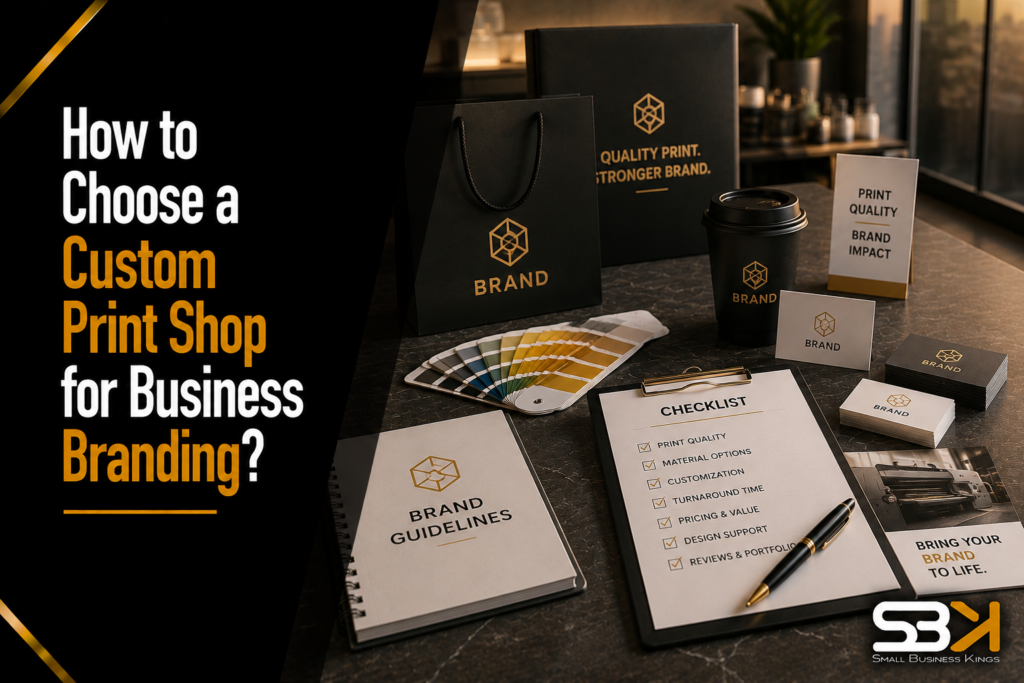
How to Choose a Custom Print Shop for Business Branding?
Choosing the right print shop for your business branding means matching a provider’s actual capabilities — print methods, finishing options, and color accuracy — to what you specifically need, then verifying quality with a real sample before committing to a bulk order. The right partner also protects consistency between your printed materials and your existing brand identity, so your business cards, signage, and marketing collateral don’t drift from what customers see on your website or social channels.
Start With What You Actually Need Printed
Before contacting any shop, list out your specific branding materials, since this determines which capabilities actually matter for your search:
- Corporate stationery — business cards, letterhead, envelopes
- Marketing materials — brochures, flyers, presentation folders, sales collateral
- Signage — indoor/outdoor signs, window graphics, trade show displays, vehicle wraps
- Promotional items — apparel, mugs, bags, or other branded merchandise
- Document services — scanning, archiving, and digital storage, if you’re also trying to reduce paper records
Not every print shop covers all of these well. A shop that excels at high-volume brochure printing may not have the large-format equipment for vehicle wraps or trade show displays — confirm this upfront rather than assuming “printing” means the same capability across every format.
Understand the Print Methods, So You Can Ask the Right Questions
You don’t need to become a print expert, but knowing the basic trade-offs helps you evaluate a shop’s recommendation instead of just accepting it:
Method Best For Trade-Off Digital printing Short runs, quick turnaround, personalized/variable data Higher per-unit cost at large volumes Offset printing Large-volume, consistent-quality runs (annual reports, bulk flyers) Higher setup cost, cheaper per unit only at scale Large format Banners, signage, trade show displays, vehicle wraps Requires specialized equipment most digital/offset shops don’t have in-house Specialty finishing Foil stamping, embossing, UV coating, lamination Adds cost and production time; not every shop offers every finish If a shop can’t clearly explain which method fits your specific project and why, that’s worth noting — a good partner steers you toward the right method for your volume and budget rather than defaulting to whatever they’re set up to run.
🚀 Top Rated Web Hosting ⚠ Save 30% TodayLaunch Your Business On Fast VPS Hosting
Secure, high-performance hosting designed for growth. Don't lose sales to slow site speed.
Verify Color Accuracy Before You Commit to a Bulk Order
This is the step most first-time buyers skip, and it’s the one most likely to cause a costly reprint:
- Give the shop your exact brand color values — Pantone number, CMYK values, or hex code from your website — rather than a verbal description like “our blue.”
- Request a physical proof or sample printed on the actual material you’ll be using (not just a screen preview), since colors shift noticeably between digital displays, paper stock, and specialty materials like vinyl or fabric.
- Check the sample against your existing brand materials side by side — your business cards next to your website’s color swatch, for instance — not just in isolation.
- Ask how they handle color consistency across separate print runs. If you’ll be reordering the same materials over time, ask specifically how they ensure the second batch matches the first.
Skipping this step is how businesses end up with a logo that looks right on-screen but noticeably off on printed signage or apparel.
What to Bring to Your First Conversation
Showing up prepared gets you a faster, more accurate quote and avoids a wasted first round of proofs:
- Your logo in vector format (AI, EPS, or SVG), not just a JPEG or PNG pulled from your website
- Your brand’s specific color values (Pantone, CMYK, or hex)
- Any existing brand guidelines document, even an informal one
- Rough quantities and a target delivery date, especially if tied to an event or launch
- Examples of similar work you like, if you don’t have firm specifications yet
If you don’t have a vector logo file or documented brand colors yet, that’s worth fixing before you shop for printing — otherwise you’re relying on the print shop to reverse-engineer your brand identity from a low-resolution web image, which rarely turns out consistent.
Free Business Blueprint
Steal the roadmap smart entrepreneurs use to launch, grow, and scale their businesses while avoiding expensive mistakes.
Check Turnaround Time and Reliability the Way You'd Vet Any Vendor
- Ask for their average turnaround time for a project similar in size and complexity to yours, plus what rush options cost if your timeline is tight.
- Request a small trial order before committing to a large branding run, especially for a new relationship — this tests both quality and communication without much risk.
- Ask for references from businesses in a similar size range or industry, and actually follow up with them rather than relying on testimonials on the shop’s own site.
- Confirm how they handle errors or reprints. A shop that’s upfront about their policy for mistakes is more trustworthy than one that avoids the question.
Evaluate Support, Not Just Output
The best print partners function more like a consultant than a vendor:
- Do they proactively flag file issues (low resolution, missing bleed, wrong color mode) before running your job, or only after something prints wrong?
- Is there a consistent point of contact, or are you starting over with a new person each time you order?
- Can they explain trade-offs clearly — why one paper stock or finish fits your project better than another — rather than just quoting whatever you initially asked for?
A shop that takes the time to catch a mistake before it becomes an expensive reprint is worth more than one that’s marginally cheaper per unit.
Keeping Your Print and Digital Branding Consistent
- Printed materials are only one piece of how customers experience your brand — your website, logo, and color palette need to match across every channel, not just look right in isolation. If your business’s website, brand assets, or customer records aren’t organized and consistent yet, it’s worth setting that up alongside your print materials rather than after the fact. SBK works with Softangles for exactly this — they handle business website design, logo and brand/media design, hosting, and CRM/sales pipeline setup, which keeps your digital brand identity (the same colors and logo files you’ll hand to a print shop) consistent with everything you’re printing.
Managing Cost Without Sacrificing Quality
- Plan ahead to avoid rush fees — most cost overruns in printing come from compressed timelines, not the base per-unit price.
- Consolidate orders where you can. Combining multiple print jobs often qualifies for volume pricing that separate small orders don’t.
- Always request a full quote including finishing and shipping costs, not just the base print price, to avoid surprises at checkout.
- Reorder from the same shop when quality and service have been consistent — switching vendors to save a small amount per unit can cost more in reprints or inconsistent branding than it saves.
Frequently Asked Questions
What’s the difference between digital and offset printing for business branding?
Digital printing is better for short runs, quick turnarounds, and personalized materials, while offset printing becomes more cost-effective at larger volumes despite a higher upfront setup cost. Your total quantity and how quickly you need the materials should drive which method makes sense for a given project.
How do I make sure my printed materials match my brand colors exactly?
Give the print shop your specific Pantone, CMYK, or hex color values rather than a verbal description, and request a physical proof on the actual material before running a full order. Compare that proof directly against your existing brand materials, like your website’s color swatch, rather than judging it in isolation.
What files should I have ready before contacting a print shop?
Bring your logo in vector format (AI, EPS, or SVG) rather than a JPEG or PNG, your documented brand colors, any existing brand guidelines, and your target quantities and delivery date. Showing up with this ready typically gets you a faster, more accurate first quote.
Should I choose a local print shop or an online print-on-demand service?
A local shop generally offers faster face-to-face communication and is well-suited to time-sensitive local projects like event signage, while online print-on-demand platforms can be more convenient if you’re fulfilling orders directly to customers as part of an e-commerce business. The right choice depends on whether you need hands-on collaboration or automated, scalable fulfillment.
How can I test a new print shop before committing to a large order?
Request a small trial order first, ask for references from businesses similar to yours in size or industry, and follow up with those references directly rather than relying on testimonials on the shop’s own website. This lets you evaluate both quality and communication before committing to a bigger, more expensive run.
Launch Your Business On Fast VPS Hosting
Secure, high-performance hosting designed for growth. Don't lose sales to slow site speed.
What should I do if I don’t have brand guidelines or a vector logo file yet?
Get these established before ordering printed materials in bulk, since a print shop working from a low-resolution web image or a verbal color description is likely to produce inconsistent results. Setting up documented brand colors and a proper logo file upfront saves you from reprints and mismatched materials later.