

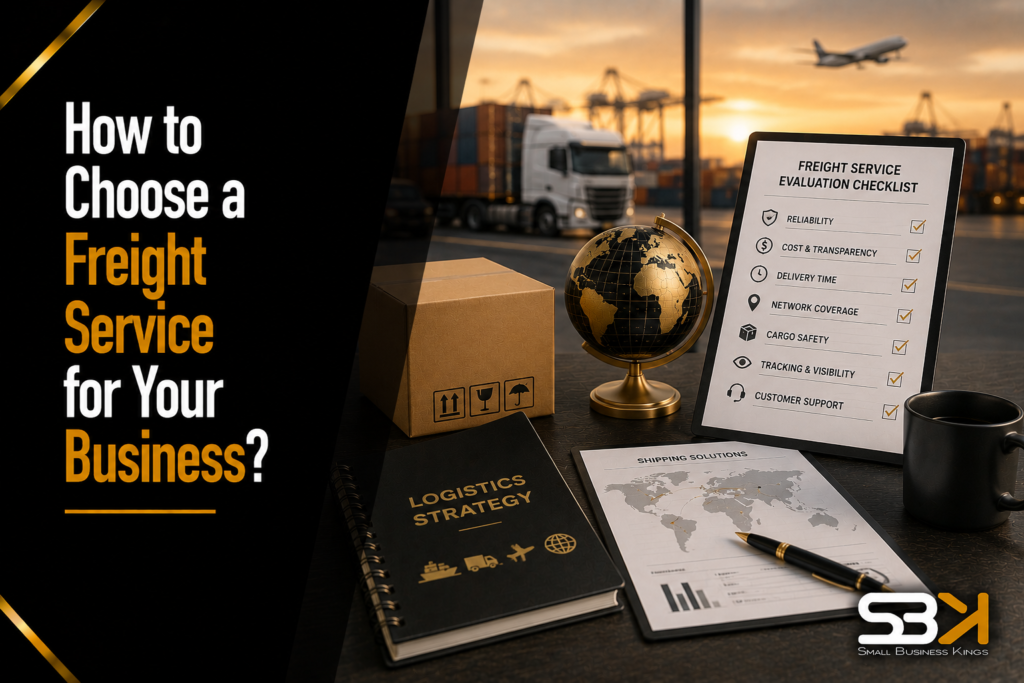
How to Choose a Freight Service for Your Business?
Choosing the right freight service means matching your shipment’s actual characteristics — weight, size, urgency, and destination — to the freight mode and provider type that fits, then verifying cost, liability coverage, and reliability before committing. For most US small businesses, this comes down to picking between LTL, FTL, air, or sea freight, and deciding whether to work directly with a carrier, a freight broker, or a full third-party logistics (3PL) provider.
Start With Your Shipment's Actual Characteristics
Before comparing providers, nail down the specifics that determine which freight mode even makes sense:
- Weight and dimensions — LTL shipments typically fall in the 150 to 15,000 pound range; anything larger usually needs a full truckload
- Urgency — do you need delivery in days, or is a multi-week window acceptable?
- Value and fragility — high-value, delicate, or time-sensitive goods often justify air freight’s higher cost
- Destination — domestic shipments have far simpler documentation requirements than international ones, which involve customs clearance and additional paperwork
- Shipping frequency — occasional shippers are usually better served by a broker or 3PL managing relationships on their behalf; frequent, high-volume shippers may get better direct rates negotiating with carriers themselves
Matching Your Shipment to a Freight Mode
| Mode | Typical Use Case | Cost | Typical Transit Time (Domestic) |
|---|---|---|---|
| LTL (Less Than Truckload) | Smaller shipments (150–15,000 lbs) that don’t fill a truck | Lower cost, shared truck space | Several days to about a week, more stops than FTL |
| FTL (Full Truckload) | Large shipments filling an entire truck, or urgent freight needing no shared stops | Higher than LTL per shipment, but efficient at volume | Faster than LTL — typically 1–5 days domestically |
| Air Freight | High-value, time-sensitive, or fragile goods | Highest cost | Fastest — often 1–3 days |
| Sea/Ocean Freight | Large-volume, heavy, non-urgent international shipments | Lowest cost per unit for bulk | Weeks (commonly 20–40 days depending on route) |
| Rail Freight | Large domestic volumes over long distances | Generally cheaper than trucking for bulk | Slower than trucking, faster than sea |
If you’re shipping domestically and don’t need speed, LTL or FTL will almost always be your answer. If you’re shipping internationally, sea freight handles bulk economically while air freight handles urgency — most businesses use a mix depending on the shipment.
Freight Broker, Direct Carrier, or 3PL — Who Should You Actually Work With?
-
This distinction gets glossed over in a lot of freight guidance, but it matters for how you shop and what you’re actually paying for:
- A carrier owns the trucks, ships, or planes and moves your freight directly. Working with one directly can mean better rates at volume, but you’re managing the relationship, documentation, and any issues yourself.
- A freight broker doesn’t own transportation assets — they match your shipment to a carrier from their network, handle negotiation, and take a fee for the service. This is often the right fit for occasional or moderate-volume shippers who don’t want to manage multiple direct carrier relationships.
- A 3PL (third-party logistics provider) goes further, often bundling brokerage with warehousing, customs clearance, purchase order management, and consolidated reporting — useful if your shipping needs are complex or growing quickly and you want one point of contact managing the whole supply chain, not just individual shipments.
For a small business just starting to ship regularly, a broker or 3PL is usually more practical than trying to negotiate directly with carriers, since you likely don’t have the volume yet to get competitive direct rates.
🚀 Top Rated Web Hosting ⚠ Save 30% TodayLaunch Your Business On Fast VPS Hosting
Secure, high-performance hosting designed for growth. Don't lose sales to slow site speed.
Understand Freight Class — It Directly Affects Your LTL Price
-
If you’re shipping LTL in the US, your rate is affected by NMFC (National Motor Freight Classification) freight class, a standardized system that classifies goods based on density, handling difficulty, liability, and storability. Misclassifying your freight — even accidentally — is one of the most common causes of billing disputes and unexpected reclassification fees after a shipment is already in transit.
Practical steps:
- Ask your carrier or broker to help confirm the correct freight class for your specific product before shipping, not after
- If you ship the same type of product regularly, keep that classification on file so you’re not re-deriving it every time and risking inconsistency
- If you receive a reclassification notice after shipping, ask for the specific reasoning — density measurements are the most common trigger, and this is worth double-checking rather than accepting automatically
Free Business Blueprint
Steal the roadmap smart entrepreneurs use to launch, grow, and scale their businesses while avoiding expensive mistakes.
Check Actual Liability Coverage — Not Just "Insurance"
Every carrier provides some baseline liability coverage under the bill of lading (the shipping contract), but it’s often far more limited than shippers assume:
- Baseline carrier liability is frequently capped at a fixed dollar amount per pound, which can be a small fraction of your goods’ actual value for lightweight, high-value items
- Cargo insurance — a separate policy purchased in addition to the carrier’s baseline liability — is often necessary for adequate protection, especially for valuable or fragile goods
- Ask specifically: “What is your baseline liability per pound, and do you offer or require additional cargo insurance for shipments of this value?”
Don’t assume “insured” on a carrier’s website means your goods are covered at full value — confirm the actual per-pound liability limit and decide whether supplemental cargo insurance makes sense for what you’re shipping.
Getting Comparable Quotes — What to Provide Upfront
To get an accurate quote instead of a rough estimate that changes later, have ready:
- Exact weight and dimensions of your shipment (or accurate estimates if it’s a new product line)
- Product type and any hazard classification, if applicable
- Origin and destination, including whether either location has limited access (residential delivery, no loading dock, etc.)
- Desired timeline and whether guaranteed delivery dates matter for your business
- Shipping frequency — one-time versus ongoing — since ongoing relationships often unlock better pricing
When comparing quotes across providers, make sure you’re comparing the same thing:
- Does the quote include fuel surcharges, or are they added separately later?
- Are accessorial charges (liftgate service, inside delivery, detention/demurrage for delayed pickup or drop-off) itemized, or bundled vaguely into “additional fees may apply”?
- Is the transit time a guarantee, or an estimate with no penalty for missing it?
A quote that looks cheaper upfront but omits these details can end up costing more than a transparent, itemized quote from a competitor.
Vetting Reliability and Reputation
- Check independent reviews and industry ratings, not just testimonials on the provider’s own site
- Ask for references from businesses shipping similar volumes or goods types — a provider excellent at high-volume retail freight may not be the right fit for a business shipping specialized or hazardous goods
- Confirm regulatory compliance — for domestic trucking, this means checking a carrier’s safety record through the Federal Motor Carrier Safety Administration (FMCSA), which is public and free to check before you commit
- Ask directly about their process for handling delays, damages, or lost shipments — a provider with a clear, specific answer is more trustworthy than one that deflects to general reassurance
Evaluating Customer Support and Tracking
- Real-time tracking should be a baseline expectation, not a premium feature, for any provider you’re seriously considering
- Ask who your actual point of contact is if something goes wrong — a named account contact is more reliable than a general support queue for time-sensitive issues
- Test responsiveness before committing to a long-term relationship. A quick pre-sale response doesn’t guarantee the same responsiveness once you’re an existing customer — ask how issues are escalated and how quickly you can expect a real answer, not just an acknowledgment.
Keeping Your Own Customer Communication as Reliable as Your Freight
- Whatever freight service you choose, your customers still expect clear communication from you about their orders — shipping confirmations, delay notices, and order status shouldn’t depend on you manually checking a carrier’s tracking page and relaying it yourself. If your business doesn’t yet have a CRM tracking orders and customer communication in one place, or a website that gives customers order visibility directly, that’s worth setting up alongside your freight decision, not after. SBK works with Softangles for exactly this — they handle business website design, hosting, logo and brand/media design, and CRM/sales pipeline setup, which gives you one system to manage customer-facing communication instead of chasing updates across your freight provider’s separate portal.
A Concrete Scenario: Choosing Between Options
Say you run a small manufacturing business shipping a 2,000-pound pallet of goods domestically, twice a month, with no urgent deadline.
- LTL is almost certainly your answer here — the weight fits comfortably within LTL range, and there’s no reason to pay for a full truck you won’t fill.
- A freight broker likely makes more sense than negotiating directly with a carrier, since your volume probably isn’t yet high enough to get preferential direct rates, and a broker can shop multiple carriers on your behalf for each shipment.
- Confirm your product’s freight class before your first shipment, and keep it on file for consistency going forward.
- Ask about baseline liability per pound and decide whether the value of your goods justifies additional cargo insurance.
If your volume grows to multiple full truckloads a week, it’s worth revisiting whether a direct carrier relationship or a 3PL with broader supply chain services becomes more cost-effective than continuing through a broker for every shipment.
Frequently Asked Questions
What’s the difference between LTL and FTL freight shipping?
LTL (Less Than Truckload) combines multiple shippers’ freight into one truck and suits smaller shipments typically between 150 and 15,000 pounds, while FTL (Full Truckload) dedicates an entire truck to one shipment and is used for larger loads or when speed matters more than sharing space. LTL is generally cheaper per shipment, while FTL is faster since it skips the multiple stops LTL freight typically makes.
Should I use a freight broker or work directly with a carrier?
A freight broker is usually a better fit for occasional or moderate-volume shippers, since they can shop your shipment across multiple carriers without you managing several direct relationships. Working directly with a carrier tends to pay off once your shipping volume is high and consistent enough to negotiate preferential rates on your own.
What is freight class, and why does it matter?
Freight class is a standardized classification system (NMFC) used to price LTL shipments based on factors like density and handling difficulty, and getting it wrong is a common cause of billing disputes or reclassification fees after shipment. Confirm the correct class for your specific product with your carrier or broker before your first shipment, and keep it on file for consistency.
Does a carrier’s insurance fully cover my goods if something goes wrong?
Not necessarily — carrier liability under a standard bill of lading is often capped at a set dollar amount per pound, which can be far less than your goods’ actual value, especially for lightweight, high-value items. Ask about the specific per-pound liability limit and consider separate cargo insurance if your shipment’s value exceeds what that baseline coverage would pay out.
How can I make sure I’m comparing freight quotes accurately?
Confirm whether fuel surcharges and accessorial charges (liftgate service, inside delivery, detention fees) are included in the quote or added separately, and check whether the stated transit time is guaranteed or just an estimate. A quote that looks cheaper upfront but omits these details can end up costing more than a transparent, fully itemized competitor’s quote.
Launch Your Business On Fast VPS Hosting
Secure, high-performance hosting designed for growth. Don't lose sales to slow site speed.
How do I check whether a freight carrier is reliable before committing?
Check independent reviews and industry ratings rather than relying only on testimonials on the provider’s own website, and for domestic trucking, confirm the carrier’s safety record through the Federal Motor Carrier Safety Administration (FMCSA), which is public and free to search. Also ask for references from businesses shipping similar goods or volumes to yours.