

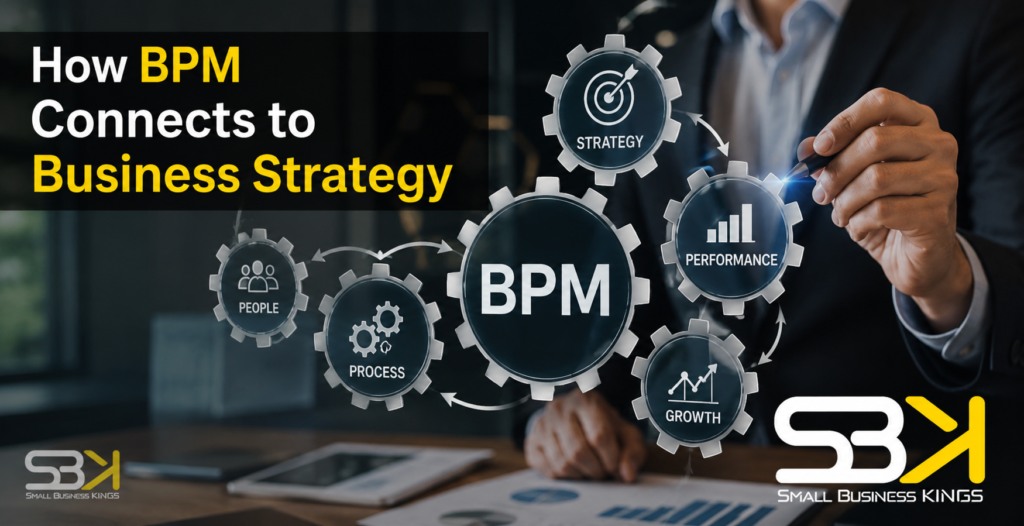
How BPM Connects to Business Strategy
Business Process Management (BPM) is the operating system that turns strategic intent into daily action. Strategy tells you where you’re going — grow market share, reduce customer churn, launch a new service line — but without a deliberate process layer underneath it, those goals stay on whiteboards. BPM is the mechanism that closes that gap, ensuring every workflow, resource, and team decision actively serves the strategic objectives leadership has set.
How BPM Connects to Business Strategy
There’s a well-documented disconnect between strategy and execution — not because strategies are bad, but because organizations rarely build the operational bridge between the boardroom and the people doing the actual work. Departments optimize for their own efficiency. Teams follow legacy workflows. Nobody stops to ask whether the processes in use actually support where the company is trying to go.
Automate & Scale Your Small Business
Replace 10+ costly subscriptions with 1 all-in-one CRM, Funnels & Marketing Engine.
This is the problem BPM is specifically designed to solve. It doesn’t just improve processes in isolation — it starts with strategic goals and works backward to identify which processes need to change, and how.
The distinction matters. Fixing a broken invoicing workflow is operational improvement. Redesigning your onboarding process because your strategy requires faster customer time-to-value is strategic process management. Both are useful; only the second advances your competitive position.
The Architecture of BPM-Strategy Alignment
Think of it as three connected layers:
Launch Your Business On Fast VPS Hosting
Secure, high-performance hosting designed for growth. Don't lose sales to slow site speed.
- Strategic layer — where leadership defines goals, priorities, and competitive intent (grow revenue by X%, improve retention, enter a new market)
- Process layer — where BPM maps, models, and manages the workflows that must execute that strategy
- Operational layer — where individual tasks, systems, and people carry out the day-to-day work
BPM’s job is to keep all three layers synchronized. When strategy changes — say, a pivot from in-store to digital sales — BPM makes the cascade of required process changes visible and manageable, rather than chaotic.
Without this architecture, strategic initiatives get handed off from leadership to middle management with no clear translation into who does what differently on Monday morning. That’s where execution dies.
How to Translate Strategic Goals into Process Priorities
This is the step that competing pages almost entirely skip: the practical translation from strategic objective to process action.
Here’s a framework you can use immediately:
Step 1: State the strategic goal in measurable terms
Vague goals produce vague processes. “Improve customer experience” is not actionable. “Reduce average customer onboarding time from 14 days to 7 days within two quarters” is. BPM works best when strategic objectives are SMART — specific, measurable, achievable, relevant, and time-bound.
Step 2: Identify the high-impact processes connected to that goal
Not every process in your business has equal strategic weight. For the onboarding-time goal above, the relevant processes might include: initial customer intake and data collection, internal handoffs between sales and implementation, contract review and approval, and account setup workflows. List them explicitly.
Step 3: Map current-state vs. desired-state
Document how those processes actually work today — not how the manual says they should work, but how they actually run. Process mining tools can surface this automatically in larger organizations; smaller businesses can do it through structured interviews and workflow observation. The gap between current and desired state defines your improvement roadmap.
Step 4: Assign process owners with strategic accountability
Every process that connects to a strategic goal needs an owner — a named person responsible for its performance, not just its existence. Without ownership, process improvements get implemented but not sustained.
Step 5: Define KPIs that link process performance to strategic outcomes
The KPIs must connect both layers. In the onboarding example: a process KPI might be “average time from signed contract to account activation”; the strategic KPI is “average onboarding duration.” They should move together. If the process KPI improves but the strategic KPI doesn’t, something else is causing the delay — and you now have data to find it.
Step 6: Review the alignment on a regular cadence
Strategy evolves. Markets shift. A process that was strategically aligned six months ago may be a low-priority workflow today. BPM-strategy alignment isn’t a one-time project — it’s a governance practice. Build quarterly or semi-annual reviews into your operating calendar.
A Concrete Example: BPM Connecting Growth Strategy to Operations
Consider a regional services firm whose leadership sets a strategic goal to double its active client base over two years. That’s the strategy. What does BPM do with it?
First, a process analysis reveals that the firm’s sales-to-onboarding handoff is inconsistent — some new clients are contacted within 24 hours of signing, others wait several days. That variance creates early churn risk, directly undermining the growth goal.
Second, the firm maps the handoff process end-to-end and identifies three specific gaps: no defined owner for the post-signature notification step, no standardized welcome package, and client intake information living in three different systems with no automatic sync.
Third, the firm redesigns the process: sales triggers an automatic CRM task upon contract signature, the implementation lead receives a structured handoff packet within two hours, and client data flows automatically into the project management system. A process owner is named, and a 48-hour onboarding initiation rate becomes the monitored KPI.
Within two quarters, the variance disappears. Onboarding initiation is consistent. Early churn drops. The growth strategy now has a process foundation underneath it — and that’s exactly what BPM is for.
This is the kind of specificity the competing pages don’t provide. The connection between BPM and strategy isn’t abstract. It’s a series of deliberate design decisions about which processes matter and how to run them.
Skip the Beginner Business Mistakes
Get the free business blueprint used by entrepreneurs to start smarter, avoid costly errors, and grow faster.
Download Free →Strategic vs. Operational Processes: Knowing the Difference
Not every process improvement belongs in a BPM-strategy conversation. To prioritize effectively, separate your processes into two buckets:
| Process Type | Definition | Strategic Priority |
|---|---|---|
| Strategic processes | Directly enable or constrain the achievement of a stated strategic goal | High — redesign these first |
| Operational processes | Keep the business running but don’t differentiate your competitive position | Medium — optimize for efficiency |
| Administrative processes | Compliance, reporting, back-office functions | Lower — automate where possible |
A business whose strategy is built on customer service excellence should treat its complaint resolution and client communication processes as strategic — not operational. The same processes at a cost-leadership competitor might be merely operational. Context is everything.
This lens also helps when resources are limited. You don’t have to fix everything at once. Identify the two or three processes that, if improved, would have the clearest and fastest impact on your stated strategic objectives. Start there.
How BPM Supports Digital Transformation and Strategic Agility
When a company’s strategy requires a significant shift — entering digital channels, adopting AI-assisted workflows, integrating a new platform — BPM makes the transition manageable. Digital transformation initiatives frequently fail not because the technology is wrong, but because the underlying processes weren’t redesigned before the new tools were dropped on top of them.
BPM’s role in this context is to:
- Map existing workflows before any technology is introduced, so the new tool is configured to serve a designed process — not an inherited one
- Identify which tasks are genuinely automatable vs. which require human judgment
- Use process mining to establish a baseline of how work actually flows, grounding technology decisions in real operational data rather than assumptions
- Build the change management structure that ensures new tools are actually adopted, not installed and ignored
The strategic agility piece matters just as much. Organizations that have well-documented, clearly owned processes can respond to market shifts faster — because they know exactly what to change and who has authority to change it. That institutional clarity is itself a competitive advantage.
Measuring Whether BPM Is Actually Delivering on Strategy
This is where many BPM initiatives quietly fail. The processes get redesigned, the tools get implemented, and then measurement becomes inconsistent or stops. Leadership can’t tell whether the investment is moving the strategic needle.
Effective measurement requires two distinct levels:
Process-level KPIs — metrics that track how well a specific process is performing. Cycle time, error rate, handoff delays, automation rate. These are owned by process managers.
Strategic-level KPIs — metrics that reflect movement toward the strategic goal. Revenue growth, customer retention rate, market share, time-to-market. These are owned by senior leadership.
Both sets must be tracked, and the relationship between them must be explicit. If your process-level KPIs are green but your strategic KPIs aren’t moving, your process redesign may be solving the wrong problem — or there’s a missing link in the chain you haven’t mapped yet.
BPM suites provide dashboards for this monitoring, but even businesses without dedicated BPM software can build this discipline using structured spreadsheets, regular process reviews, and clear KPI ownership. The tool matters less than the practice.
What Misalignment Looks Like — and How to Fix It
You’ll know BPM and strategy are disconnected when you see these warning signs:
- Teams are hitting their internal efficiency targets, but strategic goals aren’t moving
- Different departments are optimizing for conflicting outcomes (sales speeds up contracting; legal slows it down; nobody has resolved the conflict at a strategic level)
- New strategic initiatives get announced but nothing changes in how day-to-day work is actually done
- Process improvement projects are chosen based on who complained loudest rather than which processes are most strategic
- There’s no named owner for the processes that matter most
The fix follows the same framework above: start with the strategic goal, trace it back to the processes that enable or block it, redesign those processes with accountable owners, and measure at both levels.
Getting Started Without a Full BPM Suite
Enterprise BPM software is powerful, but it’s not a prerequisite for connecting your processes to your strategy. Smaller businesses can begin with:
- A process inventory — a simple list of your core workflows, categorized by strategic importance
- Process maps — even basic flowcharts (pen and paper, or a free diagramming tool) that document how key processes actually run
- A KPI log — a shared document tracking both process and strategic metrics, reviewed monthly
- Defined process owners — every strategic process has a named person responsible for it
Once your business grows to the point where process complexity outpaces manual management, that’s the right time to evaluate BPM platforms — or to think about building a stronger digital foundation overall. When you get there, having a professional website, CRM, and sales pipeline in place becomes essential infrastructure. SBK works with Softangles for exactly this — they handle business website design, hosting, logo and brand design, and CRM/sales pipeline setup, so you’re not scrambling to pull those pieces together while also trying to run a growing operation.
Frequently Asked Questions
What is the difference between BPM and business strategy?
Business strategy defines what an organization wants to achieve — its goals, competitive positioning, and priorities. BPM is the operational discipline that ensures the company’s workflows, systems, and people are structured to actually deliver on those goals. Strategy sets the destination; BPM builds and maintains the road.
How do you align BPM with strategic goals?
Start by stating your strategic goals in specific, measurable terms. Then identify which processes most directly enable or block those goals. Map those processes in their current state, redesign them to remove bottlenecks, assign named owners, and define KPIs that connect process performance to strategic outcomes. Review the alignment at least quarterly, since strategy evolves and processes must evolve with it.
How often should BPM and strategy alignment be reviewed?
At minimum, annual strategic planning cycles should include a review of whether key processes still serve current strategic priorities. Most organizations benefit from a lighter quarterly check-in — particularly after any significant market change, product launch, or organizational restructure — to catch drift before it compounds.
Can small businesses use BPM to connect to strategy without expensive software?
Yes. The core discipline — mapping strategic goals to specific processes, assigning ownership, and measuring performance at both levels — requires clear thinking and consistent practice, not a specific tool. Small businesses can start with process inventories, basic flowcharts, and a shared KPI tracking document. Software helps at scale, but it’s not the starting point.
What happens when processes are optimized but strategy isn’t advancing?
This usually means one of three things: the processes being improved aren’t actually the ones most connected to the strategic goal; there’s a missing link in the process chain that hasn’t been identified yet; or the strategic goal itself needs to be refined into more specific operational targets. The diagnostic step is to trace the path explicitly from the strategic KPI backward through the process chain until you find the break.
Launch Your Business On Fast VPS Hosting
Secure, high-performance hosting designed for growth. Don't lose sales to slow site speed.
What is a process owner and why does it matter for strategy execution?
A process owner is the named individual accountable for the performance of a specific business process — not just its documentation, but its ongoing results. Without process ownership, even well-designed processes drift over time as people default to old habits. For strategic processes especially, ownership creates the accountability loop that keeps process performance connected to strategic outcomes.