

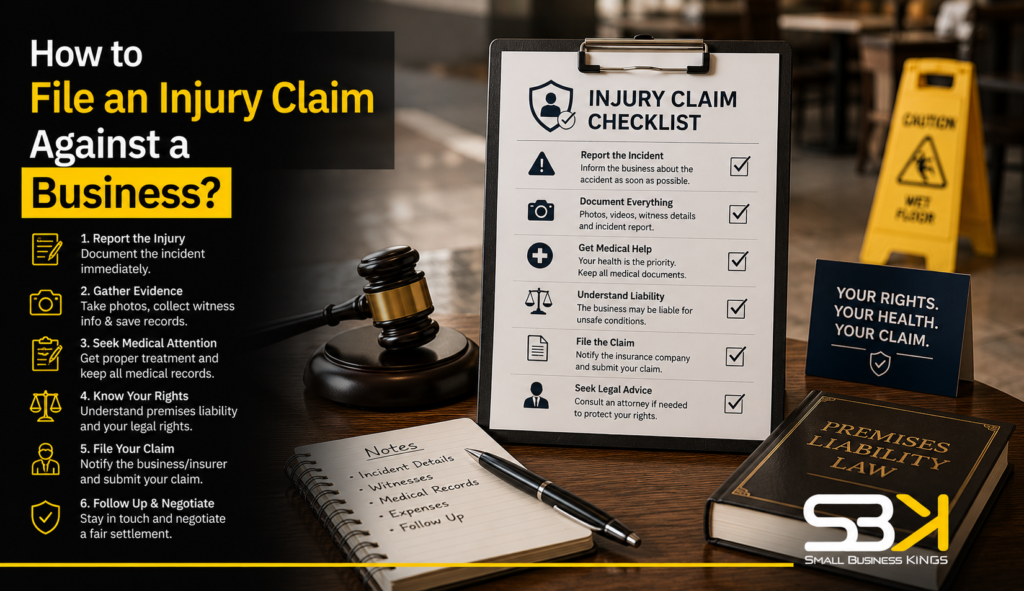
How to File an Injury Claim Against a Business?
To file an injury claim against a business, get medical treatment first, report the incident to the business and document the scene, then file a claim with the business’s liability insurer — typically through a demand letter outlining your injuries, damages, and requested compensation. Most claims settle through negotiation with the insurance adjuster; if that fails, the next step is a lawsuit, filed within your state’s statute of limitations.
The process is the same whether you slipped on a wet floor, got hurt by a defective product, or were injured through some other kind of business negligence — what changes is the type of evidence you need and who’s actually liable. Here’s how each part of that process actually works, and where people typically go wrong.
What Counts as a Valid Claim Against a Business?
Not every injury on a business’s property or from a business’s product creates a valid claim. Generally, you need to show the business was negligent — meaning they failed to take reasonable care to prevent a hazard they knew about or should have known about — and that this negligence directly caused your injury. The two most common categories:
Premises Liability Claims
These involve a hazard on the business’s physical property that they failed to fix or warn about in a reasonable time. Common examples:
- Wet or recently mopped floors without a warning sign
- Uneven flooring, broken steps, or damaged walkways
- Poor lighting in stairwells or parking areas
- Debris or clutter left in walkways
- Inadequate security leading to an assault on the premises (a subset called negligent security)
The core legal question in these cases is usually whether the business knew, or reasonably should have known, about the hazard and had enough time to address it before you were hurt.
Launch Your Business On Fast VPS Hosting
Secure, high-performance hosting designed for growth. Don't lose sales to slow site speed.
Product Liability Claims
These involve an injury caused by something the business made, sold, or supplied — a defective appliance, a mislabeled medication, unsafe packaging, or a product with a design flaw. Product liability claims can involve the manufacturer, the retailer, or both, depending on where the defect originated and who’s considered legally responsible for it in your state.
Other, less common categories include food-borne illness claims against restaurants, claims involving a business’s employee causing harm while working, and dog bite claims where a business owner’s animal was on the premises. If you’re not sure which category your situation fits, this is one of the first things an attorney will sort out — it affects who you’re actually filing against and what evidence matters most.
Free Business Blueprint
Steal the roadmap smart entrepreneurs use to launch, grow, and scale their businesses while avoiding expensive mistakes.
Step 1: Get Medical Treatment Right Away
This matters for two separate reasons: your health, and your claim. Some injuries — concussions, soft tissue damage, internal injuries — don’t show obvious symptoms right away. Getting evaluated promptly protects you medically and creates a documented, time-stamped link between the incident and your injury. Insurance adjusters routinely use a delay in seeking treatment to argue the injury wasn’t serious, or wasn’t caused by the incident at all. Waiting even a few days can weaken a claim that would otherwise be straightforward.
Step 2: Report the Incident to the Business
Ask to speak with a manager or owner and request that an incident report be completed before you leave, if possible. If the business has a standard incident report form, ask for a copy or at least a reference number. This creates an official record that the business itself acknowledges the incident occurred, which makes it much harder for them to dispute later that anything happened.
Step 3: Gather Evidence While It's Fresh
Evidence quality often determines whether a claim is straightforward or contested. Collect as much as you reasonably can at the scene or soon after:
- Photos of the hazard itself (the wet floor, broken step, product defect) from multiple angles
- Photos of your visible injuries
- Names and contact information for any witnesses
- The defective product itself, if applicable — don’t discard it, even if it seems ruined
- Any receipt, packaging, or proof of purchase related to a product claim
- The incident report or reference number from Step 2
Evidence tends to disappear quickly — hazards get fixed, spills get mopped up, security footage gets overwritten on a rolling schedule. If you’re able to, ask the business directly (or have your attorney request) whether security cameras cover the area, since footage retention windows are often short.
Step 4: Document How the Injury Affects You Over Time
Beyond the initial evidence, keep an ongoing record as your recovery progresses:
- Save every medical bill, prescription receipt, and appointment record
- Track missed work days and any reduction in income
- Keep a simple daily log of pain levels and physical limitations
- Save receipts for related costs — medical equipment, transportation to appointments, home modifications if needed
This ongoing documentation matters because damages aren’t just the initial ER visit — lost wages, ongoing treatment, and pain and suffering typically make up a real part of a claim’s value, and none of that shows up in a single hospital bill.
Step 5: Understand How the Business's Insurance Works
Most businesses carry general liability insurance specifically to cover claims like this, and in practice, you’re not filing a claim against the business directly — you’re filing against their insurance policy. Once the business is notified of your claim (or you notify their insurer directly), the insurer typically assigns a claims adjuster to investigate, which may include reviewing the incident report, interviewing witnesses, and reviewing your medical records.
Adjusters work for the insurance company, not for you — their job includes minimizing what the company pays out, which is a normal part of how the process works rather than a sign of bad faith on its own. Understanding this upfront helps calibrate expectations: an initial offer being low isn’t unusual, and it’s rarely the insurer’s final position.
Step 6: Send a Demand Letter
Once you (or your attorney) have gathered enough documentation to show the extent of your damages, the next step is typically a demand letter — a formal written document sent to the business’s insurer that lays out:
- What happened and why the business was negligent
- The injuries you sustained, supported by medical records
- Your economic damages (medical bills, lost wages, property damage)
- Your non-economic damages (pain and suffering, if applicable in your state)
- A specific dollar amount you’re requesting to resolve the claim
The demand letter is what actually starts formal negotiation. Sending it too early, before you have a clear picture of your total damages (especially if treatment is ongoing), can undervalue your claim, since it’s harder to go back and ask for more once a number is on the table.
Step 7: Negotiate the Settlement
Expect the insurer’s first offer to be lower than your demand — this is standard, not a sign the claim is weak. Negotiation is typically a back-and-forth of offers and counteroffers until either both sides agree on a number or it becomes clear that a resolution won’t happen without a lawsuit. Stronger, more complete documentation from Steps 3 and 4 generally leads to better offers, since the adjuster has less room to argue the damages aren’t supported.
Step 8: File a Lawsuit if Negotiation Fails
If the insurer denies liability outright, or negotiations stall at an amount you’re not willing to accept, the next step is filing a civil lawsuit. This doesn’t necessarily mean going to trial — many personal injury lawsuits still settle before trial, once litigation makes clear both sides are prepared to go the distance. Filing a lawsuit generally follows this sequence:
- A complaint is filed laying out your claims and the compensation sought
- Both sides exchange information and evidence (discovery), which often includes depositions
- If no settlement is reached, the case proceeds to trial, where a judge or jury weighs the evidence
- If you prevail, compensation is awarded based on the damages proven
Every state sets a statute of limitations — a deadline by which you must file a lawsuit, or you permanently lose the right to. These deadlines vary by state and by claim type, and missing one bars your claim entirely regardless of how strong it was, so confirm your state’s specific deadline with a licensed attorney rather than assuming a standard timeframe.
What Is Comparative Negligence, and Why Does It Matter?
One of the most common reasons claims get reduced or disputed is comparative (or contributory) negligence — the idea that if you were partly at fault for your own injury, your compensation may be reduced or eliminated depending on your state’s rules. For example, if a hazard was clearly marked with a warning sign and you ignored it, or if you were somewhere you weren’t authorized to be, the business may argue your own conduct contributed to the injury.
States handle this differently: some reduce your compensation proportionally to your share of fault, some bar recovery entirely if you’re found more than 50% at fault, and a small number bar recovery if you bear any fault at all. This is exactly the kind of state-specific rule where generic advice online can be misleading, so it’s worth confirming how your state handles shared fault before assuming a low percentage of blame won’t affect your claim.
Comparing Your Options: DIY Claim vs. Hiring an Attorney
| Handling the Claim Yourself | Hiring a Personal Injury Attorney | |
|---|---|---|
| Best for | Minor injuries, clear liability, low-dollar claims | Significant injuries, disputed liability, ongoing treatment |
| Cost | No attorney fees, but you negotiate without leverage | Typically contingency-based (a percentage of any settlement or award) |
| Time investment | You handle documentation, calls, and negotiation yourself | Attorney handles most communication and negotiation |
| Negotiating leverage | Adjusters may offer less, knowing you’re unrepresented | Attorneys often secure higher settlements, even after fees |
| Risk | Missing deadlines, undervaluing damages, weak documentation | Vetting the attorney’s experience with similar cases matters |
Many people start by documenting everything themselves and consult an attorney once it’s clear whether the injury is serious, ongoing, or disputed — even a single consultation, which many personal injury firms offer free, can clarify whether your specific situation needs representation.
Common Challenges That Complicate These Claims
- Disputes over fault — the business may argue the hazard was obvious or that you were careless
- Insurer pushback on injury severity — adjusters may argue your injuries are less serious or unrelated to the incident
- Missing witnesses — without independent accounts, it can become your word against the business’s
- Delayed medical treatment — waiting too long to see a doctor weakens the causal link between the incident and the injury
- Disappearing evidence — hazards get fixed and footage gets overwritten quickly, so the window to document conditions is short
Knowing these in advance doesn’t prevent every obstacle, but it helps you prioritize the right evidence early, when it’s still available to collect.
Frequently Asked Questions
How long do I have to file a claim against a business?
This is governed by your state’s statute of limitations, which varies significantly by state and by claim type, so there’s no single universal deadline. Confirm your specific timeframe with a licensed attorney in your state as soon as possible, since missing this deadline permanently bars your claim.
Do I need a lawyer to file an injury claim against a business?
Not always — minor injuries with clear liability and low costs are sometimes resolved without one, but attorneys are strongly recommended for significant injuries, ongoing treatment, or any dispute over fault. Many personal injury attorneys offer a free initial consultation, which can help you decide without committing to anything.
What if the business denies the incident happened?
This is exactly why reporting the incident immediately and requesting a written incident report matters — it creates a contemporaneous record that’s much harder to dispute than a claim made after the fact. Witness statements, photos, and any available surveillance footage become especially important if the business disputes that the incident occurred.
Will my own actions affect how much compensation I can get?
Potentially, yes — most states apply some form of comparative or contributory negligence, meaning your compensation can be reduced or eliminated if you were partly at fault for your own injury. How much your own conduct affects your claim depends heavily on your state’s specific rules, so this is worth discussing with an attorney early.
What’s the difference between a premises liability claim and a product liability claim?
Premises liability involves a hazard on the business’s physical property, like a wet floor or broken step, while product liability involves an injury caused by a defective or dangerously designed product the business made or sold. The type of claim affects who’s potentially liable (the property owner, the manufacturer, the retailer, or some combination) and what evidence matters most.
Launch Your Business On Fast VPS Hosting
Secure, high-performance hosting designed for growth. Don't lose sales to slow site speed.
Can I still file a claim if I didn’t see a doctor right away?
Yes, but delaying medical treatment can weaken your claim, since insurers often use the gap to argue the injury wasn’t serious or wasn’t caused by the incident. If you’re in this situation, see a doctor as soon as possible and be prepared to explain the delay clearly when documenting your claim.