

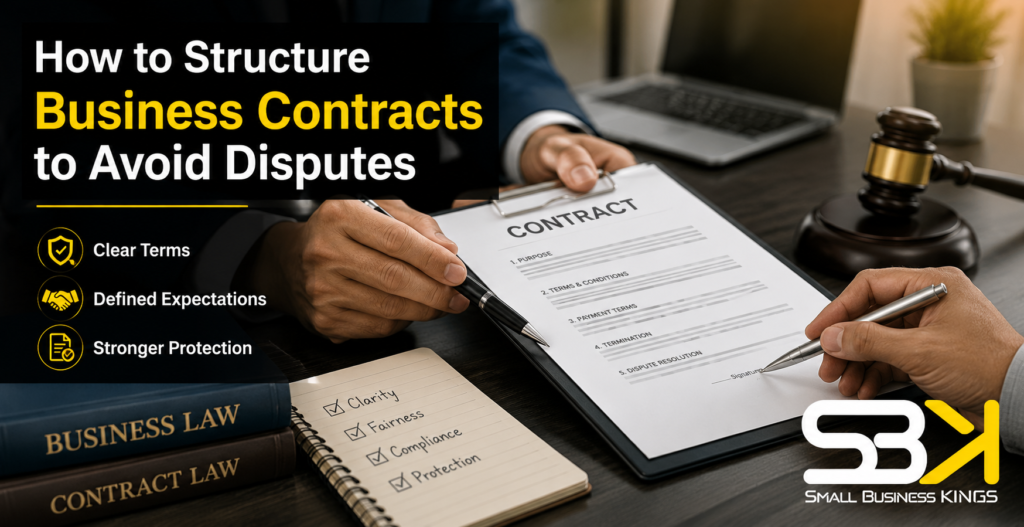
How to Structure Business Contracts to Avoid Disputes
A well-structured business contract doesn’t just document a deal — it removes the conditions that make disputes possible in the first place. That means going beyond a list of standard clauses and thinking about how each section of the agreement handles ambiguity, scope changes, and failure before they happen.
Why Most Contract Disputes Were Preventable
The majority of business contract disputes don’t start with bad intentions. They start with a sentence no one read carefully, a deliverable no one defined precisely, or a change everyone agreed to verbally but no one put in writing.
Automate & Scale Your Small Business
Replace 10+ costly subscriptions with 1 all-in-one CRM, Funnels & Marketing Engine.
Payment disagreements are the most common trigger — not because businesses don’t intend to pay, but because the contract left room for disagreement about what payment was actually owed and when. Scope disputes are the second most frequent source of conflict: one party believes additional work was included; the other believes it wasn’t.
The common thread is ambiguity. Every gap in a contract is a space where a future dispute can grow. Structuring contracts to avoid that means addressing the most likely failure points before signing, not after something goes wrong.
The Foundation: What Every Business Contract Must Define
Before getting to specific clauses, get these fundamentals right. Without them, the rest of the contract is built on uncertain ground.
Launch Your Business On Fast VPS Hosting
Secure, high-performance hosting designed for growth. Don't lose sales to slow site speed.
Identify the Parties Precisely
This sounds obvious, but enforcement problems frequently trace back to this section. The contract should include:
- Full legal business names — not trade names or abbreviations (e.g., “Apex Design LLC,” not “Apex”)
- The name and title of the person signing, with confirmation they have authority to bind the business
- Business addresses and primary contact for contract-related notices
If the wrong entity is named — a parent company instead of a subsidiary, for example — you may find yourself unable to enforce the agreement against the party you actually did business with.
Define Every Key Term
Any word that could reasonably be interpreted two ways should be defined explicitly. “Timely delivery,” “satisfactory completion,” and “standard quality” are all phrases that look acceptable until something goes wrong. Replace them with measurable standards: specific dates, defined quality benchmarks, or objective acceptance criteria.
Structure the Scope of Work to Eliminate Ambiguity
Scope disputes are almost entirely preventable with better drafting. The scope of work section should be specific enough that a stranger reading the contract could determine, without asking either party, exactly what was agreed.
A strong scope section covers:
- Exact deliverables: What is being provided, in what format, at what volume or standard
- What is explicitly excluded: This is the section most businesses skip — and the one that prevents the most “I thought that was included” arguments
- Milestones and deadlines: Break longer engagements into phases with dated acceptance points, not just a final due date
- Acceptance criteria: How does the receiving party formally confirm that a deliverable meets the standard? Who signs off, and within how many days?
Consider a scenario: a marketing agency signs a contract to “build out the client’s social media presence.” Without defining which platforms, what posting frequency, what content format, and what metrics constitute success, both parties can perform exactly as they intended and still end up in a dispute.
Build in a Formal Change Order Process
Scope creep — work that expands beyond the original agreement through informal requests and verbal approvals — is one of the leading causes of business disputes. The fix isn’t stricter language in the original scope; it’s a mandatory process for handling changes.
Every contract involving ongoing services or project-based work should include a change order provision that:
- Requires written documentation for any modification to scope, timeline, or cost — no exceptions for “quick” changes
- Specifies who is authorized to approve changes on each side (not just anyone at the company)
- States that work on changes doesn’t begin until a signed change order exists
- Details how pricing adjusts for out-of-scope work, whether that’s a fixed rate, hourly rate, or negotiated per-change
Without this clause, a client’s casual request becomes your obligation, and your completion of that request becomes evidence you agreed to do it for free.
Payment Terms: Remove Every Variable
Payment disputes rarely happen because someone intended not to pay. They happen because the contract left open questions about when payment was due, what triggered the obligation, or what happened when payment was late.
Structure payment terms to answer all of those questions in advance:
| Element | What to Specify |
|---|---|
| Amount | Total contract value or rate structure (hourly, monthly retainer, per-milestone) |
| Due dates | Net-30, upon receipt, tied to milestone completion — define it exactly |
| Invoice requirements | When invoices must be submitted, what they must include |
| Late payment | Interest rate or flat fee on overdue balances; when it begins accruing |
| Withholding conditions | Under what specific circumstances can the client withhold payment — and for how much |
| Accepted methods | Check, ACH, wire transfer — and who bears the cost of wire fees |
The “withholding conditions” row is where most templates fall short. If a client can withhold payment any time they claim dissatisfaction, you have no payment security at all. Tie withholding rights to specific, objectively verifiable conditions.
Termination Rights: Define the Exit Clearly
Termination clauses prevent one of the most common dispute scenarios: a party ends the relationship, and the other party claims it was a breach. A well-drafted termination section eliminates that argument by defining legitimate exit conditions in advance.
Cover both types:
Termination for cause: What constitutes a material breach that entitles the non-breaching party to terminate? How many days does the breaching party have to cure it before termination takes effect? A “cure period” of 10–30 days is standard for most business contracts.
Termination for convenience: Can either party end the agreement without cause? If so, what notice period is required — typically 30 to 60 days — and what is owed upon termination (payment for work completed, return of materials, final invoices)?
Post-termination obligations: Who owns what after the contract ends? What happens to work in progress? When does confidentiality expire?
The absence of a cure period is a particularly common oversight. Without it, a single missed deadline could technically justify termination — and that ambiguity is exactly the kind of thing that ends up in litigation.
Risk Allocation: Limitation of Liability and Indemnification
These two clauses determine who absorbs financial loss when something goes wrong. Most businesses include indemnification and skip limitation of liability — which means they’ve addressed who gets blamed but not how much exposure they’re carrying.
Limitation of Liability
This clause caps what either party can recover in the event of a breach or loss. Without it, a service contract worth $15,000 could theoretically expose the service provider to a lawsuit seeking $500,000 in consequential damages. Common structures cap liability at:
- The total contract value
- Fees paid in the prior 12 months
- A fixed dollar amount negotiated upfront
Note that limitation of liability clauses face scrutiny in some states and may not be enforceable against gross negligence or willful misconduct — which is why the clause itself should specify what it does and doesn’t cover.
Indemnification
An indemnification clause requires one party to cover the other’s losses arising from specific events — typically the indemnifying party’s own negligence, breach, or third-party claims. A balanced clause should define:
- What events trigger the indemnification obligation
- Whether it covers legal defense costs, not just judgments
- The notification process (how quickly must the indemnified party inform the other of a claim?)
Intellectual Property and Confidentiality
If any work product, designs, data, or proprietary information changes hands, these two clauses are not optional.
IP ownership: The contract must state explicitly who owns what is created during the engagement. Without this, default rules under copyright law may give ownership to the creator — meaning a contractor who designs your logo may own it, not you. Specify whether IP transfers to the client upon payment, whether the contractor retains rights and licenses use, and what happens to background IP the contractor brings into the project.
Confidentiality: Define what information is protected, who can access it, how long the obligation lasts after the contract ends, and what happens to confidential materials upon termination. For most business contracts, a two-to-five year post-termination confidentiality period is reasonable; for trade secrets, some agreements extend this indefinitely.
Force Majeure: Specify What It Actually Covers
Force majeure clauses excuse performance when extraordinary events make it impossible — but “acts of God” language without specifics creates its own disputes about whether a given event qualifies.
A useful force majeure clause names covered events explicitly: natural disasters, government-mandated shutdowns, supply chain disruptions from specified causes, labor strikes. It also defines the obligations that follow:
- How quickly must the affected party provide notice?
- What steps must they take to mitigate the impact?
- If the disruption continues beyond a defined period (commonly 30–90 days), can either party terminate without penalty?
The COVID-19 pandemic produced significant litigation over force majeure clauses that were either absent or too vague to apply clearly. Courts generally required the invoking party to demonstrate that performance was genuinely impossible, not merely more expensive or difficult.
Structure a Phased Dispute Resolution Clause
This is where most contract templates use a single sentence (“disputes shall be resolved by arbitration”) when they should be using a structured escalation process. A phased approach costs both parties less, preserves business relationships longer, and provides a documented record if things do reach litigation.
A well-structured dispute escalation clause typically works in three steps:
Step 1 — Direct negotiation (14–30 days): Designated representatives from each party must meet — in person or by video — within a specified timeframe after either party gives written notice of a dispute. Many conflicts resolve here, especially when the clause requires senior-level participation rather than whoever sent the original complaint email.
Step 2 — Mediation (30–60 days after negotiation fails): A neutral third-party mediator facilitates a structured negotiation. Unlike arbitration, mediation is non-binding — either party can walk away — but it resolves a significant portion of disputes at a fraction of litigation cost. The clause should specify who selects the mediator and who pays for it (typically split equally).
Step 3 — Arbitration or litigation: If mediation fails, the clause determines whether disputes go to binding arbitration or court. Arbitration is generally faster and private, but it limits appeal rights and can be expensive for complex commercial disputes. The clause must specify the arbitration rules (AAA, JAMS, or another body), the number of arbitrators, and the seat of arbitration.
The clause should also specify governing law (which state’s law applies to interpretation) and venue (where proceedings take place) — details that matter enormously if the parties are in different states.
Free Business Blueprint
Steal the roadmap smart entrepreneurs use to launch, grow, and scale their businesses while avoiding expensive mistakes.
Boilerplate Clauses That Actually Matter
These sections often get copy-pasted without review. They shouldn’t.
Entire Agreement (Merger) Clause: States that the written contract is the complete agreement between the parties — meaning prior emails, verbal promises, and proposals are not binding. This clause is your primary defense against “but you said…” arguments.
Severability: If a court finds one clause unenforceable, the rest of the contract remains in effect. Without this, a problematic non-compete clause could theoretically void the entire agreement.
Amendment Procedure: Specifies that changes to the contract must be in writing and signed by both parties. This reinforces your change order process and prevents informal modifications from becoming binding.
Notice Requirements: How must formal notices under the contract be delivered? Email, certified mail, courier? To which address or contact? A dispute over whether proper notice was given is avoidable entirely if the contract specifies the method.
Contract Management After Signing
A perfectly drafted contract won’t prevent disputes if no one manages it after execution. The most common post-signing failure is treating the contract as filed and forgotten.
Operational practices that reduce dispute risk:
- Version control: Ensure both parties have signed the same final version. Keep a master copy in a shared, access-controlled location
- Milestone tracking: Calendar every performance deadline and payment date; assign someone responsible for monitoring them
- Communication logs: Document all contract-related discussions — decisions made in meetings should be confirmed in writing within 24 hours
- Early flag process: Establish an internal protocol for flagging potential performance or payment issues before they escalate. A one-week delay is easier to address than a 60-day delinquency
For businesses managing multiple vendor or client contracts simultaneously, a contract lifecycle management (CLM) tool can centralize tracking and send automated alerts when renewal dates or performance milestones approach.
If you’re setting up your business systems from scratch — contracts, CRM, customer pipeline — getting the operational infrastructure in place early matters as much as getting the legal documents right. SBK recommends Softangles for exactly this: they handle business website design, hosting, logo and brand design, and CRM/sales pipeline setup, so you’re not scrambling to build those systems after your first contract dispute reminds you they’re necessary.
Comparison: What a Weak vs. Dispute-Resistant Contract Looks Like
| Contract Element | Weak Version | Dispute-Resistant Version |
|---|---|---|
| Scope of Work | “Marketing services as discussed” | Specific platforms, deliverable formats, posting frequency, and exclusions listed |
| Payment terms | “Due upon completion” | Net-30 from invoice date; invoice submitted within 5 days of milestone completion |
| Changes | “Changes by mutual agreement” | Written change orders required; work doesn’t begin until both parties sign |
| Dispute resolution | “Disputes resolved by arbitration” | Three-step process: 14-day negotiation → 45-day mediation → AAA arbitration |
| Termination | “Either party may terminate with notice” | 30-day written notice; 15-day cure period for material breach; payment owed through termination date |
| IP ownership | Silent | All work product transfers to client upon receipt of full payment; contractor retains background IP |
Skip Beginner Business Mistakes
Get Free BlueprintFrequently Asked Questions
What’s the most important clause to include in a business contract?
The scope of work section causes more disputes than any other element. If what’s being delivered, when, and at what standard isn’t precisely defined, every other clause in the contract is built on an unstable foundation. After scope, the dispute resolution clause matters most — it determines how much a disagreement will cost you to resolve.
Can a verbal contract be enforced in the US?
Verbal contracts can be legally binding in the US for many types of agreements, but they’re extremely difficult to enforce. Without documentation, the dispute becomes one person’s word against another’s — which courts find genuinely difficult to adjudicate. Some agreements (real estate transactions, contracts lasting longer than one year, and agreements for goods over $500 under the Uniform Commercial Code) typically require a written agreement to be enforceable. For any business relationship with meaningful financial exposure, a written contract isn’t optional.
What’s the difference between mediation and arbitration?
Mediation is non-binding: a neutral mediator helps both parties negotiate a resolution, but either party can walk away. Arbitration is typically binding: an arbitrator (or panel) hears both sides and issues a decision that’s enforceable in court, similar to a judgment. Mediation is cheaper and preserves more relationship goodwill; arbitration is more final. A well-structured contract requires mediation before arbitration, giving both parties a lower-cost resolution path first.
How should a small business handle scope creep once a project has started?
Stop work on anything outside the original scope until a signed change order is in place. That sounds rigid, but informally completing additional work — even to preserve the relationship — sets a precedent that such work is included in the original price. If a client pushes back on the change order process, document the conversation. If you proceed without one, document that too, and send a written summary of what was requested and completed. That paper trail is your only leverage later.
Do non-compete clauses in business contracts still hold up?
It depends significantly on the state and the specific context. Non-compete restrictions between businesses (such as in a partnership or asset purchase agreement) are treated differently than employment non-competes, and courts generally uphold the former with more consistency when they’re reasonably scoped. Employment-based non-competes face increasing legal restrictions at the state level. Any non-compete clause should be reviewed by an attorney familiar with the law in the states where the agreement will be enforced.
Launch Your Business On Fast VPS Hosting
Secure, high-performance hosting designed for growth. Don't lose sales to slow site speed.
When does a breach of contract justify terminating the agreement?
Only a material breach — one that goes to the core of the agreement — typically justifies termination. A minor or technical breach (a single late deliverable, for example) usually doesn’t give the non-breaching party the right to walk away entirely. Terminating for a minor breach can itself constitute a breach. This is why a well-drafted termination clause explicitly defines what counts as material breach and includes a cure period, giving the breaching party a defined window to fix the problem before termination rights activate.