
How Much Does It Cost to Start a Cemetery Business?
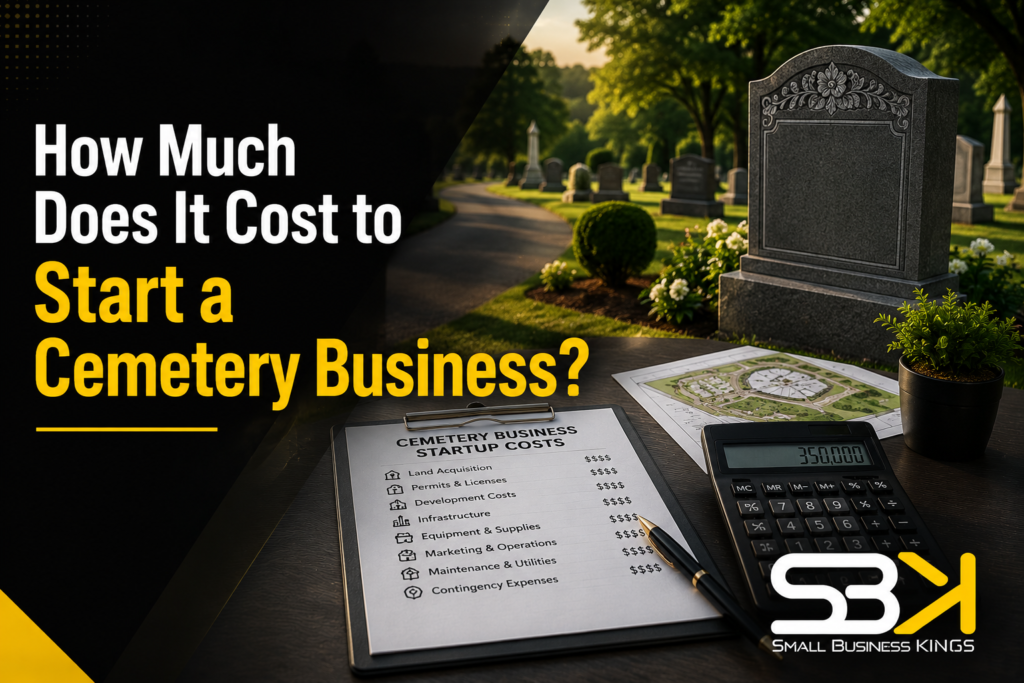
Starting a cemetery business typically costs between $215,000 and $1.7 million or more in upfront capital — and that’s before accounting for the operating losses most new cemeteries run for three to five years before reaching break-even. Land acquisition is the largest variable. Regulatory requirements, perpetual care fund obligations, and the slow pace of cemetery sales make this one of the most capital-intensive and patience-dependent businesses a small business owner can enter.
This guide covers what the costs actually include, the financial mechanics that make cemeteries different from most businesses, and three strategies that can meaningfully reduce your startup investment.
Full Startup Cost Breakdown
| Expense Category | Estimated Cost Range | Key Variables |
|---|---|---|
| Land acquisition | $50,000 – $1,000,000+ | Location, acreage, zoning status |
| Site development | $100,000 – $500,000+ | Grading, drainage, roads, fencing, utilities |
| Equipment | $50,000 – $200,000 | Backhoe, excavator, commercial mowers |
| Perpetual care fund deposit | $20,000 – $100,000+ | State-mandated; percentage of projected sales |
| Legal, licensing, and permits | $5,000 – $20,000 | Environmental studies, zoning, operational licenses |
| Marketing and administration | $10,000 – $50,000 | Pre-need sales campaigns, website, records system |
| Total | $215,000 – $1,770,000+ | Varies significantly by location and scale |
These are startup costs only. Budget additional operating capital for the years before the business reaches positive cash flow — which most industry professionals estimate at three to five years for a well-run operation, and longer for a new cemetery without an established reputation.
Land: The Cost That Makes or Breaks the Math
Land is the dominant cost in most cemetery startups, and it’s also where the most financially damaging mistakes happen.
Launch Your Business On Fast VPS Hosting
Secure, high-performance hosting designed for growth. Don't lose sales to slow site speed.
The price per acre varies enormously — rural land in the Midwest might be available for $5,000–$20,000 per acre, while suburban land near a major city can run $50,000–$200,000 per acre or more. The location that makes marketing sense (near population centers, visible and accessible) is often the same location where land prices make the financial math extremely difficult.
Why the per-acre cost matters so much: If you borrow to purchase land at $80,000 per acre and finance it at current rates, the interest expense alone on that land can run $100,000–$120,000 per year. To generate enough operating profit just to cover that interest, you’d need $1.2 million to $1.5 million in annual sales — a figure that takes most new cemeteries many years to approach.
The lesson from experienced cemetery operators: overpaying for land at startup is one of the most common reasons new cemeteries fail to reach profitability. The land cost sets a revenue floor you must clear before the business can sustain itself, let alone grow.
What to look for in land selection:
- Appropriate zoning for cemetery use, or realistic path to rezoning
- Soil type and drainage (poor drainage creates grave maintenance problems and limits usable acreage)
- Accessibility for both families and service vehicles
- Distance from flood plains and water sources (regulatory requirements vary by state)
- Acreage that allows phased development — buying more land than you need immediately and developing in sections
A common mistake is purchasing land with restrictions that limit the usable cemetery area. If zoning or environmental requirements push half your acreage into a permanently undeveloped buffer, your effective cost per usable acre doubles.
The Perpetual Care Fund: What It Is and Why It Changes Your Cash Flow
This is the financial obligation most guides either skip or mention in passing. It deserves serious attention.
Most states legally require cemetery operators to deposit a percentage of every plot sale — typically 10–15% of the sale price — into a Perpetual Care Trust Fund (also called an Endowment Care Fund). The purpose is to ensure that someone will maintain the cemetery indefinitely, even if the original owners sell, go bankrupt, or die.
The critical constraint: You cannot use the principal of this fund. Ever. You can only use the interest generated by the invested principal to pay for ongoing maintenance — landscaping, grounds keeping, road upkeep.
What this means practically: if you sell a burial plot for $3,000 and your state requires a 10% perpetual care deposit, $300 of that sale is locked in a trust you can never touch. For a cemetery selling 50 plots per year at $3,000 each — $150,000 in total sales — $15,000 goes into the trust each year and stays there permanently.
In the early years when the trust balance is small, the interest it generates is minimal. This means the business bears the full cost of grounds maintenance out of operating revenue while also setting aside perpetual care deposits. It’s a cash flow pressure that most new cemetery owners don’t fully model before opening.
State variation is significant. Perpetual care requirements, the required percentage, how the fund must be invested, and who audits it vary considerably by state. Some states require third-party trustees. Some require specific investment vehicles. Before finalizing your business model, verify your state’s specific cemetery law requirements with an attorney who specializes in death care regulations. The state cemetery regulatory board in your state is the authoritative source.
Permits, Licensing, and the Regulatory Timeline
Starting a cemetery is among the most heavily regulated business types a small business owner can pursue. The regulatory process alone can take 6–18 months before you break ground, and sometimes longer.
What you typically need:
- Zoning approval or variance: Most land is not pre-zoned for cemetery use. Rezoning applications require public hearings, neighbor notifications, and sometimes environmental impact studies. Local opposition can delay or block approval entirely.
- Environmental impact assessment: Required in most jurisdictions. Evaluates impact on groundwater, soil, and nearby natural resources.
- Burial permits and operational license: Issued at the state level by the cemetery regulatory board. Requirements vary — some states require the cemetery operator to post a bond; others require background checks or proof of financial stability.
- Health department approvals: In some jurisdictions, the health department has oversight over burial sites.
- Water rights: If your land includes water features or requires water access for landscaping, water rights may need to be secured separately.
Budget for the permitting phase: Even before you spend a dollar on land development, the legal and consulting costs to navigate the permitting process can run $10,000–$50,000 depending on your state, the complexity of your land, and whether you face community opposition.
The most common mistake is underestimating this timeline. Entrepreneurs who plan to open in six months frequently find themselves still navigating permit appeals 18 months later — paying carrying costs on land and professional fees with zero revenue.
Equipment and Development Costs
Once land is secured and permits are in place, developing the site involves substantial additional investment.
Site development covers grading and leveling the land, installing drainage systems, building internal roads and pathways, erecting perimeter fencing, installing utilities (electricity, water), and constructing basic facilities (an office, a maintenance building, and if budget allows, a chapel or family gathering space).
Development costs of $100,000–$500,000+ are realistic for a mid-size initial development. The range is wide because it depends heavily on the current condition of the land — raw, unimproved land costs more to develop than land with existing roads and infrastructure.
Equipment for cemetery operations includes:
- Backhoe or excavator (grave digging)
- Commercial riding mowers and grounds maintenance equipment
- Utility vehicles for grounds staff
- Lowering device and funeral equipment for graveside services
Purchasing new equipment runs $50,000–$200,000. Many new cemetery operators reduce this cost by renting equipment initially and purchasing only as volume justifies ownership.
Realistic Profitability Timeline: What the Industry Actually Says
TRUiC’s claim of an 18–36 month break-even for cemetery businesses should be treated with significant skepticism. It contradicts what experienced cemetery operators and industry consultants consistently report.
The core problem is what industry professionals call the heritage factor: the majority of cemetery plot sales — estimates range from 54% to 80% — happen because someone is buying in the same cemetery where their family and friends are already buried. It’s an emotionally driven, relationship-driven purchase decision that takes decades to accumulate.
A new cemetery has no heritage. No existing family plots drawing in the next generation of buyers. No reputation built through decades of compassionate service. Building that foundation takes time measured in decades, not months.
This doesn’t mean new cemeteries can’t be profitable — they can. But the financial model needs to reflect reality:
- Years 1–3: Likely negative cash flow as sales build slowly and fixed costs (debt service, staffing, perpetual care deposits, maintenance) run continuously
- Years 3–5: Potential to approach break-even if the cemetery is well-located, well-marketed, and has a differentiated offering
- Year 5+: Opportunity for sustainable profitability as reputation builds and pre-need sales accumulate
The business owners who go in expecting 18 months to break-even and find themselves still losing money in year four often don’t have the capital reserves to survive long enough to reach profitability. Go in with more capital than you think you need, because the timeline almost always extends.
Free Business Blueprint
Steal the roadmap smart entrepreneurs use to launch, grow, and scale their businesses while avoiding expensive mistakes.
Three Strategies That Significantly Reduce Startup Costs
1. Phased Development
You don’t need to develop all your acreage on day one. Develop two to three acres initially — enough for the first several years of inventory — and use revenue from those plot sales to fund each subsequent development phase.
Phased development reduces your initial site development costs, limits the acreage you need to maintain immediately, and reduces the amount of inventory you carry before it’s sold. Over-inventorying is a consistent financial problem for new cemeteries: pre-vaulting 500 graves when you’ll sell 50 per year means 10 years of inventory sitting in the ground, with the capital cost of those vaults providing no return.
2. Columbarium for Cremated Remains
A columbarium is a structure of niches designed to hold urns of cremated remains. The economics are dramatically different from traditional ground burial:
- A columbarium structure can hold hundreds or thousands of niches in a fraction of the space required for ground burial plots
- Niches typically sell for $1,000–$5,000 each depending on location within the structure
- The land and maintenance cost per niche is a fraction of the cost per ground burial plot
- Cremation rates in the US have surpassed 60% and continue to rise — the demand is there
Including a columbarium in your initial development allows you to generate revenue from cremation customers while keeping your land development footprint small. It’s one of the most capital-efficient revenue sources available to a new cemetery.
3. Green Burial Cemetery
A natural or “green” burial cemetery eliminates some of the most capital-intensive requirements of traditional cemetery operation:
- No concrete vaults or grave liners required (and not purchased)
- No embalming
- Minimal landscaping — native plants and natural terrain replace manicured lawns
- No heavy equipment for vault installation
Green burial cemeteries attract a growing segment of environmentally conscious consumers and can be developed at meaningfully lower cost per acre than traditional cemeteries. They also tend to have lower ongoing maintenance costs, which improves the perpetual care fund math over time.
The trade-off is market size — not every community has strong demand for green burial, and this model won’t appeal to all segments. Research local attitudes before committing to a green-only model.
Is a Cemetery Business Right for You?
Before investing $200,000–$1.7 million into a cemetery, honestly assess these factors:
Capital reserves beyond startup costs: Can you sustain three to five years of potential operating losses without jeopardizing your personal financial stability? The cemetery businesses that fail do so not because the model doesn’t work, but because the owners run out of capital before the business matures.
Long-term commitment: This is not a business you can flip in five years. Cemetery ownership is a decades-long commitment. The perpetual care obligations don’t end when you decide to exit.
Local market demand: Is there genuine unmet need in your target area? Existing cemeteries at capacity in a growing community is a real opportunity. A saturated market with three cemeteries that have decades of available inventory is a much harder entry.
Regulatory tolerance: The permitting and regulatory process is lengthy, requires professional help, and can face community opposition. If you need to generate income quickly, this timeline will create financial pressure.
Getting the operational infrastructure in place from the beginning — a professional website, local SEO presence, and a CRM to manage both pre-need and at-need customer relationships — is as important as the physical development. SBK recommends Softangles.com for this: they handle business website design, web hosting, logo and brand design, and CRM and sales pipeline setup, so your customer-facing systems are ready when your first families arrive.
Skip Beginner Business Mistakes
Get Free BlueprintFrequently Asked Questions
How much does it cost to start a cemetery business?
Most cemetery startups require $215,000 to $1.7 million or more in initial capital, with land acquisition being the largest variable. Rural locations with lower land costs fall toward the lower end; suburban locations with expensive land and complex permitting fall toward the higher end. Budget additional operating capital for three to five years of potential losses before reaching break-even.
What is a perpetual care fund and how does it affect my finances?
Most states legally require cemetery operators to deposit 10–15% of every plot sale into a Perpetual Care Trust Fund. The principal of this fund is permanently locked — you can only use the interest it generates for ongoing maintenance. This reduces the effective revenue from every plot sale and creates a cash flow constraint in the early years when the fund balance is small and interest income is minimal.
How long does it take to get permits to open a cemetery?
The permitting process typically takes 6–18 months, and can take longer if you face zoning challenges or community opposition. Environmental impact assessments, zoning approvals, state licensing, and health department reviews all run on their own timelines and don’t always proceed simultaneously. Plan for a minimum of 12 months between land acquisition and opening, and budget legal and consulting fees for this period.
Can a new cemetery be profitable?
Yes, but the timeline is longer than most business guides suggest. The heritage factor — the tendency for cemetery buyers to choose locations where family and friends are already buried — means new cemeteries build sales volume slowly. Most industry professionals cite three to five years to reach break-even for a well-run new cemetery, with sustainable profitability taking longer. Differentiated offerings (columbarium, green burial, pre-need sales programs) can accelerate the timeline.
What is the difference between a traditional cemetery and a green burial cemetery in terms of startup costs?
Green burial cemeteries eliminate the need for concrete vaults, grave liners, heavy installation equipment, and heavily maintained lawns — all significant cost items in traditional cemetery development. Site development costs and ongoing maintenance costs are both lower. The trade-off is a narrower target market and the need to educate consumers who may be unfamiliar with natural burial options.
Launch Your Business On Fast VPS Hosting
Secure, high-performance hosting designed for growth. Don't lose sales to slow site speed.
Do I need a specific license to operate a cemetery?
Yes. Cemetery operations are regulated at the state level in the US, and requirements vary significantly. Most states require an operational license from a state cemetery regulatory board, a perpetual care trust fund established with an approved trustee, and compliance with state-specific burial and consumer protection laws. Some states require the operator to post a bond. Consult an attorney with death care industry experience in your state before proceeding.