

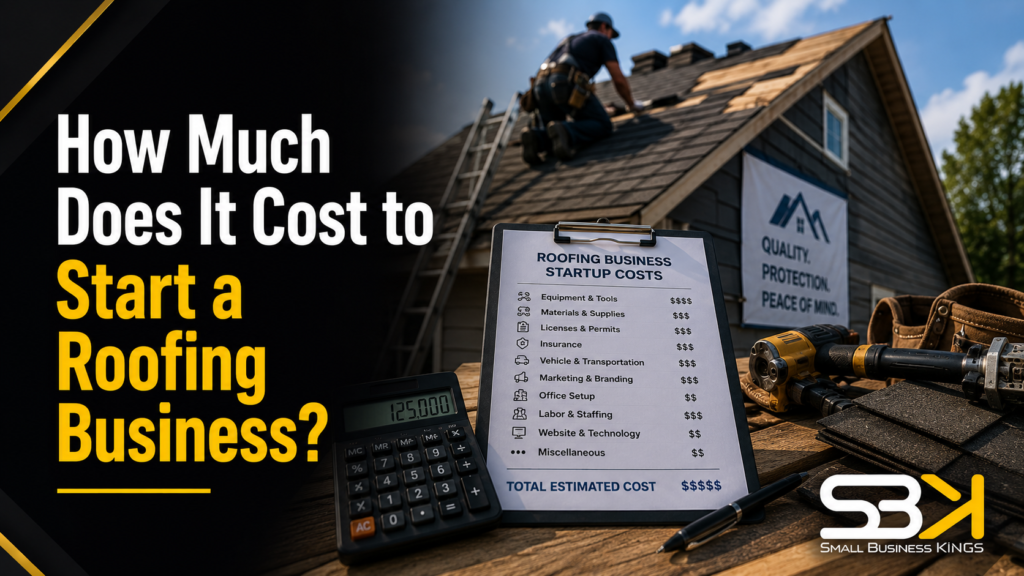
How Much Does It Cost to Start a Roofing Business?
Starting a roofing business costs $10,000–$25,000 for a lean subcontractor model, $50,000–$100,000 for a mid-scale operation with your own crew, and $150,000+ for a full-scale launch with multiple trucks and a sales team. The range is that wide because the model you choose — not the industry itself — determines your startup capital requirement.
Before any cost breakdown makes sense, decide which of these you’re actually building.
The Model Decision Drives Everything Else
Most roofing startup guides give you a cost range without telling you what’s inside it. The reason the range is so wide ($10,000 to $180,000) is that these are fundamentally different businesses:
| Launch Model | Startup Cost | How It Works |
|---|---|---|
| Lean / Subcontractor | $10,000 – $25,000 | You sell and manage jobs; subcontracted crews do the labor |
| Mid-Scale / In-House Crew | $50,000 – $100,000 | You hire W-2 employees, own a truck, buy equipment |
| Full-Scale Operation | $150,000 – $180,000+ | Multiple vehicles, office, sales team, dedicated estimator |
The lean model is real and viable. Many successful roofing business owners start by subcontracting all labor — they handle sales, project management, and customer relationships while paying experienced roofing crews per job. This eliminates the biggest cost categories: vehicles, equipment, and W-2 payroll. Your startup costs compress to licensing, insurance, marketing, and working capital.
The trade-off: lower margins per job (you’re paying subs a significant portion of labor revenue) and less control over crew quality and scheduling. But it’s the most capital-efficient path to getting your first $200,000 in revenue on the books.
Launch Your Business On Fast VPS Hosting
Secure, high-performance hosting designed for growth. Don't lose sales to slow site speed.
The in-house crew model is what most people picture when they think “roofing business.” You own your truck, buy your equipment, and hire your crew. Higher margins, more operational complexity, and significantly higher startup costs — particularly workers’ compensation insurance, which is one of the most expensive in the construction trades.
Full Startup Cost Breakdown
1. Licensing and Business Registration: $1,000–$5,000
Licensing requirements vary more for roofing than almost any other trade. Some states require no roofing license at all — you just need a general business license. Others require a state contractor license with an exam, minimum experience requirements, and a surety bond.
States with no roofing-specific license: Texas, Colorado, Missouri, Kansas, and others. Business license only ($50–$300).
States with strict licensing: Florida requires a state-issued roofing contractor license with a written exam. California requires a C-39 Roofing Contractor license. Louisiana, New Jersey, and several other states have their own requirements.
What you typically need regardless of state:
- LLC or corporation filing: $50–$500 (varies by state)
- EIN from IRS: Free
- General business license: $50–$300
- Contractor bond (where required): $500–$2,000
- State contractor license (where required): $200–$1,000 plus exam fees
Critical: Verify your state’s specific requirements before spending anything on equipment or marketing. Operating without the required license in states like Florida can result in fines and contract invalidation.
2. Insurance: $5,000–$15,000/Year
Insurance is where roofing startup costs diverge most sharply from other small businesses — and where most new contractors get surprised.
General Liability: $1,500–$3,500/year. Covers property damage and third-party bodily injury. Required by virtually every commercial property client and most residential customers who ask.
Workers’ Compensation: $3,000–$9,000+/year. Here’s why it’s expensive: roofing is classified as one of the highest-risk occupations in the construction trades. Workers’ comp rates are set per $100 of payroll by NCCI occupational codes. Roofing carries some of the highest rates — often $15–$30 per $100 of payroll in many states, compared to $3–$5 for office workers. A crew of two roofers at $40,000/year each means $80,000 in payroll, which at a $20/$100 rate generates $16,000 in annual workers’ comp premiums.
If you’re running the subcontractor model with 1099 subs rather than W-2 employees, your workers’ comp requirement drops significantly — but verify that your subs carry their own coverage. If they don’t and a worker is injured on your job, you may be liable.
Commercial Auto: $1,500–$2,500/year per truck. Required the moment a vehicle is used for business purposes.
Tools and Equipment Coverage: $300–$800/year. Covers theft or damage to tools and equipment on the job.
Insurance down payment: Most commercial policies require 20–30% upfront at binding. On a $10,000 annual premium package, that’s $2,000–$3,000 due before you run your first job.
3. Vehicle and Transportation: $10,000–$35,000
For an in-house crew model, you need at minimum one reliable work truck. A used 3/4-ton or 1-ton pickup runs $15,000–$30,000 in usable condition. Add a dump trailer ($3,000–$8,000) for debris hauling and you’ve got the core transportation setup.
For the subcontractor model, your vehicle requirements are lower — a truck capable of hauling materials and your own equipment is sufficient, and you can start with a vehicle you already own.
Don’t underestimate ongoing vehicle costs. Fuel for a commercial truck running 200+ miles per week runs $300–$600/month. Maintenance and tires add another $200–$400/month. Factor these into your monthly operating cost model.
4. Equipment and Tools: $3,000–$15,000
For a subcontractor model: Minimal. You need personal safety equipment and inspection tools — harness, hard hat, safety glasses, measuring wheel, moisture meter. Budget $1,000–$3,000.
For an in-house crew: Full tool complement including:
- Pneumatic nail guns (2–3): $400–$800 each
- Air compressor: $300–$800
- Ladders (multiple sizes): $400–$1,500
- Fall protection systems (per crew member): $200–$500 each
- Roofing hatchets and hand tools: $200–$600
- Power tools: $500–$2,000
Total for equipping a 3-person crew: $5,000–$12,000.
Safety and OSHA compliance: This isn’t optional. OSHA 29 CFR 1926.502 requires fall protection on roofs above 6 feet. The fines for non-compliance can reach $15,625 per violation — more than your entire tool budget. Budget $1,500–$3,000 for a proper fall protection system per crew, and take the OSHA 10-hour Construction course ($150–$300 per person).
5. Materials Deposit and Supplier Account: $3,000–$10,000
This cost is consistently underestimated and rarely mentioned. Before your first job, you need either:
A supplier account with net-30 terms (Home Depot Pro, ABC Supply, Beacon Roofing Supply, or similar): Apply before you need it. Most distributors extend net-30 credit to licensed contractors with a business account. This lets you purchase materials for a job and pay for them after the customer pays you — critical for managing cash flow.
Or an initial materials deposit: If you don’t have supplier credit yet, budget $3,000–$8,000 for materials on your first 1–2 jobs. You’ll recoup this when customers pay, but you need the cash first.
The storm job problem: On insurance-claim jobs, payment flow goes: homeowner files claim → adjuster inspects → adjuster approves → insurance sends check (often 30–60 days after job completion). You’ve already paid for materials and labor. Without a supplier account or working capital reserve, this cycle creates immediate cash pressure.
6. Marketing and Lead Generation: $2,000–$10,000 (First Year)
Roofing lead economics are different from most trades. Here’s what the numbers actually look like:
Shared leads (Angi, HomeAdvisor, Thumbtack): $30–$80 per lead. Close rate for new roofing contractors: 15–25%. Cost per job: $150–$500.
Google Local Services Ads: Pay per verified lead, not per click. Roofing leads run $50–$150 each. Higher quality than shared leads but require Google’s background check and license verification.
Google Search Ads: Cost-per-click for roofing keywords runs $10–$40 in most markets. Budget $1,000–$3,000/month for enough clicks to generate consistent lead volume.
Door knocking after storms: The lowest-cost lead generation strategy for a new roofing company. Zero cost beyond your time. Highly effective immediately after hail or wind events in residential areas. Many successful roofing startups generate their first $100,000 in revenue entirely through post-storm canvassing before investing in any paid marketing.
Google Business Profile: Free to set up, generates organic local search traffic. Set this up on day one. Reviews on your GBP directly affect your ranking — make generating reviews from every completed job a standard process.
Realistic first-year marketing budget: $3,000–$8,000, weighted toward door knocking and GBP in months 1–3, shifting to paid leads as cash flow allows.
7. Technology and Software: $300–$1,000/Month
A roofing CRM and estimating tool is not optional past your first few jobs. Managing proposals, job tracking, material orders, and customer communication in spreadsheets and texts breaks down fast.
EagleView or GAF QuickMeasure: Aerial measurement tools for estimating without physically measuring every roof. $1–$5 per report. Essential for accurate proposals and reducing site visit time.
JobNimbus, AccuLynx, or Roofr: Roofing-specific CRM with estimating, job management, photo documentation, and payment collection. $100–$300/month.
CompanyCam: Photo documentation app for job progress. $20–$60/month. Protects you in insurance disputes and provides before/after content for marketing.
8. Working Capital: $15,000–$40,000
This is what kills roofing startups — not a lack of jobs, but a lack of cash while waiting for jobs to pay.
The roofing payment cycle:
- You complete a job
- Customer submits insurance claim (for storm work)
- Adjuster inspects and approves
- Insurance issues payment: 30–90 days after job completion
- You’ve been paying material suppliers and crew this entire time
For service and repair jobs with direct customer payment, the cycle is shorter — but even net-30 terms on materials create a cash gap.
Working capital formula: Monthly operating costs × 3 = minimum working capital reserve.
At $8,000/month in costs (insurance, vehicle, software, marketing): you need $24,000 in reserve before your revenue cycle normalizes.
This reserve is separate from your startup equipment costs. Operators who don’t maintain it find themselves unable to buy materials for a new job because the last job hasn’t paid yet — despite having a full pipeline.
Complete First-Year Cost Summary
| Cost Category | Subcontractor Model | In-House Crew Model |
|---|---|---|
| Licensing and registration | $500–$1,500 | $1,000–$3,000 |
| Insurance (year one) | $2,000–$5,000 | $7,000–$15,000 |
| Vehicle | $0–$15,000 | $15,000–$35,000 |
| Equipment and tools | $1,000–$3,000 | $5,000–$15,000 |
| Materials deposit | $2,000–$5,000 | $3,000–$10,000 |
| Marketing (year one) | $2,000–$5,000 | $3,000–$8,000 |
| Software | $1,200–$3,600 | $1,200–$3,600 |
| Working capital reserve | $10,000–$20,000 | $20,000–$40,000 |
| Total | $18,700–$58,100 | $55,200–$129,600 |
Revenue and Break-Even: What the Math Looks Like
Average roofing job revenue: $5,000–$15,000 for a residential replacement. Repairs run $300–$2,000. Commercial jobs vary widely.
Gross margin: 30–40% for most residential roofing jobs after materials and labor. A $10,000 job might net $3,000–$4,000 in gross profit before overhead.
Break-even calculation (in-house crew, $7,000/month overhead): You need roughly $18,000–$23,000 in monthly revenue to cover overhead and generate operating profit. At an average job value of $8,000 and 35% gross margin, that’s 8–10 completed jobs per month.
For the subcontractor model with lower overhead ($4,000–$5,000/month): break-even comes at 5–7 jobs per month — achievable within the first 60–90 days for a focused operator with post-storm canvassing.
Seasonality: In most northern and midwestern US markets, roofing activity drops 50–70% from November through March. Your working capital reserve needs to carry you through the slow season — which means the 3-month reserve calculation should be based on your winter monthly costs, not your peak-season burn rate.
Getting your website and customer management infrastructure in place before you start marketing matters — roofing customers check your online presence before calling, and a missing or unprofessional website ends conversations before they start. SBK recommends Softangles for this: they handle business website design, web hosting, logo and brand design, and CRM and sales pipeline setup, so your digital foundation is solid when your first storm season hits.
Free Business Blueprint
Steal the roadmap smart entrepreneurs use to launch, grow, and scale their businesses while avoiding expensive mistakes.
Frequently Asked Questions
Can I start a roofing business with $10,000?
Yes, using the subcontractor model. At $10,000, you can cover your LLC registration, initial insurance, a basic tool set, and your first month of marketing. You’ll need supplier credit or a materials deposit for jobs, and your working capital will be thin. The subcontractor model is the only path where $10,000 is a realistic launch number — in-house crew operations need $50,000 minimum.
Why is workers’ compensation so expensive for roofing?
Roofing has one of the highest injury rates of any construction trade. Falls from roofs account for a significant percentage of construction fatalities annually. Insurance carriers price workers’ comp to reflect actual risk — roofing is classified in the highest premium bands, often $15–$30 per $100 of payroll. A two-person crew can generate $10,000–$16,000 in annual workers’ comp premiums alone.
Do I need a roofing license to start a roofing business?
It depends on your state. Some states (Texas, Colorado, Kansas) require no roofing-specific license — just a general business registration. Others (Florida, California, Louisiana) require a state contractor license with an exam, experience requirements, and bonding. Check your state’s contractor licensing board before starting operations.
How long does it take a roofing business to become profitable?
Most roofing businesses reach operating profitability within 3–9 months if they manage working capital correctly. The subcontractor model reaches profitability faster (lower overhead, lower break-even volume). In-house crew operations take longer because of higher fixed costs. The most common reason new roofing businesses fail is cash flow collapse during the first storm season — not a lack of jobs.
What’s the best way to get roofing jobs when starting out?
Door-to-door canvassing after storm events is the most cost-effective lead generation strategy for a new roofing business — zero cost, immediate results, and no competition from established companies that rely on paid leads. After your first 10–15 jobs, focus on Google Business Profile optimization and reviews, which generate organic residential leads without ongoing ad spend. Paid lead platforms (Angi, HomeAdvisor) fill gaps but shouldn’t be your primary source at launch.
Launch Your Business On Fast VPS Hosting
Secure, high-performance hosting designed for growth. Don't lose sales to slow site speed.
Is the roofing business seasonal and how does that affect startup costs?
Yes, significantly in most US markets. Northern and midwestern states see 50–70% volume drops from November through March. Your working capital reserve must account for the slow season — budget 5–6 months of overhead as reserves if you’re launching in spring and need to survive your first winter. Southern states (Florida, Texas, Arizona) have more consistent year-round demand but their own seasonal patterns tied to hurricane season and summer heat.