

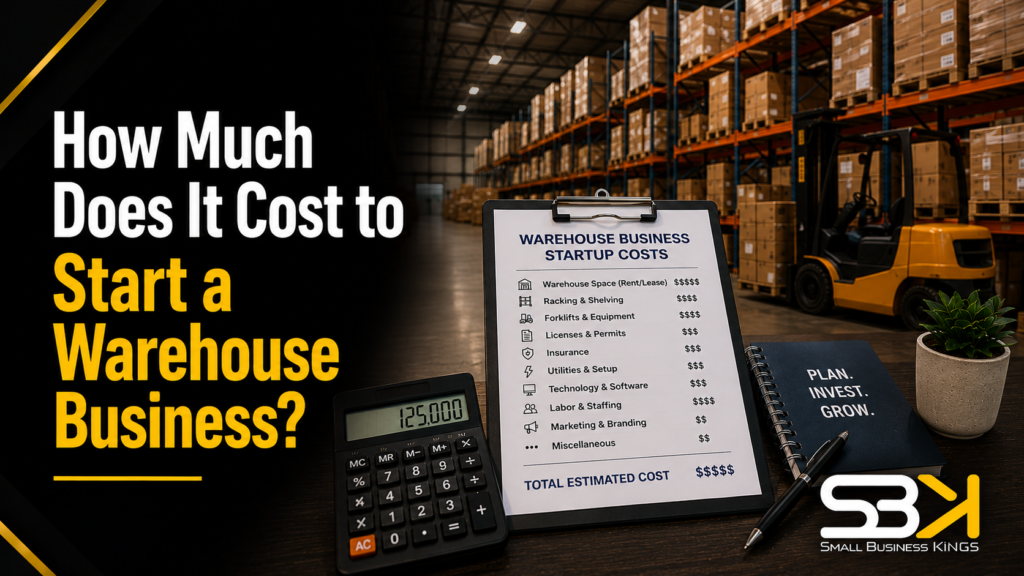
How Much Does It Cost to Start a Warehouse Business?
Starting a warehouse business costs $55,000–$150,000 for a leased small operation, $500,000–$1.5M to purchase an existing facility, and $625,000–$5.5M+ to build from the ground up. Those ranges assume a standard 10,000–25,000 sq ft dry storage operation. Cold storage adds a significant premium. The business model you’re running — third-party logistics (3PL), own-use storage, or real estate — determines which cost structure applies to you.
The Business Model Question Comes First
Most warehouse startup guides skip this and go straight to cost tables. That’s backwards. The cost structure, revenue model, and startup capital requirement are completely different depending on what you’re actually building.
Third-party logistics (3PL): You lease or own warehouse space and charge other businesses to store and manage their inventory. Revenue comes from storage fees (per pallet or per sq ft), handling fees (per pick/pack operation), and value-added services. This is the most common “warehouse business” for entrepreneurs — and the most complex to operate.
Own-use warehouse: You need warehouse space for your own products or inventory. You’re not selling storage services; you’re reducing operating costs and improving your supply chain. Cost structure is similar but there’s no client acquisition challenge — you’re the client.
Real estate / lease-to-tenant: You acquire or develop warehouse property and lease it to tenants on long-term contracts. This is a real estate investment, not an operations business. Requires significantly more capital but generates passive income.
Launch Your Business On Fast VPS Hosting
Secure, high-performance hosting designed for growth. Don't lose sales to slow site speed.
This article focuses primarily on the 3PL model — running a warehouse that serves other businesses — because that’s what most people mean when they search this keyword. The cost ranges below apply to that model unless otherwise noted.
Lease vs. Buy vs. Build: The First Financial Decision
This single decision determines whether you need $55,000 or $5 million to launch.
Option 1: Lease an Existing Warehouse (Most Common for Startups)
Leasing is the right starting point for most first-time warehouse operators. It preserves capital for equipment, working capital, and operations — and lets you validate demand before committing to a 20-year mortgage.
National average lease rates: $0.75–$2.50 per sq ft per month for industrial/warehouse space. That’s $9,000–$30,000 per year for a 1,000 sq ft space, or $90,000–$300,000 per year for 10,000 sq ft.
The lease deposit trap: Most commercial warehouse leases require 3–6 months of rent upfront as a security deposit. On a 10,000 sq ft space at $1.50/sq ft/month ($15,000/month), that’s $45,000–$90,000 in deposit alone — before you buy a single pallet rack. Factor this into your cash requirement, not just your monthly operating costs.
Total upfront cost for a leased 10,000 sq ft warehouse:
| Cost Item | Low | High |
|---|---|---|
| Lease deposit (3–6 months) | $10,000 | $45,000 |
| First month’s rent | $7,500 | $25,000 |
| Facility fit-out (lighting, basic office) | $10,000 | $30,000 |
| Pallet racking | $10,000 | $30,000 |
| Forklifts (1–2 units, used) | $15,000 | $30,000 |
| WMS software | $500 | $10,000 |
| Security system | $2,000 | $8,000 |
| Business registration and permits | $1,000 | $5,000 |
| Insurance (first year) | $3,000 | $10,000 |
| Total | $59,000 | $193,000 |
Option 2: Purchase an Existing Warehouse
Buying eliminates rent payments and builds equity — but requires significantly more capital and locks cash into real estate. A 10,000–25,000 sq ft industrial building runs $140–$200+ per sq ft to purchase, meaning $1.4M–$5M for the property alone. This tier is typically financed through SBA 504 loans or conventional commercial real estate financing.
The case for buying: if you have a long-term committed client base and stable revenue, ownership makes more sense than 20 years of rent payments. The case against: don’t buy real estate to prove a concept you haven’t validated yet.
Option 3: Build a New Facility
Building gives you maximum customization — ceiling height, dock configuration, power infrastructure, cold storage integration — but at the highest cost and longest timeline.
Standard construction costs (2026):
- Basic warehouse shell: $85–$120 per sq ft
- Build-out with dock equipment, lighting, office space: $120–$220 per sq ft
- Cold storage (refrigerated): $240–$350+ per sq ft — driven by advanced HVAC, insulation, reinforced floors, and refrigeration systems
What this means in dollars:
- 10,000 sq ft standard: $850,000–$2.2M
- 25,000 sq ft standard: $2.1M–$5.5M
- 10,000 sq ft cold storage: $2.4M–$3.5M+
Building is for operators who have secured anchor clients, have access to commercial financing, and need specific facility characteristics that existing buildings don’t provide. It’s not a startup move — it’s a scale-up move.
Free Business Blueprint
Steal the roadmap smart entrepreneurs use to launch, grow, and scale their businesses while avoiding expensive mistakes.
Equipment Costs: What You Actually Need
Pallet Racking: $10,000–$60,000
Pallet racking is your primary revenue-generating infrastructure — it determines how many pallets you can store and therefore how much revenue a given sq ft can generate.
Cost: $20–$40 per pallet position for standard selective pallet racking. A 10,000 sq ft warehouse can accommodate 500–800 pallet positions with efficient rack layout.
500 positions × $30/position = $15,000 in racking.
Racking type matters:
- Selective pallet racking (most common): $20–$40/position, accessible from aisle
- Drive-in racking (higher density, limited SKU access): $50–$90/position
- Narrow aisle racking (higher density, requires specialized forklift): $40–$80/position plus $30,000–$60,000 for compatible forklift
For most small warehouse startups, selective pallet racking is the right choice — lower cost, simpler operation, more flexible for mixed inventory clients.
Forklifts: $15,000–$60,000
Used electric forklift: $15,000–$25,000. Appropriate for most indoor warehouse operations. Lower operating cost than propane; no emissions for indoor use.
New electric forklift: $25,000–$45,000. Longer warranty coverage, lower maintenance risk in early operations.
Pallet jacks (electric): $3,000–$6,000 each. Essential for operations where full-size forklift access is limited. Buy at least two.
Dock equipment: Dock levelers run $2,000–$5,000 each, plus $1,000–$3,000 for installation. Required at any loading dock — skip this and your load/unload operations become a safety and efficiency problem.
Warehouse Management System (WMS): $500–$50,000
This is where cost ranges vary most widely, and where overspending in year one is a real risk.
Cloud-based WMS (appropriate for startups): $100–$500/month subscription. No upfront license cost. Adequate for operations with under 10 clients and moderate pick volume. Examples: Fishbowl, Stitch Labs, Cin7.
Mid-tier WMS: $5,000–$15,000 upfront plus $200–$500/month. Adds EDI integration, client portals, and more sophisticated reporting.
Enterprise WMS: $30,000–$120,000. For operations with 50+ clients, high pick volumes, or specific integration requirements. Not appropriate for a startup.
Critical: Start with a cloud-based subscription WMS. Don’t buy enterprise software to prove a concept. You can upgrade when volume justifies it.
Security: $2,000–$15,000
A warehouse storing other people’s goods requires robust security — both for insurance qualification and for client confidence.
Minimum setup: 8–12 cameras ($3,000–$6,000), alarm system with monitoring ($1,500–$3,000/year), access control ($1,000–$3,000). Total: $5,500–$12,000 for a basic but functional system.
Insurance: What You Actually Need and Why
General Liability: $1,000–$5,000/Year
Covers third-party bodily injury and property damage. Required by every commercial lease and every client contract. This is your baseline — don’t operate a day without it.
Bailee’s Coverage: $1,500–$8,000/Year
This is the insurance most warehouse startup guides skip and that causes the most financial damage when absent. As a 3PL operator, you have legal custody of your clients’ goods. If those goods are damaged, stolen, or destroyed on your watch — from a burst pipe, a forklift accident, or a fire — you’re liable to your client for the value of their inventory.
Standard general liability does NOT cover goods in your care, custody, or control. Bailee’s coverage fills this gap. Without it, a single incident involving a client’s $100,000 inventory could end your business.
Cost varies by the total value of goods you hold. Get a quote before you sign your first client contract.
Workers’ Compensation: $2,000–$8,000/Year
Warehouse operations have a higher-than-average injury rate — back injuries from lifting, forklift accidents, slip and fall incidents. Workers’ comp is legally required in most states the moment you hire your first employee. Premiums are based on payroll and occupational classification.
Commercial Property: $1,200–$6,000/Year
Covers your building, equipment, and racking if you own the facility. If you’re leasing, the landlord’s policy covers the building — you need coverage for your equipment and improvements inside.
Staffing Costs: What a Minimal Team Actually Costs
A warehouse operation cannot run on automation alone in the early stage. Minimum viable team for a small 3PL:
Warehouse manager: $55,000–$85,000/year. The person who runs day-to-day operations, manages receiving/shipping, and interfaces with clients on operational issues.
Forklift operators / warehouse associates: $18–$24/hour. One operator can handle 80–120 pallet movements per day. For a 500-pallet operation with regular receiving and shipping, budget 2–3 associates.
Administrative/billing: $20–$30/hour. Invoicing clients, managing WMS data entry, handling paperwork. Often part-time or shared with management in the early stage.
First-month payroll: $15,000–$30,000 for a minimal 3–4 person team before you generate meaningful revenue.
Working Capital: The Number That Kills Warehouse Startups
This section is more important than every cost table above.
Warehouse businesses are slow to reach positive cash flow. You sign a lease in Month 1. You install racking in Month 2. You start approaching clients in Month 3. A client signs a 3-month trial contract in Month 4. You invoice them in Month 5. You receive payment in Month 6 (if they pay on net-30 terms).
You’ve been paying rent, payroll, insurance, and utilities for six months before your first real payment arrives.
Six-month working capital requirement for a small leased warehouse:
| Operating Cost | Monthly | 6-Month Total |
|---|---|---|
| Rent (10,000 sq ft at $1.25/sq ft) | $12,500 | $75,000 |
| Payroll (3 employees) | $12,000 | $72,000 |
| Insurance | $700 | $4,200 |
| Utilities | $1,500 | $9,000 |
| Software and communications | $500 | $3,000 |
| Total | $27,200 | $163,200 |
This is before your startup equipment costs. A warehouse operator who opens with $60,000 in startup capital and no working capital reserve runs out of cash before a single client invoice is paid.
Minimum viable capital structure for a leased startup:
- Startup costs (equipment, deposit, fit-out): $60,000–$120,000
- Working capital reserve (6 months): $120,000–$170,000
- Total minimum capital required: $180,000–$290,000
Operators who launch with less than this either have pre-committed anchor clients before opening (which significantly compresses the cash gap) or they fail before reaching profitability.
The Revenue Model: How 3PL Warehouses Actually Charge Clients
This is absent from every competing page and it’s essential for building a realistic financial model.
Storage fees (per pallet, per month): $12–$35 per pallet position per month depending on location, warehouse quality, and client volume. A warehouse with 400 occupied pallet positions at $20/position generates $8,000/month in storage revenue alone.
Handling fees (per inbound/outbound pallet): $10–$25 per pallet for receiving and put-away; $10–$25 for pick and ship. A client receiving 100 pallets and shipping 100 pallets per month generates $2,000–$5,000 in handling fees on top of storage.
Value-added services: Labeling, kitting, repackaging, cross-docking. These command $0.50–$3.00 per unit depending on complexity and add meaningful revenue per client.
Minimum billing: Most 3PL operators set monthly minimums ($500–$2,000) to ensure small clients are worth the administrative overhead.
Revenue model example (10,000 sq ft, 400 positions occupied):
- Storage: 400 × $20 = $8,000/month
- Handling (100 pallets in, 100 out × 5 clients): $3,000/month
- Value-added services: $1,500/month
- Total: $12,500/month
Against $27,200 in monthly costs, this operation is losing $14,700/month until occupancy grows. Full profitability at $0/position margin requires 600+ positions filled — which, at a 10,000 sq ft warehouse, means running near capacity.
This math is why location, client acquisition speed, and working capital reserves are more critical than almost any other startup decision.
Location: Where You Launch Matters More Than Most Guides Acknowledge
Warehouse lease rates vary by 200–300% between US markets:
- High-cost markets (Los Angeles, New Jersey, Seattle): $1.80–$3.50/sq ft/month
- Mid-tier markets (Atlanta, Dallas, Denver): $0.75–$1.50/sq ft/month
- Lower-cost markets (Midwest secondary cities, parts of the Southeast): $0.40–$0.90/sq ft/month
The instinct to locate near major distribution hubs (LA port, Newark, Chicago) is understandable — there’s more freight volume. But the lease premium can be 3–4x a secondary market, dramatically raising your break-even occupancy requirement.
A warehouse in Columbus, Ohio or Memphis, Tennessee at $0.65/sq ft/month needs to fill far fewer positions to break even than one in Southern California at $2.50/sq ft/month — with comparable access to major distribution networks.
Getting your client-facing infrastructure in place — a professional website, strong local business presence, and a CRM to manage prospect and client relationships — matters as much as your physical infrastructure. SBK recommends Softangles for this: they handle business website design, web hosting, logo and brand design, and CRM and sales pipeline setup, so your business presents credibly to potential clients from day one.
Cold Storage: A Materially Different Cost Structure
If you’re considering temperature-controlled storage — food, pharmaceuticals, chemicals, floral — understand that cold storage is a fundamentally different capital investment:
Construction/fit-out premium: $240–$350+ per sq ft vs. $85–$220 for standard warehouse. The difference comes from:
- Advanced HVAC and refrigeration systems
- High R-value insulation and vapor barriers
- Reinforced floors rated for refrigeration loads
- Specialized dock equipment with thermal seals
Ongoing utility costs: Refrigeration is a major fixed cost regardless of occupancy. A 5,000 sq ft cold storage facility can run $3,000–$8,000/month in electricity alone.
The upside: Cold storage commands significantly higher per-pallet rates ($40–$80/position/month vs. $12–$35 for ambient) and faces less competition than dry storage. The barrier to entry is higher, which is exactly why margins are better for operators who clear it.
Don’t attempt cold storage as a first warehouse venture unless you have prior refrigerated logistics experience and committed clients before you build.
Frequently Asked Questions
How much does it cost to start a small warehouse business?
A leased small warehouse operation (5,000–10,000 sq ft) requires $180,000–$290,000 in total capital — $60,000–$120,000 in startup costs (deposit, equipment, fit-out) plus $120,000–$170,000 in six-month working capital reserves. Operators who launch without adequate working capital typically fail before their first client base generates consistent revenue.
Is leasing or buying warehouse space better for a startup?
Lease first. Buying locks significant capital into real estate before you’ve validated your client base, pricing model, and operational efficiency. Lease for 2–3 years, prove the model, then evaluate whether to buy or expand. The exception: if you have anchor clients committed before opening and SBA 504 financing available, buying can make sense from day one.
How do 3PL warehouses charge their clients?
The primary revenue streams are storage fees (per pallet position per month, typically $12–$35), handling fees (per inbound and outbound pallet, typically $10–$25 each), and value-added services (labeling, kitting, repackaging at $0.50–$3.00 per unit). Most operators also set monthly minimums to ensure small clients generate sufficient margin to cover administrative overhead.
What is bailee’s coverage and why do warehouse operators need it?
Bailee’s coverage protects you when goods in your care, custody, or control are damaged or destroyed. As a 3PL operator, you’re legally responsible for your clients’ inventory while it’s in your warehouse. Standard general liability insurance does not cover this exposure. Without bailee’s coverage, a fire, flood, or forklift accident that damages a client’s inventory could expose you to a liability claim equal to the full value of the goods — potentially exceeding your entire startup investment.
How long does it take a warehouse business to become profitable?
Most small 3PL warehouse businesses reach operating profitability in 12–24 months, depending on how quickly they fill pallet positions and how efficiently they control overhead. The critical variable is client acquisition speed — a warehouse that fills 60% of capacity in month 6 breaks even far faster than one that reaches that threshold in month 18. Pre-committing anchor clients before signing your lease is the single most effective way to compress this timeline.
Launch Your Business On Fast VPS Hosting
Secure, high-performance hosting designed for growth. Don't lose sales to slow site speed.
What types of goods are most profitable to store?
High-value, space-efficient goods (electronics, pharmaceuticals, specialty foods) generate more revenue per sq ft than bulk commodities. Temperature-controlled goods command higher per-pallet rates and face less competition. Hazardous materials require specialized permits and equipment but can command significant premiums. Avoid low-margin bulk commodities (sand, grain, aggregate) unless you have extreme volume — the economics rarely support a small operator.