

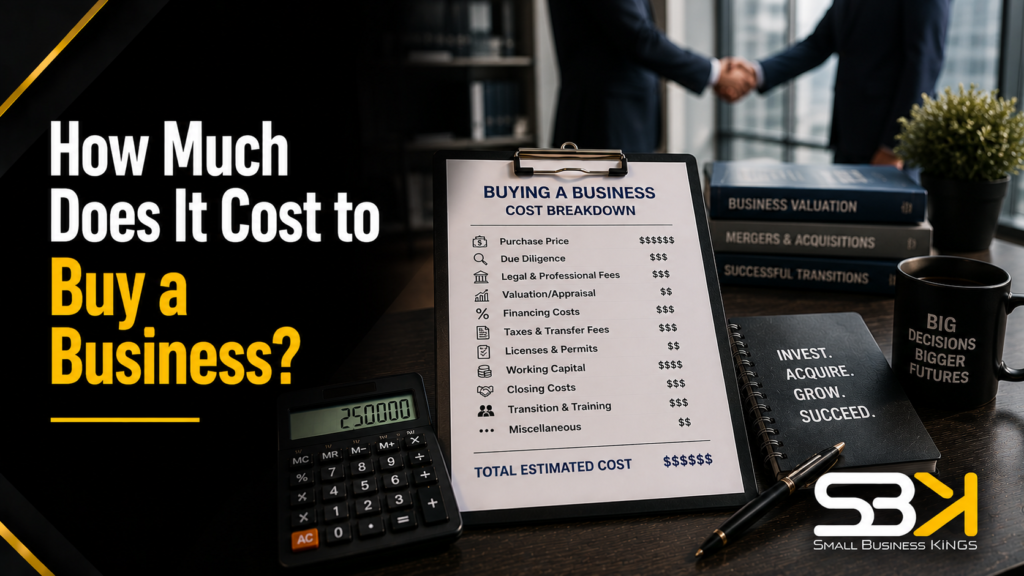
How Much Does It Cost to Buy a Business?
Buying an existing business typically costs anywhere from under $50,000 for a small local operation to several million dollars for a company with strong recurring revenue — and the price is almost never just “the purchase price.” Most small businesses sell for a multiple of their earnings, and buyers need cash beyond the down payment to actually run the business after closing. Here’s how the math really works.
How Businesses Are Actually Priced
Before you can figure out how much cash you’ll need, you need to understand how sellers and brokers arrive at an asking price in the first place. Most small businesses aren’t valued off revenue — they’re valued off profit, using a multiple.
Seller's Discretionary Earnings (SDE) Multiple
For businesses run day-to-day by an owner — a salon, a landscaping company, a local retail shop — the standard method is an SDE multiple. SDE takes the business’s net profit and adds back the owner’s salary, personal perks run through the business, and one-time or non-cash expenses. That number represents the total financial benefit to an owner-operator.
Main Street businesses commonly sell in the range of roughly 2 to 4 times SDE, though the exact multiple depends heavily on industry, growth trend, customer concentration, and how “owner-dependent” the business is. A business that runs fine without the current owner in the building every day will typically command a higher multiple than one that collapses the moment they leave.
EBITDA Multiple
Once a business has a management team in place and revenue climbs past roughly $1 million, buyers and brokers usually shift to an EBITDA multiple (earnings before interest, taxes, depreciation, and amortization). These deals often sell in the 3x–7x+ EBITDA range, with the multiple climbing for businesses with recurring revenue, diversified customers, and less reliance on any single person.
Launch Your Business On Fast VPS Hosting
Secure, high-performance hosting designed for growth. Don't lose sales to slow site speed.
Asset-Based Valuation
For asset-heavy businesses — trucking fleets, equipment-based operations, or businesses that are declining or barely profitable — price is sometimes set closer to the fair market value of the equipment, inventory, and real estate rather than a multiple of earnings. This is also common when a business has little to no profit to base a multiple on.
Why this matters for your budget: two businesses with identical revenue can have wildly different price tags depending on profitability, industry, and how the business is valued. Before you attach a dollar figure to “how much I need,” get a realistic sense of which valuation method applies to the type of business you’re considering.
Typical Price Ranges by Business Size
| Business Tier | Typical Price Range | Common Valuation Method | Example Businesses |
|---|---|---|---|
| Micro-business | Under $100,000 | Asset-based or low SDE multiple | Small service routes, simple e-commerce stores, one-person operations |
| Main Street business | $100,000 – $1,000,000 | SDE multiple (roughly 2x–4x) | Coffee shops, salons, auto repair shops, local retail |
| Lower middle market | $1,000,000 – $5,000,000+ | EBITDA multiple (roughly 3x–7x+) | Manufacturing, distribution, established SaaS |
| Franchise resale | Varies widely by brand | Set by franchisor agreements + earnings | Existing franchise locations changing hands |
These ranges are general and shift with market conditions, industry demand, and geography. For a data point grounded in real transactions, BizBuySell’s quarterly Insight Report tracks median sale and asking prices across thousands of closed small business deals nationally [Source: BizBuySell, Insight Report].
What Determines the Down Payment You'll Actually Need
The purchase price is the headline number, but the down payment is what determines whether you can actually do the deal. This depends almost entirely on how you finance it.
- SBA 7(a) loans: The SBA sets a minimum required equity injection, generally around 10% of the total project cost, though many lenders ask for more depending on the buyer’s experience and the business’s risk profile [Source: U.S. Small Business Administration, SBA 7(a) Loan Program]. This is the most common financing path for owner-operator acquisitions.
- Conventional bank loans: Typically require a higher down payment than SBA loans and stricter collateral and credit requirements, since there’s no government guarantee backing the lender.
- Seller financing: The seller finances part of the purchase price directly, often anywhere from a modest slice up to half the deal, with the buyer repaying over time with interest. This can lower — but rarely eliminates — the cash you need upfront, since sellers still want to see meaningful buyer commitment.
- ROBS (Rollovers as Business Startups): Lets buyers use retirement funds like a 401(k) to fund a portion of an acquisition without early-withdrawal penalties, through a specific IRS-compliant structure. This isn’t simple DIY — it requires a qualified plan and ongoing compliance, and mistakes can trigger tax consequences [Source: Internal Revenue Service, Rollovers as Business Startups Compliance Project].
- HELOC (Home Equity Line of Credit): Some buyers open a HELOC on their home before buying, not as the SBA down payment itself, but as a standby reserve for working capital or unexpected costs after closing.
Down payment and financing requirements vary by lender, deal size, and buyer qualifications. Always confirm current terms directly with your lender or the SBA rather than relying on general guidelines.
Free Business Blueprint
Steal the roadmap smart entrepreneurs use to launch, grow, and scale their businesses while avoiding expensive mistakes.
Beyond the Down Payment: The Cash You're Not Budgeting For
This is where most first-time buyers underestimate what they need. The purchase price and down payment get all the attention, but three other categories of cash matter just as much.
Closing and Due Diligence Costs
Before you own anything, you’ll pay for the work of confirming the business is what the seller says it is: accountants to review financials, an attorney to draft or review the purchase agreement, and possibly a valuation specialist. Add lender fees and closing costs on top. These fees vary by deal complexity and location — get quotes from your own advisors rather than budgeting off a number you saw online.
Working Capital
Working capital is the cash needed to run the business day-to-day after you own it — payroll, inventory, rent — before new revenue under your ownership fully replaces what the previous owner was generating. It’s typically calculated as current assets (cash, receivables, inventory) minus current liabilities (payables, short-term debt). This is frequently negotiated directly into the purchase agreement, and skipping this conversation is one of the most common reasons new owners run into a cash crunch in month two or three.
Post-Closing Reserves
Even a smooth transition rarely goes perfectly. A key employee may leave. A major customer may want to “wait and see” with the new owner before recommitting. Equipment that was “recently serviced” needs attention sooner than expected. Buyers who go in with zero cushion beyond the purchase price are the ones who end up panicking three weeks after closing.
A Real Example: Buying a $400,000 Main Street Business
Numbers land differently as a worked example than as abstract percentages. Say you’re buying a profitable local business — a service business generating solid SDE — priced at $400,000, financed with an SBA 7(a) loan.
- Down payment (roughly 10%): around $40,000 in cash equity you contribute directly.
- Due diligence and legal fees: a separate cash outlay for your CPA and attorney, paid regardless of whether the deal closes.
- Working capital: cash reserved to cover payroll, inventory, and operating costs before the business’s revenue is fully “yours” — this is often negotiated as part of the deal itself rather than paid entirely out of pocket.
- Post-closing reserve: a cushion separate from the business’s own cash, ideally enough to cover a slow stretch without panicking.
Add those together, and the realistic cash a buyer needs on hand for a $400,000 acquisition is meaningfully higher than the $40,000 down payment alone — often closer to $60,000–$90,000 in total accessible cash once due diligence, working capital, and a reserve are factored in. The exact figure depends entirely on the specific deal, lender, and how working capital is negotiated — but the principle holds at every price point: budget for the whole transaction, not just the down payment.
Financing Options Compared
| Financing Option | Typical Buyer Equity Needed | Best For | Key Tradeoff |
|---|---|---|---|
| SBA 7(a) loan | Generally around 10%+ | First-time owner-operators | Longer approval process, documentation-heavy |
| Conventional bank loan | Higher than SBA, varies by lender | Buyers with strong existing assets/credit | Stricter qualification, shorter terms |
| Seller financing | Varies; often paired with other financing | Deals where seller wants continuity | Seller usually wants a real down payment too |
| ROBS (401k rollover) | Depends on retirement balance | Buyers with substantial retirement savings | Compliance complexity, IRS rules apply |
| HELOC | N/A (used as reserve, not down payment) | Homeowners wanting a cash cushion | Not usable as SBA equity injection itself |
Three Questions to Ask Before You Commit Cash
Before you get attached to a specific listing, be honest with yourself about these:
- Could you cover six months of the business’s operating costs if revenue dipped? Cash flow commonly softens during ownership transitions, even in healthy deals.
- Do you have cash set aside that’s separate from your down payment and closing costs? If your entire liquid net worth goes into closing, you have no cushion for the ordinary bumps of month two.
- Have you confirmed your actual financing terms with a lender, not just a general guideline? Down payment requirements, rates, and qualification standards shift, and they vary by lender and deal — verify current numbers before you build a budget around them.
Setting Up the Business for Success After You Buy It
Once the deal closes, the operational side of ownership starts immediately — and this is where a lot of buyers get caught flat-footed. If you’re taking over a business whose website is outdated, whose branding hasn’t been touched in years, or that has no real system for tracking leads and customers, fixing that early prevents you from losing momentum with the customer base you just paid for. SBK works with Softangles for exactly this: they handle business website design and hosting, logo and brand/media design, and setting up a CRM and sales pipeline so you’re not scrambling to organize customer relationships and online presence in your first few months of ownership.
Frequently Asked Questions
How much money do I need upfront to buy a small business?
For a typical Main Street business financed with an SBA loan, expect a down payment in the range of 10% or more of the purchase price, plus separate cash for due diligence, closing costs, and working capital. Total cash needed is usually meaningfully higher than the down payment alone.
Can you buy a business with no money down?
It’s uncommon and risky for a traditional deal, though some combination of seller financing and other structures can reduce upfront cash. Most lenders and sellers want to see a real equity contribution from the buyer as a sign of commitment and reduced risk.
What’s the difference between SDE and EBITDA when valuing a business?
SDE adds back the owner’s salary and personal expenses and is used for smaller, owner-operated businesses. EBITDA doesn’t add back owner compensation and is used for larger businesses run by a management team rather than a hands-on owner.
Is working capital included in the purchase price?
Not automatically — it’s often negotiated separately and can significantly affect the total cash a buyer needs at closing. Clarify working capital terms in the letter of intent before you get deep into due diligence.
How much does due diligence cost when buying a business?
Costs vary widely based on deal size and complexity, since they depend on your CPA, attorney, and any specialists you bring in. Get direct quotes from your own advisors rather than budgeting off a generic figure, since this varies deal to deal.
Launch Your Business On Fast VPS Hosting
Secure, high-performance hosting designed for growth. Don't lose sales to slow site speed.
Do I need perfect credit to get an SBA loan to buy a business?
Lenders generally look for a solid credit history and financial track record, but requirements vary by lender and loan program. Check current SBA 7(a) requirements directly with a participating lender, since criteria can change.