

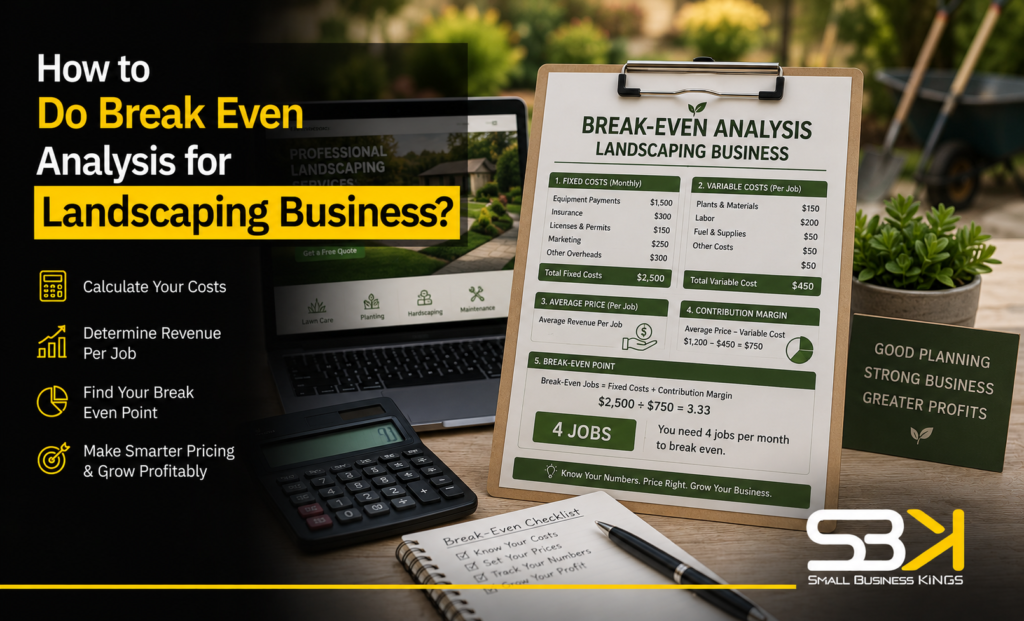
How to Do a Break-Even Analysis for a Landscaping Business?
A break-even analysis for a landscaping business tells you exactly how much revenue — or how many jobs — you need each month to cover your costs before any of it counts as profit. You calculate it by dividing your total fixed costs by your contribution margin (your price per job minus the variable cost of doing that job). Everything past that number is profit; everything short of it is a loss.
Most landscapers price jobs based on gut feel or what competitors charge nearby. Break-even analysis replaces that guesswork with an actual number — the minimum you need to hit before you’re covering rent, insurance, loan payments, and payroll, let alone paying yourself.
Why This Matters More in Landscaping Than in Most Small Businesses?
Landscaping has a cost structure that makes break-even analysis unusually useful compared to, say, a retail shop with steady year-round demand:
- Revenue is seasonal, but many fixed costs — equipment loans, insurance, a shop lease — run every month regardless of whether you’re mowing in July or sitting idle in January.
- Crews and equipment sit at variable cost until they’re deployed, so your break-even point shifts meaningfully with headcount and fleet size.
- Pricing models mix within the same business — flat-rate mowing, hourly maintenance contracts, project-based design/build — which means a single “price per unit” doesn’t always capture your real break-even math.
Because of this, a break-even number calculated once in the spring and never revisited is close to useless. Treat it as something you recalculate whenever a major cost or price changes.
Step 1: Separate Fixed Costs From Variable Costs
This is the foundation of the whole calculation, and getting a cost miscategorized here throws off everything downstream.
Launch Your Business On Fast VPS Hosting
Secure, high-performance hosting designed for growth. Don't lose sales to slow site speed.
Fixed costs don’t change based on how many jobs you run in a given month. For a landscaping business, these typically include:
- Truck, trailer, and equipment loan or lease payments
- Business insurance and workers’ compensation premiums
- Shop, yard, or storage rental
- Software subscriptions (routing, invoicing, CRM)
- Salaried staff pay (as opposed to hourly crew wages tied to jobs)
Variable costs rise and fall directly with the volume of work you do:
- Hourly crew wages for jobs actually worked
- Fuel and vehicle wear tied to routes run
- Materials — mulch, sod, plants, fertilizer, pavers
- Equipment maintenance driven by usage
- Dump and disposal fees per job
A quick test: if you did zero jobs next month, would you still owe this cost? If yes, it’s fixed. If it disappears along with the work, it’s variable. Costs like fuel or insurance vary by provider, location, and business size, so don’t rely on generic published ranges — pull your own numbers from your last 3–6 months of bank and card statements for an accurate baseline.
Step 2: Calculate Your Contribution Margin
Your contribution margin is what’s left from a job’s revenue after covering that job’s variable costs — the amount actually available to pay down your fixed costs and, eventually, generate profit.
Contribution margin = Price per job − Variable cost per job
Say you charge $500 for a maintenance visit, and the direct crew labor, fuel, and materials for that visit run $200. Your contribution margin on that job is $300, or a 60% contribution margin ratio ($300 ÷ $500).
This ratio matters because it lets you calculate break-even in dollars rather than just job count — useful once you’re running multiple service lines at different price points, where “number of jobs” stops being a meaningful single unit.
Free Business Blueprint
Steal the roadmap smart entrepreneurs use to launch, grow, and scale their businesses while avoiding expensive mistakes.
Step 3: Apply the Break-Even Formula
There are two versions of the formula, depending on whether your pricing is uniform (like flat-rate mowing) or mixed (multiple service types at different prices).
Break-even in units (jobs):
Break-even point = Total fixed costs ÷ (Price per job − Variable cost per job)
Break-even in dollars (revenue target):
Break-even revenue = Total fixed costs ÷ Contribution margin ratio
Use the units version when most of your revenue comes from one standardized service at one price. Use the dollars version when your business blends mowing, installs, and contract maintenance at different rates — it gives you one clean revenue target instead of trying to average incompatible job types.
Worked Example: A Small Maintenance-Focused Landscaping Business
Here’s a full walkthrough using illustrative numbers — plug in your own figures to get a real answer for your business.
Business profile: A two-crew residential maintenance company, “Ridgeline Lawn & Garden,” operating out of a rented storage yard.
Monthly fixed costs:
Fixed Cost Illustrative Monthly Amount Equipment and truck loan payments $1,800 Insurance and workers’ comp $900 Yard rental $600 Software subscriptions $150 Owner/admin salary draw $2,500 Total fixed costs $5,950 Per-job figures:
- Average price per maintenance visit: $85
- Variable cost per visit (crew labor, fuel, materials): $40
- Contribution margin per visit: $45
- Contribution margin ratio: 53% ($45 ÷ $85)
Break-even in units:
$5,950 ÷ $45 = 132 visits per monthBreak-even in dollars:
$5,950 ÷ 0.53 = $11,226 in monthly revenueBoth numbers describe the same break-even point from two angles: Ridgeline needs roughly 132 visits, or about $11,226 in monthly revenue, before any of it becomes profit. If Ridgeline’s owner wants a specific profit target on top of that — say, $3,000 a month for reinvestment — that target simply gets added to fixed costs before dividing: ($5,950 + $3,000) ÷ 0.53 = about $16,887 in required monthly revenue.
What If You Run Multiple Service Lines?
This is where a lot of landscaping-specific guidance stops short, because most landscaping businesses don’t sell one uniform product — they mix mowing, seasonal cleanups, and design/build projects, often at very different margins.
The cleanest approach is a weighted contribution margin: calculate the contribution margin ratio for each service line separately, then weight it by the share of total revenue each line represents.
For example, if mowing (55% contribution margin) makes up 70% of Ridgeline’s revenue, and design/build projects (35% contribution margin) make up the remaining 30%:
Weighted contribution margin ratio = (0.70 × 55%) + (0.30 × 35%) = 38.5% + 10.5% = 49%
Use this blended ratio in the break-even-in-dollars formula instead of a single service’s margin. It’s more work upfront, but it prevents the common mistake of using your highest-margin service’s numbers to estimate a break-even point the whole business isn’t actually hitting.
Accounting for Seasonality
A monthly break-even number is only half the picture if your revenue is concentrated in six or seven months of the year, which is normal for most landscaping businesses outside warm climates.
To plan realistically:
- Calculate your annual fixed costs (multiply monthly fixed costs by 12, or use your actual annual totals if they vary by season).
- Estimate what share of your total annual revenue you realistically generate in each month based on last year’s actuals.
- Divide annual fixed costs by your contribution margin ratio to get an annual break-even revenue target.
- Map that annual target against your monthly revenue distribution to see which months need to carry the heaviest load to cover slow-season costs.
This matters because a business can be “above break-even” in July and still be in serious trouble if its peak months don’t generate enough surplus to cover fixed costs through a slow December and January. If off-season fixed costs are a persistent strain, some landscaping businesses add a snow removal or holiday lighting service specifically to smooth out year-round cash flow rather than carrying fixed costs through months with zero revenue.
Margin of Safety: What Happens After You Break Even
Once you know your break-even point, the next useful number is your margin of safety — the gap between your actual (or projected) sales and your break-even point. It tells you how much revenue could drop before you’re back to losing money.
Margin of safety = Actual or projected revenue − Break-even revenue
If Ridgeline is projecting $15,000 in monthly revenue against an $11,226 break-even point, their margin of safety is $3,774 — meaning revenue could fall by roughly that much before the business stops being profitable. This number is especially useful before taking on a new fixed cost, like hiring a salaried supervisor or leasing a second truck, since it shows how much cushion you’re giving up.
Comparing Break-Even Scenarios
Small changes to price or cost structure shift your break-even point more than most owners expect. Here’s how adjusting one variable at a time affects Ridgeline’s numbers from the earlier example:
Scenario Price per Visit Variable Cost per Visit Fixed Costs Break-Even Point Baseline $85 $40 $5,950 132 visits / $11,226 Raise price by $10 $95 $40 $5,950 108 visits / $11,226 Add a $600/mo lease (new mower) $85 $40 $6,550 146 visits / $12,358 Cut variable cost by $5/visit (route efficiency) $85 $35 $5,950 119 visits / $11,226 Notice that raising price and cutting variable cost both reduce the number of jobs needed, but only price changes shift break-even revenue in dollars — cutting variable costs improves your margin per job without necessarily lowering the total revenue target. This is exactly the kind of comparison worth running before committing to a price increase, a new lease, or a route optimization push.
Turning the Analysis Into a Pricing Decision
Break-even analysis is most useful when you flip it around: instead of asking “will I break even at this price,” ask “what price do I need to charge to hit a specific job volume or profit target.” If you know you can realistically service 100 maintenance visits a month with your current crew, you can solve for the minimum price:
Required price = (Fixed costs ÷ target job volume) + variable cost per job
For Ridgeline at 100 visits: ($5,950 ÷ 100) + $40 = $99.50 per visit just to break even at that volume — a useful reality check if the business has been pricing visits well below that.
Getting Your Numbers Organized
The calculation itself takes minutes once you have accurate fixed and variable cost figures — the harder part is usually getting clean numbers out of scattered invoices, bank statements, and job notes. A basic spreadsheet works for a solo operator, but once you’re running multiple crews or service lines, job-costing or CRM software that tracks actual labor, material, and fuel costs per job will give you a far more accurate break-even calculation than manual estimates.
The same applies to the business side beyond the numbers: once you’ve got your cost structure figured out, a professional website and a real CRM to track leads, quotes, and recurring maintenance contracts pays off quickly — most landscaping businesses lose more margin to disorganized follow-up and missed rebooking than to any single cost line item. SBK works with Softangles for exactly this: they handle business website design, hosting, logo and brand design, and CRM/sales pipeline setup, which covers the operational side that break-even math alone won’t fix.
Common Mistakes That Cause Problems Later
- elying on a verbal agreement. Even between friends or family, put the dissolution terms in writing.
- Skipping the buyout valuation discussion. Assuming a 50/50 split is “obviously fair” often isn’t, especially when partners contributed unevenly in time, capital, or clients.
- Forgetting to close joint accounts. An open joint account or credit line after dissolution can create ongoing liability for both partners.
- Not confirming state filing requirements. Assuming your state doesn’t require a filing, when your entity type actually does, can leave the business technically “active” for years.
- Ignoring contract notice periods. Missing a required notice window on a lease or vendor contract can trigger penalties or continued obligations.
Frequently Asked Questions
How often should I redo my break-even analysis?
Recalculate whenever a major fixed cost changes — a new lease, loan, or hire — or at least once per season, since fuel, material, and labor costs shift enough over a year to move your break-even point meaningfully.
What’s the difference between break-even point and profit margin?
Break-even point is the specific sales level where revenue equals total costs with zero profit or loss; profit margin measures how much profit you’re making as a percentage of revenue once you’re past that point. You need to know your break-even point before profit margin becomes a meaningful number to track.
Can a landscaping business have different break-even points for different services?
Yes, and for businesses running multiple service lines, calculating break-even per service (or using a weighted average across services) is more accurate than a single blended number, since mowing, installs, and design/build work typically carry very different margins.
Does break-even analysis account for taxes?
No — the standard break-even formula uses pre-tax fixed and variable costs and doesn’t factor in income tax, so your actual after-tax profit threshold sits somewhat above the calculated break-even point. Talk to an accountant if you want a break-even figure that accounts for your specific tax situation.
What if my break-even point seems impossibly high?
That’s usually a sign your fixed costs are too high relative to your job volume and pricing, your prices are too low, or both — work through the price-adjustment and cost-cutting scenarios (like the comparison table above) to see which lever moves the number most before assuming the business model itself is broken.
Launch Your Business On Fast VPS Hosting
Secure, high-performance hosting designed for growth. Don't lose sales to slow site speed.
Is a lower break-even point always better?
Generally yes, since it means less revenue is needed before you’re profitable, but a very low break-even point sometimes reflects under-investment in equipment or staff that’s actually limiting how much revenue you can generate — the goal is a break-even point your realistic sales volume can comfortably clear, not the lowest number possible.