
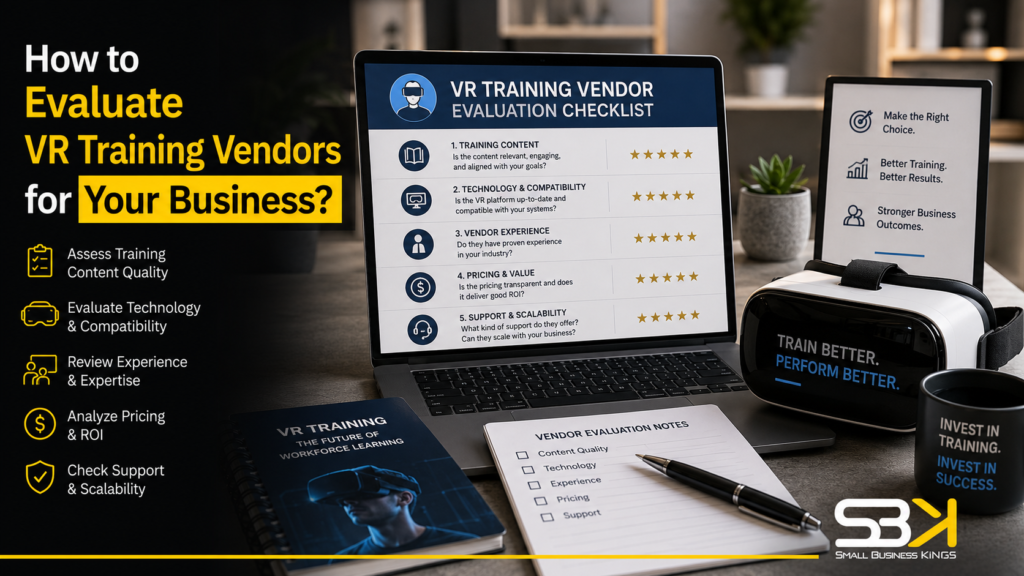
How to Evaluate VR Training Vendors for Your Business?
Evaluating a VR training vendor means judging them on evidence rather than demo polish: verified deployments in your industry or a comparable use case, measurable learning outcomes (not just engagement scores), hardware and LMS compatibility, transparent pricing, and a willingness to run a paid pilot with agreed-upon success metrics before you commit to a full rollout. Vendors who can’t produce these things aren’t ready for your budget yet, no matter how impressive their headset demo looks.
The VR training market right now mixes serious studios with agencies that added “immersive learning” to their homepage last year. Both can produce an equally polished five-minute demo. The difference only shows up once you ask about deployed outcomes, data handling, and what happens eighteen months from now when your procedures change — which is exactly where this guide focuses
Why VR Training Evaluation Is Harder Than It Looks?
Most software evaluations rely on trials, reviews, and reference architecture you can compare directly. VR training resists this in a few specific ways:
- The demo is not the product. A polished five-minute showcase module tells you almost nothing about whether the vendor can build and maintain a 40-module onboarding program for your actual workforce.
- Learning outcomes are hard to fake convincingly, but easy to obscure. “Engagement” and “completion rate” metrics look good in a sales deck without proving anyone learned anything.
- Hardware and standards shift fast. A vendor tied to one headset manufacturer or a proprietary player format can leave you stuck when that device line gets discontinued.
- The category spans wildly different use cases — safety and compliance simulation, hands-on procedural training, soft-skills role-play, onboarding — and a vendor strong in one isn’t automatically strong in another.
Because of this, treat vendor evaluation as a structured process with defined checkpoints, not a series of sales calls that ends when you run out of questions.
What to Look for in a VR Training Vendor
Relevant Industry Experience
Ask for work built in a setting like yours, or at minimum a comparably complex one — a regulated, safety-critical, or multi-step procedural environment, not just “have you done VR training before.” Two shipped deployments in your actual sector or a closely adjacent one carry more weight than twenty polished demos across ten unrelated industries. If nobody’s built for your exact vertical, look for evidence they’ve handled comparable complexity: compliance requirements, multi-step workflows, or high-stakes procedures.
Launch Your Business On Fast VPS Hosting
Secure, high-performance hosting designed for growth. Don't lose sales to slow site speed.
Off-the-Shelf vs. Custom Content
Decide early which category you actually need, because it changes everything downstream — pricing, timeline, and which vendors are even a fit.
| Off-the-Shelf Content | Custom-Built Content | |
|---|---|---|
| Best for | Generic soft-skills, general safety awareness, common compliance topics | Site-specific procedures, proprietary equipment, unique workflows |
| Time to launch | Fastest — often available immediately or with light customization | Slower — requires discovery, scripting, and asset production |
| Cost pattern | Lower upfront, often licensed per seat or per module | Higher upfront investment, but tailored to your exact processes |
| Update flexibility | Limited — you’re relying on the vendor’s release schedule | High if the vendor architects for easy updates; ask specifically |
| Risk | May not reflect your actual equipment or procedures closely enough to transfer to real performance | Vendor quality varies widely; harder to evaluate before building |
Many businesses start with off-the-shelf modules for general topics (workplace safety basics, harassment prevention, customer service scenarios) and move to custom content once they’ve identified a specific, high-value procedural or compliance need that justifies the build cost.
Hardware Compatibility and Platform Risk
Headset product lines change faster than training content should. Ask whether the vendor builds on portable, standards-based foundations (OpenXR, WebXR, or a widely supported engine) versus locking content into a proprietary player tied to one manufacturer’s hardware. If your preferred vendor can’t clearly explain what it costs to port existing content to a new headset, that’s a real constraint on your future flexibility — not a hypothetical one, given how quickly enterprise headset lines have shifted in recent years.
Free Business Blueprint
Steal the roadmap smart entrepreneurs use to launch, grow, and scale their businesses while avoiding expensive mistakes.
Measurable Learning Outcomes, Not Just Engagement
This is where weaker vendors get exposed fastest. “Learners loved it” is a satisfaction metric. A vendor building real training programs designs for assessment from the start — scored task completion, error tracking, time-on-task, and decision-point analytics that an L&D team or compliance auditor can actually use. Ask to see an anonymized analytics dashboard from a shipped project, not a mockup. If assessment feels like an afterthought bolted onto an otherwise polished experience, you’re buying entertainment with a training label on it.
LMS Integration and Data Portability
If completion and performance data can’t flow into your existing learning management system, someone on your team ends up manually tracking VR training completions in a spreadsheet — which defeats a lot of the point for compliance-driven training. Ask specifically about SCORM and xAPI (Tin Can) support, which LMS platforms the vendor has actually shipped integrations with (not “can integrate with” — ask for a named, working example), and what single sign-on looks like for a learner walking up to a headset. Standards-based reporting also protects you if you ever switch vendors, since your training data stays portable rather than locked in a proprietary format.
Pricing Transparency
Vendors willing to share pricing — even as ranges or tiers — are telling you they’ve scoped enough similar projects to standardize. Vendors who insist on multiple discovery calls before any number appears may still be legitimate, but you lose your best negotiating anchor and your ability to budget accurately early on. At minimum, ask for a line-item breakdown: content build, art/asset production, hardware, deployment, LMS integration, and ongoing support priced separately, so you can see exactly what you’re paying for.
Data Security and Privacy
VR training content often encodes sensitive operational detail — facility layouts, equipment configurations, emergency procedures — and headsets are networked devices, frequently with cameras and microphones. Ask directly where learner data and training content are hosted, how data is encrypted in transit and at rest, whether the vendor supports your organization’s device management and single sign-on requirements, and — increasingly relevant as vendors add AI features — whether any learner data or content flows to third-party AI services. A vendor who can’t give you a straight answer here is a bigger risk than one with a smaller portfolio.
Support and Ongoing Maintenance
Training programs tend to fail operationally more than technically: an unmanaged headset fleet, an unresolved bug, or a version mismatch across locations. Get support terms in writing before you sign anything — response times by severity, what’s covered post-launch and for how long, who’s responsible for device management, and exactly what ongoing support costs once any included period ends.
Questions Worth Asking Every Vendor
- Can we talk to a client whose deployment is at least a year old, and ideally one who eventually left?
- Who owns the source files, 3D assets, and learner data once the engagement ends?
- What happens to our content if the headset line we deploy on gets discontinued?
- How do you measure whether learners can actually perform the task afterward, not just whether they completed the module?
- What does a routine content update cost eighteen months from now, and how fast can you turn one around?
- What learner or content data does the application collect, where does it live, and does any of it reach third-party or AI services?
- Which LMS platforms have you actually shipped integrations to, and can we see the reporting?
If a vendor answers most of these confidently and specifically, you’re likely dealing with a real training partner. If answers get vague or redirect to “let’s set up another call,” treat that as data too.
Turning the Analysis Into a Pricing Decision
Break-even analysis is most useful when you flip it around: instead of asking “will I break even at this price,” ask “what price do I need to charge to hit a specific job volume or profit target.” If you know you can realistically service 100 maintenance visits a month with your current crew, you can solve for the minimum price:
Required price = (Fixed costs ÷ target job volume) + variable cost per job
For Ridgeline at 100 visits: ($5,950 ÷ 100) + $40 = $99.50 per visit just to break even at that volume — a useful reality check if the business has been pricing visits well below that.
Red Flags to Watch For
- All demos, no deployments — a portfolio of trade-show pieces or proof-of-concepts with no evidence any client actually rolled the training out to real learners
- No pricing signals at all, even after a real scoping conversation
- Proprietary lock-in — content that only runs in the vendor’s own player, with no source access, asset escrow, or export path for your data
- Engagement metrics standing in for learning metrics — session counts and satisfaction scores where assessment results should be
- Guaranteed ROI before any discovery — specific return numbers promised before the vendor has seen your operations, staffing, or training cadence
- Reluctance to run a small pilot, framed as “the value only shows up at full scale” — that’s a reason to start small, not a reason to skip it
- A senior sales team paired with an unnamed delivery team — ask specifically who will actually build your project
Running a Pilot Before You Commit
The single most effective way to de-risk a VR training decision is a paid pilot: one focused module, deployed to a real group of learners at one location, with success metrics agreed on before work starts — completion rate, assessment scores, and qualitative learner feedback at minimum. A vendor confident in their delivery will structure this without friction and often credit some or all of the pilot cost toward a larger rollout if you move forward.
Be skeptical of “free pilots,” which are usually sales demos in different packaging, and of any pilot that launches without defined success metrics — without them, you have no real basis for a go/no-go decision afterward. For a small or first-time buyer, a pilot in the range of a few dozen learners at one site is typically enough to validate both the content quality and the vendor’s actual delivery process before scaling further.
How to Score and Compare Vendors Side by Side
Once you’ve narrowed your list to two or three vendors, score each one against the same weighted criteria rather than relying on gut impressions after separate sales calls, which tend to favor whoever presented most recently or most confidently. A simple approach:
- List the criteria that matter most for your use case (industry fit, analytics depth, LMS integration, pricing transparency, hardware flexibility, support terms)
- Weight each criterion by importance to your business — compliance-heavy industries should weight analytics and data security higher; onboarding-focused programs might weight time-to-launch higher
- Score each vendor 1–5 on each criterion based on evidence gathered from references, demos, and their answers to your questions
- Multiply scores by weights and total them for a comparable, evidence-based number per vendor
This turns a set of subjective impressions into something you can actually defend to whoever’s approving the budget — and it surfaces disagreements on the buying team earlier, when they’re cheap to resolve, rather than after a contract’s already signed.
Getting Internal Buy-In
Vendor evaluation doesn’t happen in a vacuum — you’ll typically need sign-off from L&D or operations, IT or security, and finance, and each group cares about a different part of this guide. IT wants the data security and LMS integration answers. Finance wants the pricing breakdown and total cost over time, not just the pilot number. Operations or L&D wants the analytics and outcome evidence. Bring the vendor’s answers to your specific questions into that conversation rather than a generic pitch deck, since it’s far more persuasive to show “here’s exactly what they said when we asked about data handling” than to summarize a sales call secondhand.
If you’re running conversations with multiple vendors at once — which you should be — treat it like any other structured sales process: track proposals, call notes, and follow-ups in one place instead of scattered across email threads and calendar invites, or details from vendor A and vendor B start blending together right when you need to compare them clearly. SBK works with Softangles for setting up exactly this kind of CRM and sales-pipeline structure for small businesses, alongside their website design and hosting work — useful well beyond a single vendor search, but a good example of the kind of organized system that makes a multi-vendor evaluation like this one manageable instead of chaotic.
Engagement Models: Fixed-Price, Retainer, or In-House
How you structure the engagement matters as much as which vendor you pick.
Factor Fixed-Price Project Retainer / Ongoing Partner In-House Build Upfront cost Defined and capped before work starts Lower monthly cost, but commits budget long-term Highest — salaries and tooling before content ships Time to first module Fast, if scope is well-defined Fast after initial ramp-up Slow — expect months of hiring first Ongoing cost Quoted per change or project as needed Predictable monthly spend Continuous payroll regardless of output Flexibility Scope changes mid-project typically cost extra High — priorities can shift between work cycles Full control, including over mistakes Best fit A first module, a pilot, or a narrowly defined need A multi-module roadmap that updates often Large organizations making VR a permanent function Many businesses sequence these deliberately: a fixed-price pilot to validate the vendor and format, a retainer once a real content roadmap exists, and in-house capability only if VR training becomes a permanent, high-volume part of the operation — not the starting point.
Frequently Asked Questions
How long should evaluating a VR training vendor take?
Plan for roughly four to eight weeks for a first project: about two weeks to shortlist several vendors and hold discovery calls, two weeks for detailed proposals and reference checks, and the remainder for pilot scoping. Rushing this process is how businesses end up with an impressive demo and no realistic path to a working deployment.
Should we buy VR headsets before choosing a vendor?
No — pick your vendor and content strategy first, then let that decision guide hardware. Headset product lines change quickly, and a hardware-agnostic vendor can recommend devices that actually fit your environment, IT requirements, and budget, rather than locking you into whatever you bought first.
What should a pilot program cost and include?
A meaningful pilot covers one focused training module deployed to a real group of learners, with success metrics — completion rate, assessment scores, learner feedback — agreed on before work begins. Costs vary significantly by scope and vendor, so get a specific quote rather than assuming a standard figure, and be cautious of any pilot offered without defined metrics attached.
Is a bigger, more established VR training studio automatically the safer choice?
Not necessarily. A larger studio buys process and capacity, but outcomes still depend on the specific team assigned to your project, their track record in your industry, and how rigorously they measure learning. A smaller specialist with real deployments in your sector and transparent pricing often outperforms a large generalist agency where XR is a side offering.
What’s the difference between off-the-shelf and custom VR training content?
Off-the-shelf content covers common, generalizable topics like basic safety awareness or soft skills and launches faster at lower upfront cost; custom content is built around your specific equipment, procedures, or compliance requirements and costs more upfront but transfers more directly to real job performance. Many businesses start with off-the-shelf modules and move to custom content once a specific high-value need is identified.
Launch Your Business On Fast VPS Hosting
Secure, high-performance hosting designed for growth. Don't lose sales to slow site speed.
How do we know if a vendor’s ROI claims are credible?
Ask for the underlying data behind any ROI or performance claim — the study, the sample size, and whether it reflects a business similar to yours — rather than accepting a headline statistic at face value, since training vendors sometimes cite figures loosely or without clear sourcing. A credible vendor will walk you through their assumptions and methodology rather than just repeating an impressive-sounding number.