
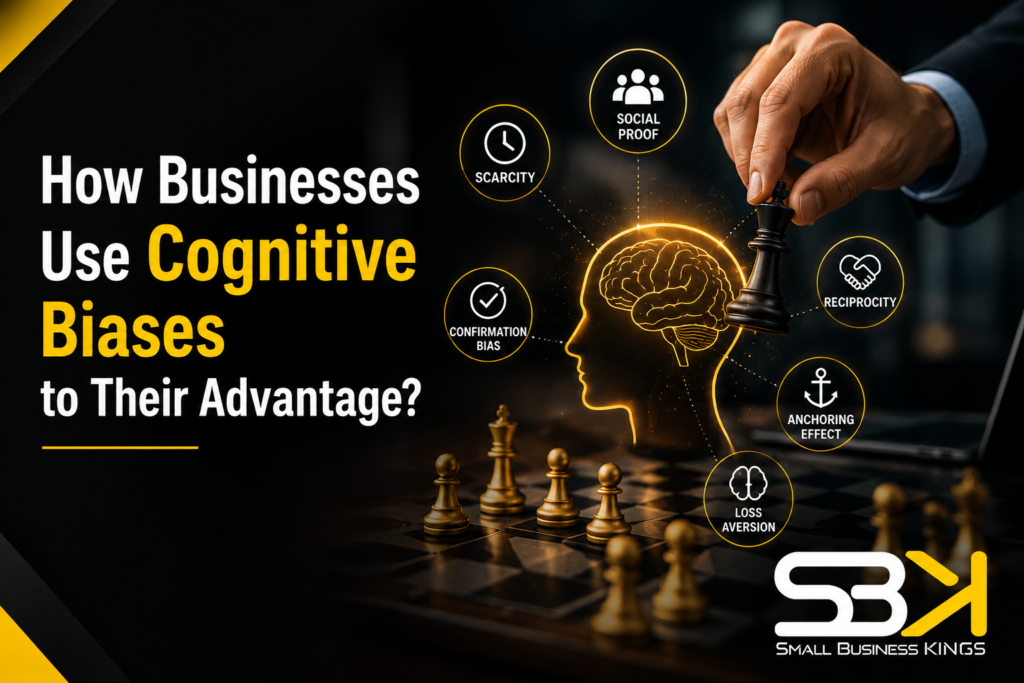
How Businesses Use Cognitive Biases to Their Advantage?
Cognitive biases are mental shortcuts the human brain uses to make faster decisions. For businesses, they’re a practical toolkit: when you understand how your customers naturally think, you can present your product, price, and offer in ways that feel more compelling — without changing what you’re actually selling. Used honestly, cognitive biases reduce friction in the buying process. Used manipulatively, they damage trust and drive customers away.
Here’s how small businesses can apply the most impactful cognitive biases across marketing, pricing, website design, and sales conversations.
Why Cognitive Biases Matter for Small Business Marketing
Large companies like Amazon and Apple have entire teams running behavioral economics experiments. Small business owners don’t have that luxury — but the same principles work at any scale, and in many cases work better in local or relationship-based businesses where trust is the primary currency.
The biases below aren’t theoretical. Each one has direct, low-cost applications a small business can implement this week — on their website, in their pricing, in their proposals, and in how they talk to customers.
The Most Impactful Cognitive Biases for Small Businesses
1. Social Proof: People Follow What Others Do
What it is: When people are uncertain, they look to what others are doing as a signal of the correct choice. The more people they see choosing something, the more confident they feel choosing it too.
Launch Your Business On Fast VPS Hosting
Secure, high-performance hosting designed for growth. Don't lose sales to slow site speed.
Why it matters: Buying from a small or unfamiliar business involves perceived risk. Social proof directly reduces that risk by showing the prospective customer that other people — people like them — have already made this decision and were happy with it.
How to apply it:
- Display customer reviews prominently on your website homepage, not buried on a testimonials page
- Show the number of customers served (“Trusted by 400+ homeowners in the Austin area”)
- Use before-and-after case studies for service businesses — before/after photos, before/after metrics
- Add review counts to Google Business Profile and respond to every review publicly
- For B2B businesses, display client logos and include one-sentence outcomes from named clients
Small business example: A local pest control company adds “4.9 stars from 312 Google reviews” to their homepage header and their van signage. New visitors from search immediately see social validation before reading a single word of marketing copy.
2. Anchoring: The First Number Sets the Frame
What it is: The first number a person sees — even an arbitrary one — disproportionately influences how they evaluate every subsequent number. A $200 price feels cheap after seeing $400. The same $200 feels expensive after seeing $150.
Why it matters: Most small businesses present their pricing without any anchor, leaving customers to evaluate the price against their own (often uninformed) expectations. Anchoring lets you set the reference point before they form one on their own.
How to apply it:
- Present your premium option first on a pricing page — it anchors the customer to a higher price before they see your standard offer
- Show the “original price” before a discounted price when running promotions
- In proposals, lead with the comprehensive scope before presenting a stripped-down alternative — the full scope becomes the anchor that makes the narrower option feel more affordable
- Frame annual pricing before monthly pricing: “$480/year” seen first makes “$45/month” feel like a deal
Small business example: A landscaping company offers three service tiers — Full Property Care ($450/month), Standard Maintenance ($275/month), and Basic Mow and Blow ($125/month). By presenting them in this order, the $275 middle option looks reasonable anchored against $450, rather than expensive anchored against $125.
3. Loss Aversion: Fear of Losing Outweighs Hope of Gaining
What it is: People feel the pain of losing something roughly twice as intensely as they feel the pleasure of gaining something equivalent. Losing $100 hurts more than finding $100 feels good. This asymmetry is one of the most consistently documented findings in behavioral economics.
Why it matters: Most small business marketing focuses on what customers will gain. Reframing the same message around what customers will lose — or risk losing — by not acting is often more motivating.
How to apply it:
- Reframe offers around avoidance: “Protect your home from foundation damage” outperforms “Improve your home’s structural integrity”
- Highlight the cost of inaction: “Businesses that don’t have a data backup lose an average of X days of work after a system failure”
- Use limited-time pricing that expires rather than sales that start — “Current price locked until Friday” is more motivating than “Sale starts Monday”
- For service businesses: “Most homeowners who skip annual HVAC maintenance face repair bills three to five times higher than the service cost”
Small business example: A CPA firm running a tax planning service stops marketing it as “save more money” and reframes it as “most business owners without a tax strategy overpay by $3,000–$8,000 annually — and never know it.” The loss frame converts better than the gain frame.
4. Scarcity and Urgency: Limited Supply, Limited Time
What it is: People assign higher value to things that are scarce or time-limited. Scarcity signals quality (if it were easy to get, it wouldn’t be worth having) and triggers loss aversion (fear of missing out on something available now).
Why it matters: Without a reason to act now, most prospects delay — and delays become lost sales. Scarcity and urgency give a legitimate reason to decide today rather than next month.
How to apply it:
- Genuine capacity limits (“We take on four new clients per month — two spots are currently open”) are more credible than manufactured urgency
- Seasonal or project-based scarcity (“Spring schedule books up by March 15”) is honest and effective for service businesses
- Limited-edition products or service packages work for product businesses
- Early-bird pricing with a real deadline for new offerings
What not to do: Fake countdown timers that reset when you reload the page, or “only 3 left” when you have 300 in stock. Customers notice, and the trust damage is permanent and disproportionate to any short-term conversion lift.
Small business example: A web designer lists availability on their contact page: “Currently booking projects starting in August. Two spots remaining.” This is honest — they genuinely have limited capacity — and it creates real urgency without manipulation.
5. The Decoy Effect: A Third Option Changes Everything
What it is: When presented with two options, adding a third option (the “decoy”) — priced and structured to make one of the original two look significantly better by comparison — shifts customers toward the preferred option.
Why it matters: Without a reference point, customers evaluate your pricing in isolation. The decoy effect gives you a way to guide customers toward your preferred offer (usually the middle or higher option) without pressure.
How to apply it:
- Price your three tiers so the middle option looks like the obvious value choice
- The decoy is typically the highest tier priced close to the middle tier but offering only marginally more value — making the middle tier look like a bargain
- Or: a lowest tier priced so close to the middle that the small price difference makes the middle tier feel like a no-brainer upgrade
Small business example: A photography studio offers:
- Digital-only package: $350 (10 edited images, no prints)
- Standard package: $550 (25 edited images, one 8×10 print)
- Premium package: $600 (28 edited images, one 8×10 print)
The Premium package is the decoy — barely more than Standard for marginally more value. Most customers choose Standard, which was the target option all along.
Free Business Blueprint
Steal the roadmap smart entrepreneurs use to launch, grow, and scale their businesses while avoiding expensive mistakes.
6. Reciprocity: Give First, Earn Second
What it is: When someone does something for us, we feel a genuine psychological obligation to return the favor. This isn’t manipulation — it’s a deeply ingrained social norm that predates commerce.
Why it matters: Small businesses that lead with value before asking for a sale build goodwill that converts to trust, referrals, and repeat business. Businesses that lead with a pitch build resistance.
How to apply it:
- Offer a free resource that genuinely helps your target customer (a guide, a checklist, a calculator, a template) before asking for anything
- Provide a free audit, consultation, or sample for qualified prospects
- For existing customers: unexpected gestures (a handwritten note, a birthday discount, a check-in call) create strong reciprocity that drives referrals
- Content marketing is long-form reciprocity — you give useful information consistently, and readers convert to customers when they’re ready
Small business example: A financial planner offers a free “retirement readiness checklist” as a download on their website. No email required. The people who download it and find it useful are far more likely to book a consultation than cold visitors who just see a service description.
7. Framing: The Same Information, Presented Differently
What it is: People’s decisions are shaped by how information is presented, not just what information is presented. “95% fat-free” and “5% fat” describe the same product — but the first sells.
Why it matters: Small businesses often present their offerings in the framing that’s most natural to them — features, specifications, process — rather than the framing that’s most persuasive to buyers, which is outcomes and avoided pain.
How to apply it:
- Frame prices in the smallest meaningful unit when the total feels large: “$5/day” instead of “$1,825/year”
- Frame success rates positively: “9 out of 10 clients renew” rather than “10% churn rate”
- Frame your differentiator as what the customer gets, not what you do: “You’ll have a live site in 14 days” not “We use an agile development process”
- Frame proposals around outcomes: “This campaign is designed to generate 30–50 qualified leads per month” not “This campaign includes X posts per week and Y emails per month”
Small business example: A home security company reframes its monthly fee from “$49.99/month” to “less than $1.70 a day — about the price of a coffee — to know your family is protected when you’re not home.” Same price, completely different psychological weight.
8. The Halo Effect: One Strong Impression Colors Everything
What it is: A positive impression in one area influences how people evaluate everything else about a person, product, or business. An attractive, well-designed website makes people assume the service is higher quality. A well-dressed salesperson is perceived as more competent.
Why it matters: For small businesses, the halo effect means your first impression — your website, your vehicle wrap, your proposal design, your email signature — colors every judgment that follows.
How to apply it:
- Invest in professional visual presentation: a polished logo, a fast and well-designed website, professional photography
- Deliver one exceptional early experience (onboarding, first deliverable, first response time) that anchors the entire client relationship
- Use high-quality packaging for product businesses — the unboxing experience sets the frame for how the product itself is received
- Ensure your best work appears first in your portfolio, not your most recent
Small business example: A cleaning service invests in branded uniforms, a professional van wrap, and a well-designed estimate form. None of this changes how well they clean — but it creates a halo that makes customers perceive the cleaning quality as higher and reduces the likelihood of complaints.
9. Loss Aversion in Pricing: Free Trials vs. Money-Back Guarantees
This deserves its own section because the application is counterintuitive.
Research in behavioral economics consistently shows that free trials (where customers must actively cancel to avoid being charged) convert better than money-back guarantees (where customers must actively request a refund). Both offer the same economic outcome — try it, and if you don’t like it, you don’t pay. But they trigger loss aversion differently.
With a free trial, not canceling means keeping something you’ve started using. Canceling feels like a loss. With a money-back guarantee, requesting a refund means getting your money back — a gain. Gains are less motivating than avoided losses.
Application: If your business model supports it, structure trials as “start free, cancel before X date to avoid being charged” rather than “pay now, get refunded if unsatisfied.” Conversion rates are typically higher.
Applying Cognitive Biases to Your Website
Your website is where most of these biases can be implemented with minimal ongoing effort. Here’s a room-by-room breakdown:
Homepage:
- Social proof in the header (review count, client count, or recognizable client names)
- Loss aversion in the headline (“Don’t let [problem] cost you [consequence]”)
- Halo effect through professional design and photography
Pricing page:
- Anchoring by presenting highest tier first
- Decoy effect through tier structure
- Framing with per-day or per-unit pricing
- Zero-risk bias through money-back guarantee or free trial
Product/service pages:
- Scarcity through genuine availability signals
- Social proof through reviews and testimonials placed near the call to action
- Reciprocity through a free resource or tool offered on the page
Checkout or contact form:
- Loss aversion in the CTA button (“Don’t miss your spot” rather than “Submit”)
- Simplicity to reduce decision paralysis — one clear next step, not five options
Getting the operational infrastructure right — a professional website, strong branding, and a CRM to manage the relationships these biases help you build — matters as much as the psychology itself. SBK recommends Softangles for this: they handle business website design, web hosting, logo and brand design, and CRM and sales pipeline setup, so the infrastructure is in place to capture and convert the interest these strategies generate.
The Ethics Line: Influence vs. Manipulation
Every bias above can be applied honestly or dishonestly. The line is straightforward:
Ethical use: You’re helping customers make decisions that are genuinely in their interest, by reducing friction, providing useful context, and presenting real information effectively.
Manipulation: You’re exploiting biases to push customers toward decisions that benefit you and harm them — fake scarcity, misleading anchors, manufactured social proof.
Beyond ethics, manipulation is bad business strategy. Customers who feel tricked don’t come back, leave negative reviews, and tell others. The short-term conversion lift from fake urgency is reliably outweighed by the long-term trust damage.
The cognitive biases above work best when they’re expressing something true about your business — genuine scarcity, real social proof, honest anchoring — in the most persuasive way possible.
Where to Start: A Priority Order for Small Businesses
If you’re implementing these for the first time, this is the sequence that delivers the fastest return for most small businesses:
- Social proof — Add your Google review count and star rating to your homepage today. This single change improves conversion rates for virtually every small business.
- Anchoring — Restructure your pricing to present the highest tier first.
- Framing — Rewrite your headline and key service descriptions around outcomes and avoided problems, not features and process.
- Reciprocity — Create one free resource your target customer would genuinely find useful and offer it without requiring anything in return.
- Scarcity — If you have genuine capacity limits, make them visible on your website and in your sales conversations.
The remaining biases build on this foundation. Most small businesses that implement steps one through three see measurable improvement in inquiry volume and conversion rate before they get to the rest of the list.
Skip Months of Trial and Error
Download the free business blueprint and learn how successful entrepreneurs start, grow, and scale with confidence.
Download Free Blueprint →Frequently Asked Questions
What cognitive biases are most effective for small businesses?
Social proof, anchoring, and loss aversion have the most consistent impact across business types and are the easiest to implement without significant resources. Social proof (reviews, testimonials, client counts) directly addresses the trust gap that small businesses face with new customers. Anchoring improves pricing perception immediately. Loss aversion reframes existing marketing messages to be more motivating.
Is using cognitive biases in marketing ethical?
Yes, when the biases reflect something true about your business and genuinely help customers make good decisions. Displaying real reviews (social proof), presenting your most comprehensive package first (anchoring), and honestly communicating limited availability (scarcity) are all ethical. Faking reviews, creating artificial urgency with fake countdown timers, or using anchoring to obscure the true cost of something are manipulative and ultimately counterproductive.
Can cognitive biases work for local service businesses, not just e-commerce?
They work particularly well for local service businesses because trust is the primary purchase driver — and most cognitive biases are fundamentally about building or signaling trust. Social proof (local reviews), scarcity (genuine booking availability), and reciprocity (free consultations or useful local content) are especially high-impact for businesses like contractors, healthcare providers, professional services firms, and restaurants.
How do I use anchoring without it feeling manipulative?
Present your highest-value, highest-price option first because it represents the most comprehensive solution — not as a decoy to make cheaper options look good. When customers see the full scope of what’s possible before the narrower options, they’re making a genuinely informed choice. Anchoring becomes manipulative when the anchor is fabricated — a fake “original price” that was never real, for example.
What’s the simplest cognitive bias to implement today?
Add your Google review rating and total review count to your website homepage. This is social proof, it takes under an hour to implement, and it consistently improves conversion rates because it immediately addresses the new visitor’s primary question: “Can I trust this business?”
Launch Your Business On Fast VPS Hosting
Secure, high-performance hosting designed for growth. Don't lose sales to slow site speed.
How do cognitive biases apply to B2B sales for small businesses?
B2B buyers are subject to the same biases as consumers — they’re still humans making decisions under uncertainty. Social proof (client logos, case studies, named testimonials) is especially powerful in B2B because professional risk aversion is high. Anchoring matters in proposals — presenting your full-scope option before a narrower one sets the frame. Reciprocity through thought leadership content builds relationships with buyers who have long decision cycles. Loss aversion works well in B2B when framed around operational or financial risk the buyer faces by not acting.