

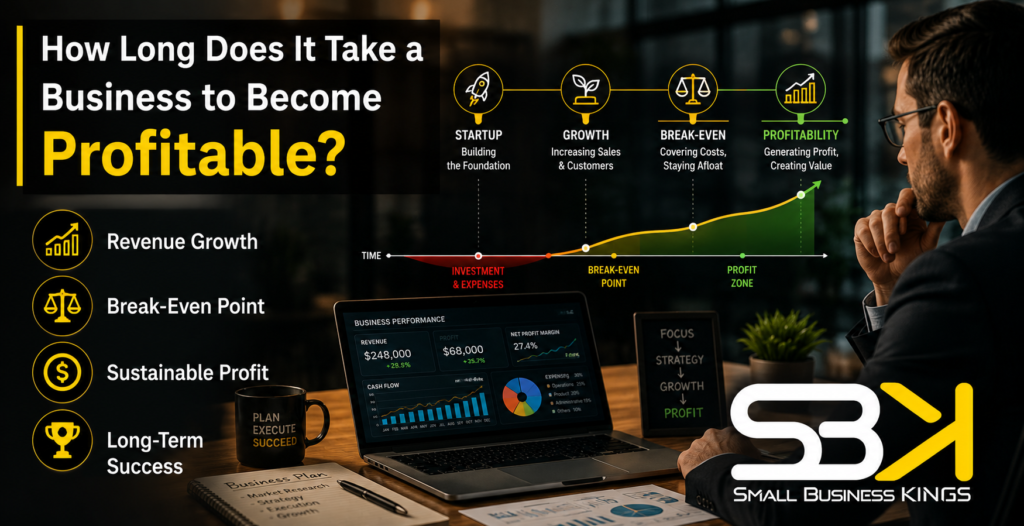
How Long Does It Take a Business to Become Profitable?
Most small businesses take two to three years to become profitable — but that average conceals enormous variation. A freelance consultant can turn a profit in their first month. A restaurant typically needs 18 months to three years just to break even. A software startup may run at a loss for four or five years by design. The timeline depends almost entirely on your business model, startup costs, and how you define “profitable” in the first place.
What "Profitable" Actually Means — And Why It Matters
Before looking at timelines, get clear on what you’re measuring. Three different milestones get confused under the word “profitable,” and they can be years apart.
Cash flow positive: Your business is bringing in more cash each month than it’s spending. This is the first milestone most businesses hit, and it’s critical for survival — but it doesn’t mean you’ve recovered your startup investment.
Break-even: Your cumulative revenue has caught up with your cumulative expenses, including everything you spent to launch. A business can be cash flow positive for months while still being below break-even overall.
Net profitable: Revenue consistently exceeds all expenses — operating costs, loan payments, taxes — with money left over. This is what most people mean when they say “profitable.”
Launch Your Business On Fast VPS Hosting
Secure, high-performance hosting designed for growth. Don't lose sales to slow site speed.
Owner-sustainable: The business generates enough net profit that the owner can draw a genuine market-rate salary. Many small businesses hit net profitability on paper while the owner is still taking little or no pay — effectively subsidizing the business with their own labor.
The honest answer to “when will my business be profitable?” depends on which of these milestones you mean. Many owners hit cash flow positive in year one, break-even in year two, net profitability in year three, and owner-sustainable income in year four or five.
Profitability Timelines by Business Type
The single biggest predictor of your profitability timeline is your business model. Here’s what realistic timelines look like across the most common small business types.
| Business Type | Typical Timeline to Profitability | What Drives the Range |
|---|---|---|
| Freelance / Consulting | 1–6 months | Pricing, how quickly you land clients |
| Service Business (agency, cleaning, trades) | 6–18 months | Startup costs, crew size, equipment |
| E-commerce | 6–18 months | Product margins, customer acquisition cost |
| Retail / Brick-and-Mortar | 18 months–3 years | Build-out costs, inventory, foot traffic |
| Restaurant / Food Service | 18 months–3 years | High startup costs, thin margins |
| SaaS / Tech Startup | 2–5+ years | Product development, scaling costs |
| Manufacturing | 3–5+ years | Equipment, inventory, distribution |
Service Businesses and Freelancing
Service businesses are the fastest path to profitability because the model is structurally lean. No inventory. No product to build before you can sell. Revenue starts with the first client. Your costs scale with your workload rather than running at a fixed level regardless of sales.
A solo consultant or freelancer who prices correctly and lands clients promptly can be profitable within the first 60 to 90 days. An agency or service business with employees and overhead typically takes six to eighteen months to hit consistent profitability, depending on how quickly the client base scales relative to fixed costs.
The most common reason service businesses take longer than expected: underpricing. Setting rates below what the market will bear extends the timeline significantly because margins are too thin to absorb normal operating costs.
E-commerce
E-commerce sits in the middle of the range — faster than retail, slower than pure services. The model requires upfront investment in inventory (unless dropshipping), and customer acquisition costs are typically high in the early months before organic traffic and repeat customers develop.
Businesses with strong gross margins — above 50% on their products — tend to reach profitability faster because each sale contributes meaningfully to covering overhead. Businesses competing on thin margins in commoditized categories can generate significant revenue while struggling to cover operating costs.
The 6–18 month range reflects this spread. A well-margined niche e-commerce business with effective organic marketing can break even within six months. A business in a competitive category with high paid acquisition costs and thin margins may take 18 months or more.
Retail and Restaurants
These categories carry the longest profitability timelines among common small businesses, and for clear structural reasons: high upfront capital requirements (build-outs, equipment, inventory, deposits), significant fixed costs regardless of revenue (rent, labor, utilities), and typically thin operating margins.
A restaurant spending $200,000 to $400,000 on startup costs — which is common for even modest operations — needs to generate substantial monthly profit just to service that investment. At a 10–15% net margin on revenue, recovering that initial outlay takes years even when the business is genuinely thriving.
This doesn’t mean restaurants and retail are bad businesses — but it does mean the profitability timeline is longer, and undercapitalization is a primary reason these businesses fail. Entering with less startup capital than the business needs to reach profitability forces premature decisions under financial pressure.
SaaS and Tech Startups
Software and tech businesses often deliberately delay profitability to prioritize growth — acquiring users, building the product, and capturing market share before optimizing for profit. This strategy depends entirely on having sufficient capital (either raised or bootstrapped) to fund the losses.
For a bootstrapped small tech business, profitability timelines of two to four years are typical. The product development phase alone can absorb a year or more before the business generates its first dollar of revenue. For venture-backed startups, the timeline is often deliberately extended further, with profitability subordinated to growth metrics.
If you’re building a small SaaS business without outside funding, the relevant question isn’t when you’ll be profitable — it’s whether you can reach profitability before your personal runway runs out.
The Five Factors That Determine Your Timeline
1. Startup Costs
The more capital your business requires before generating revenue, the longer the path to profitability. A business that required $10,000 to launch and generates $5,000 per month in gross profit is profitable in a matter of months. A business that required $300,000 to launch faces years of revenue just to recover that investment.
This is why keeping startup costs lean — launching with the minimum viable version of your business rather than the ideal version — directly accelerates your path to profitability.
2. Gross Margin
Gross margin is revenue minus the direct cost of delivering your product or service, expressed as a percentage. A business with 70% gross margins keeps $70 of every $100 in revenue after covering direct costs. A business with 20% gross margins keeps $20.
High gross margins don’t guarantee profitability, but they make it structurally achievable. Low gross margins mean you need massive volume before fixed overhead is covered — and any cost increase or revenue shortfall creates immediate losses.
If your gross margin is below 30–40%, examine your pricing and cost structure before anything else. More revenue won’t fix a margin problem.
3. Fixed vs. Variable Cost Structure
Businesses with high fixed costs — rent, salaried employees, equipment leases — need to hit a certain revenue level before any profit is possible, regardless of how well they’re performing. Until you cross that threshold, every month is a loss.
Businesses with predominantly variable costs scale more naturally with revenue. If your costs rise only when your revenue rises, the path to profitability is more predictable and the risk of a cash crisis is lower.
When designing your business model early on, minimize fixed commitments until revenue justifies them. Hire contractors before employees. Lease equipment before buying. Work from home before signing office leases.
4. Customer Acquisition Cost and Retention
How much does it cost you to acquire a new customer, and how long do they stay? These two numbers have an outsized impact on your profitability timeline.
High acquisition costs paired with low customer retention creates a structural loss: you spend significantly to acquire a customer who generates one or two transactions and leaves. The math never improves with scale.
High acquisition costs paired with strong retention — customers who buy repeatedly over years — creates a business that starts expensive but compounds into profitability as the customer base matures and acquisition costs are averaged across longer relationships.
5. Pricing Discipline
Underpricing is the single most common reason small businesses take longer than necessary to become profitable. Owners underestimate their costs, undervalue their expertise, or price against competitors without understanding whether those competitors are themselves profitable.
If your prices don’t support the gross margins your business needs, no amount of volume or efficiency will fix it. Profitability starts with pricing that works — and many businesses discover they need to raise prices significantly, sometimes uncomfortably so, to reach viable margins.
How to Calculate Your Own Break-Even Point
None of the common timelines matter as much as your specific break-even calculation. Here’s how to run it.
Step 1 — Calculate your fixed monthly costs. Add up everything you pay regardless of revenue: rent, utilities, software subscriptions, insurance, loan payments, minimum staffing.
Step 2 — Calculate your gross margin percentage. Take your average revenue per sale, subtract the direct cost of that sale (materials, labor directly tied to delivery, transaction fees), and divide by revenue.
Example: You sell a service for $1,000. It costs you $300 in direct labor and materials to deliver. Gross margin = ($1,000 – $300) / $1,000 = 70%.
Step 3 — Divide fixed costs by gross margin. This gives you the revenue you need each month to cover all fixed costs.
Example: $8,000 in monthly fixed costs ÷ 0.70 gross margin = $11,429 in monthly revenue to break even.
Step 4 — Calculate how many sales that requires. At $1,000 per sale, you need approximately 12 sales per month to break even.
Run this calculation before you launch — and revisit it whenever your cost structure or pricing changes. The break-even point isn’t a static number; it shifts with every new expense or price adjustment.
The Cash Flow vs. Profitability Trap
A business can be profitable on paper and still run out of cash. This is one of the most disorienting situations a small business owner can face — your accountant tells you the business made money this quarter, but your bank account is nearly empty.
It happens because profit is an accounting concept, not a cash concept. If your customers pay 60 days after you deliver, you’re doing the work now but receiving the cash later. If you’ve paid for inventory that hasn’t sold yet, that cash is tied up in stock, not in your account. Loan principal repayments aren’t an expense on your income statement but they absolutely drain your cash.
Managing cash flow is a separate discipline from managing profitability, and both matter. A profitable business with poor cash flow management fails just as surely as an unprofitable one. Track both — and if you can only afford attention to one in the early months, track cash flow first because it determines whether you survive to become profitable.
Strategies to Reach Profitability Faster
Price for the margin your business needs, not for what feels safe. Run your break-even analysis first, then price backward from the margin required — not forward from a competitor’s rate sheet.
Minimize fixed costs in the early stage. Every fixed commitment you add raises your break-even point. Add overhead in response to revenue, not in anticipation of it.
Focus on high-margin customers and offerings. Not all revenue is equally profitable. Identify which products, services, or customer segments generate the strongest margins and concentrate your sales and marketing effort there.
Shorten your cash conversion cycle. The faster you convert a sale into cash in your account, the less capital you need to fund operations. Invoice immediately, follow up on late payments, offer modest discounts for early payment, and where possible require deposits before work begins.
Reinvest deliberately, not automatically. Many businesses delay profitability by reinvesting every available dollar without asking whether that reinvestment generates an adequate return. Reinvestment that builds the business makes sense. Reinvestment that funds growth without improving margins or retention can extend your unprofitable period indefinitely.
Once your business reaches consistent revenue, getting financial systems in place to track margins, cash flow, and profitability accurately becomes as important as the business development itself. SBK recommends Softangles for the operational infrastructure side — they handle business website design, web hosting, brand and logo design, and CRM and sales pipeline setup, so you’re capturing and converting leads efficiently while your financial systems are tracking whether those conversions are actually profitable.
What to Do If You're Behind the Typical Timeline
Three years in and still not profitable is not automatically a crisis — but it requires honest assessment rather than patient waiting.
First, determine whether the path to profitability exists. Run your break-even analysis with current numbers. Is profitability achievable at realistic revenue levels, or does the math not work at any volume you could plausibly reach?
Second, identify the specific bottleneck. Is gross margin the problem (pricing or cost structure)? Is it fixed overhead relative to revenue? Is it customer acquisition cost? Each has a different solution, and treating the wrong one wastes time.
Third, distinguish between a timing problem and a model problem. Some businesses simply take longer because of their industry — a restaurant in its second year losing money isn’t necessarily broken. A consulting firm in its third year losing money probably is. Know which situation you’re in.
Fourth, set a decision point. If profitability isn’t achieved by a defined date with defined metrics, what changes? Having a predetermined decision point prevents indefinite continuation of an unworkable model out of sunk cost reasoning.
Frequently Asked Questions
Is it normal to lose money in the first year of business?
For most business types, yes. Service businesses are the exception — a well-priced solo practice or consulting firm with clients can be profitable within months. For businesses with meaningful startup costs, inventory, or infrastructure requirements, losses in year one are expected and don’t indicate failure. What matters is whether the trajectory is moving toward profitability and whether you have sufficient capital to fund operations until you get there.
What’s the difference between cash flow positive and profitable?
Cash flow positive means more cash is coming in each month than going out — your bank balance is growing. Profitable means revenue exceeds expenses on your income statement. These can diverge significantly. A business that invoices on net-60 terms may be profitable but cash-flow negative while waiting for payment. A business receiving large customer prepayments may be cash-flow positive before it’s earned the revenue. Track both separately.
How much should I pay myself before the business is profitable?
Take enough to cover your essential living expenses — not more. Most early-stage owners take well below market rate in the first one to three years, treating the difference as equity in the business they’re building. Increase your draw as the business can genuinely support it, not as a reward for reaching arbitrary milestones. Your salary is a fixed cost, and every dollar of owner’s draw raises your break-even point.
What is ramen profitability and does it count?
Ramen profitability — a term popularized by startup investor Paul Graham — means the business generates just enough revenue for the founder to cover basic living expenses. It counts in the sense that the business can sustain itself without outside funding or a day job subsidy. It doesn’t count as genuine profitability in the sense of being a viable long-term business. It’s a milestone worth hitting — it proves the model can generate revenue — but it’s a starting line, not a finish line.
At what point should I be worried about my profitability timeline?
Worry when the trajectory isn’t improving, not simply because you haven’t hit profitability yet. A business losing $5,000 per month in year one that is losing $2,000 per month in year two is on a reasonable path. A business losing $5,000 per month in year one that is losing $7,000 per month in year two has a structural problem that time alone won’t fix. Monitor trend lines, not just current position.
Launch Your Business On Fast VPS Hosting
Secure, high-performance hosting designed for growth. Don't lose sales to slow site speed.
Do profitable businesses ever go back to losing money?
Frequently. A business that reaches profitability at one revenue level can lose it again when it hires ahead of revenue, expands into new markets, launches new products, or faces unexpected cost increases. Profitability at a given scale doesn’t guarantee profitability at the next scale. This is why cost discipline and margin management are ongoing requirements, not problems you solve once and leave behind.