

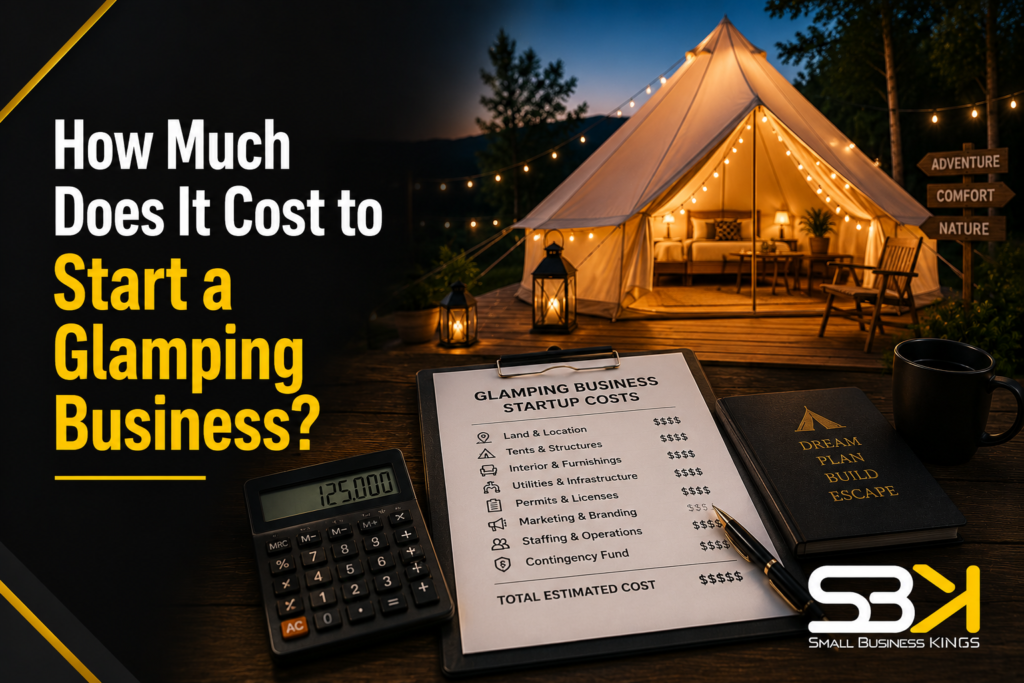
How Much Does It Cost to Start a Glamping Business?
Starting a glamping business costs anywhere from $10,000 for a bare-bones micro-setup to $750,000 or more for a commercial-grade resort. That range is so wide because “glamping business” covers everything from two bell tents on leased land to a ten-yurt luxury destination with private hot tubs and full utility hookups.
The most useful starting point isn’t the average — it’s figuring out which scale you’re actually building toward, then pricing that specific model.
Cost by Scale: Find Your Tier First
| Business Scale | Typical Startup Cost | What’s Included |
|---|---|---|
| Micro / Back-to-Basics | $10,000 – $30,000 | 2–3 bell tents, DIY decks, composting toilets, basic off-grid power |
| Boutique Mid-Scale | $50,000 – $150,000 | 3–5 domes or safari tents, basic plumbing, private fire pits |
| Luxury Commercial | $250,000 – $750,000+ | 5–10 insulated pods or yurts, full electrical/septic, hot tubs |
The micro tier is genuinely achievable — one operator in New York launched for under $10,000 by leasing a small plot from an existing RV site, where permits were already in place and the landowner handled day-to-day operations. That’s the exception, not the rule, but it shows the floor is real.
The luxury commercial tier — the $755,000 figure that circulates widely — is based on a 10-yurt site with spaced-out units, full utilities run to each unit, and hot tubs. It’s a real number, but it applies to a specific type of project. Most first-time glamping operators don’t start there and shouldn’t.
The strategic insight most guides miss: your infrastructure costs are front-loaded. Roads, utility lines, and septic systems cost roughly the same whether you’re installing them for three units or ten. Starting with three units and scaling to ten costs meaningfully less per unit than building ten from scratch, because the infrastructure is already paid for. Starting small and using early cash flow to fund expansion is how most successful glamping operators actually grow.
Launch Your Business On Fast VPS Hosting
Secure, high-performance hosting designed for growth. Don't lose sales to slow site speed.
Land: Your Biggest Variable
Land is where cost projections go wrong most often — in both directions.
If you already own land, your startup cost picture changes dramatically. Skip the land acquisition cost and focus on whether the land is zoned for commercial hospitality use. Zoning verification is the first thing you must do before spending anything else — a property that can’t be permitted for paying guests has no value to a glamping business regardless of how beautiful it is.
If you need to acquire land, costs range from $30,000 for rural acreage in low-demand regions to $250,000+ for desirable land near tourist destinations. Raw land appears cheaper on paper but hides costs: you’ll need surveys, and utility installation from scratch is significantly more expensive than connecting to existing infrastructure.
The lease alternative is underused by first-time operators. Leasing land from a willing landowner — sometimes in exchange for a revenue share rather than fixed rent — reduces your upfront capital requirement substantially. The arrangement that works best: a landowner who’s willing to handle on-site operations in exchange for a profit split, which also reduces your staffing burden.
How much land do you need? A practical minimum is one to two acres per unit for a genuinely private experience — the defining characteristic of upscale glamping. Three yurts with meaningful privacy between them need at minimum three to five acres. Cramped units undermine the premium positioning that justifies glamping’s price point.
Groundworks, Utilities, and Infrastructure: The Cost That Surprises Everyone
This is consistently the most underestimated budget category, and it’s the one with the widest range.
For a site with existing utility connections and units placed close together, groundworks and utilities might run $30,000–$50,000. For a larger site with units spread across acreage in a remote location requiring new utility runs, the cost can exceed $400,000 — a real figure from a documented US glamping startup.
What falls in this category:
- Land clearing, grading, and leveling
- Access roads (required to meet commercial standards — wider, reinforced, navigable by emergency vehicles)
- Parking area construction
- Electrical service (running to each unit from the main connection, or establishing a commercial solar/battery system if off-grid)
- Water supply lines to each unit
- Septic system installation (a significant cost — percolation testing alone can run $3,000–$5,000 before you know if a septic system is even feasible)
- Drainage systems
- Internet infrastructure
Off-grid vs. grid-connected: If utility connections are distant or the permit process for commercial-grade connections is complex, off-grid solar and composting toilet systems can reduce infrastructure costs — but introduce their own operational complexity. Off-grid setups work well for micro and boutique tiers targeting eco-conscious guests. They’re less practical for luxury-tier sites where guests expect reliable power, hot water, and fast WiFi.
The only reliable way to estimate your specific groundworks and utility costs is to get a contractor’s quote for your specific parcel. Estimates from similar sites elsewhere are a starting point, not a budget.
Glamping Unit Costs by Structure Type
This is the category with the clearest per-unit pricing, and it’s where you have the most control.
| Structure Type | Per Unit Cost (Basic) | Per Unit Cost (Furnished) | Notes |
|---|---|---|---|
| Bell tents | $1,000 – $3,000 | $3,000 – $6,000 | Seasonal only; minimal weatherproofing |
| Safari tents / canvas tents | $5,000 – $15,000 | $10,000 – $25,000 | Better weather resistance; more spacious |
| Geodesic domes | $10,000 – $30,000 | $15,000 – $40,000 | Visual appeal; varies significantly by manufacturer |
| Yurts | $15,000 – $40,000 | $25,000 – $60,000 | Durable; strong year-round potential with insulation |
| Custom luxury pods | $25,000 – $75,000+ | $35,000 – $100,000+ | Highest nightly rates; best four-season performance |
These are unit costs only — the structure itself plus basic furnishings. They don’t include decks, outdoor furniture, or amenity additions.
Furnishings budget per unit: Plan $2,500–$8,000 per unit for interior outfitting depending on your tier. At minimum: quality mattress, bedding, lighting, small seating area, and basic kitchenette. At the luxury tier: wood-burning stove, premium linens, private outdoor decking, and a hot tub (hot tubs run $5,000–$12,000 each installed).
Don’t forget shipping. Glamping structures are bulky and heavy. Shipping costs from manufacturer to site run $500–$3,000 per unit depending on distance and structure type. Get a shipping quote as part of your unit pricing.
Permits, Fees, and Legal Costs
Glamping sits in a regulatory gray zone in many US jurisdictions — not quite a campground, not quite a hotel — which makes permitting more complex and less predictable than most other businesses.
What you typically need:
- Zoning verification and any required variance or conditional use permit
- Commercial building permits for any permanent structures
- Health department permits if you’re serving food or operating communal bathrooms
- Fire safety inspection and permits
- Business license (state and local)
- Liquor license if you plan to serve alcohol
Permit costs: $5,000–$20,000 in fees for a mid-scale site in a typical US county. More complex situations — contested variances, environmental impact reviews, septic permitting on challenging soil — can run significantly higher.
Timeline: Budget 3–9 months for the permitting process. This is time you’re paying carrying costs on land without generating any revenue. Factor it into your working capital requirements.
The zoning check is free and must happen first. Before purchasing or leasing land, call the county planning department and ask whether short-term rental glamping operations are a permitted use in that zoning district. This conversation costs nothing and can save you from a catastrophic mistake.
Hidden Costs That Don't Appear in Most Guides
Commercial Hospitality Insurance
Your personal homeowner’s policy does not cover paying guests — and if a guest is injured on your property without proper commercial coverage, you have no protection. Specialized commercial hospitality and general liability insurance for glamping operations costs $3,000–$8,000 annually depending on site size, location, and number of units. Get quotes from insurers who specialize in short-term rental and outdoor hospitality before finalizing your financial model.
Seasonality: Off-Season Fixed Costs
If your glamping site is in a climate with harsh winters, you may be operating at 20–30% of capacity for four to six months of the year while your fixed costs — land lease, insurance, loan payments, software subscriptions — continue at 100%. Many glamping operators underestimate how severely seasonality compresses their effective revenue window.
Run your financial model with a realistic occupancy assumption by month, not an annual average. A site that looks profitable at 65% annual occupancy may not cover debt service if 65% is driven by a four-month peak season followed by a near-zero winter.
Laundry Operations
Glamping sites go through significant linen volume. Each unit turn requires fresh sheets, towels, and any other textiles. For an off-grid or remote site, this means either a commercial washer/dryer setup ($2,000–$5,000) or a contract laundry service that picks up and returns. Neither is free, and the time cost of in-house laundry on a busy weekend is real. Budget for this from the start.
Working Capital for Year One
Most glamping businesses don’t generate consistent revenue in their first season. You need reserves to cover fixed costs — land payments, insurance, debt service, utilities, marketing spend — during the months before bookings mature. Budget a minimum of six months of operating expenses as working capital before you open.
Free Business Blueprint
Steal the roadmap smart entrepreneurs use to launch, grow, and scale their businesses while avoiding expensive mistakes.
Revenue Potential: What the Investment Can Return
Startup cost only makes sense in the context of what it produces. Here’s a realistic revenue framework.
Nightly rates by tier:
- Micro (bell tents): $75–$150/night
- Boutique (domes, safari tents): $150–$300/night
- Luxury (pods, yurts with hot tubs): $250–$500+/night
Occupancy assumptions: 50–65% annual occupancy is achievable for a well-marketed site in a strong tourism market. In seasonal markets, model occupancy month by month — 80–90% in peak months, 10–30% in shoulder/off season.
Margin potential: Well-run glamping operations can achieve 40–60% net profit margins, driven primarily by low variable costs per occupied night once infrastructure is paid. The main costs per occupied night are laundry, consumables, cleaning labor, and platform fees — typically $30–$80 per booking depending on your setup.
A simplified example: Four luxury yurt units at $300/night, 60% annual occupancy: 4 units × $300 × 365 days × 60% = $262,800 in gross annual revenue. At a 50% net margin after all operating costs: $131,400 in net income. Against a $400,000 investment, that’s roughly a three-year payback — before accounting for debt service.
This math changes significantly based on your actual nightly rate, occupancy, cost structure, and whether you’re servicing a loan or building with equity capital.
Getting your direct booking infrastructure right from the start — a professional website where guests can book without paying Airbnb commissions — is one of the highest-ROI investments in the glamping business. SBK recommends Softangles for this: they handle business website design, web hosting, logo and brand design, and CRM and sales pipeline setup, so your booking and guest management systems are in place before your first guests arrive.
What to Do Before Spending Anything
1. Verify zoning. Call the county planning department before committing to any land. This is free and eliminates the most common catastrophic mistake.
2. Get a utility feasibility assessment. Hire a civil engineer to assess your specific parcel for utility connection costs, septic feasibility, and access road requirements. This typically costs $2,000–$5,000 and prevents $100,000+ surprises later.
3. Model your occupancy honestly. Research comparable glamping sites in your target market on Airbnb and VRBO. Look at their calendars to estimate actual occupancy, not their stated availability. Run your financial model at 50% occupancy before assuming anything higher.
4. Start with fewer units than you think you need. Infrastructure is your big fixed cost. Three units generating strong occupancy and reviews provides the cash flow and market intelligence to expand intelligently. Ten units with thin occupancy creates debt pressure and operational complexity simultaneously.
Skip Beginner Business Mistakes
Get Free BlueprintFrequently Asked Questions
How much does it cost to start a small glamping business?
A small glamping business — two to four units on leased or owned land — can be launched for $50,000–$150,000 depending on structure type and whether utility infrastructure exists on the property. Bell tent setups with composting toilets and off-grid power can fall below $30,000. Geodesic domes or safari tents with basic plumbing typically run $80,000–$150,000 for three to four units.
Do I need to own land to start a glamping business?
No. Leasing land from a willing landowner is a legitimate and lower-capital entry point. Some operators structure arrangements where the landowner receives a revenue share in exchange for the lease and handles on-site management. The critical requirement is that the land is zoned appropriately for commercial short-term rental operations — owned or leased, that check must happen first.
How long does it take for a glamping business to become profitable?
Most glamping businesses reach positive monthly cash flow within the first full operating season if occupancy is healthy. Recovering the full initial investment typically takes three to five years for a mid-scale operation. The timeline compresses significantly for operators who start small, build strong reviews early, and self-fund expansion rather than servicing large startup debt.
What glamping structures give the best return on investment?
Insulated year-round structures — quality yurts, geodesic domes with proper insulation, or custom pods — generate better annual ROI than seasonal canvas tents because they extend your operating season. The premium nightly rates these structures command also compress your payback period. Bell tents and basic canvas structures have lower upfront cost but are limited to warmer months in most US climates, which limits annual revenue potential.
What’s the biggest mistake first-time glamping operators make?
Underestimating utility and groundworks costs, then running out of capital before opening. The second most common: overbuilding initially — launching with more units than the market can fill in the first season, which creates debt pressure during the occupancy-building phase. Start with three or four units, generate strong reviews and consistent occupancy, then expand using cash flow.
Launch Your Business On Fast VPS Hosting
Secure, high-performance hosting designed for growth. Don't lose sales to slow site speed.
Can I run a glamping business on Airbnb without my own website?
You can, especially in the early stage when visibility on Airbnb drives your initial bookings. The problem is platform dependency — Airbnb charges 3% host fees, can remove your listing, and owns the guest relationship. As your business matures, building a direct booking channel through your own website reduces commission costs and gives you full control of your guest data and pricing. Most successful operators use both — Airbnb for discovery, their own website for repeat and direct bookings.