
How Much Does It Cost to Start a Hat Business?
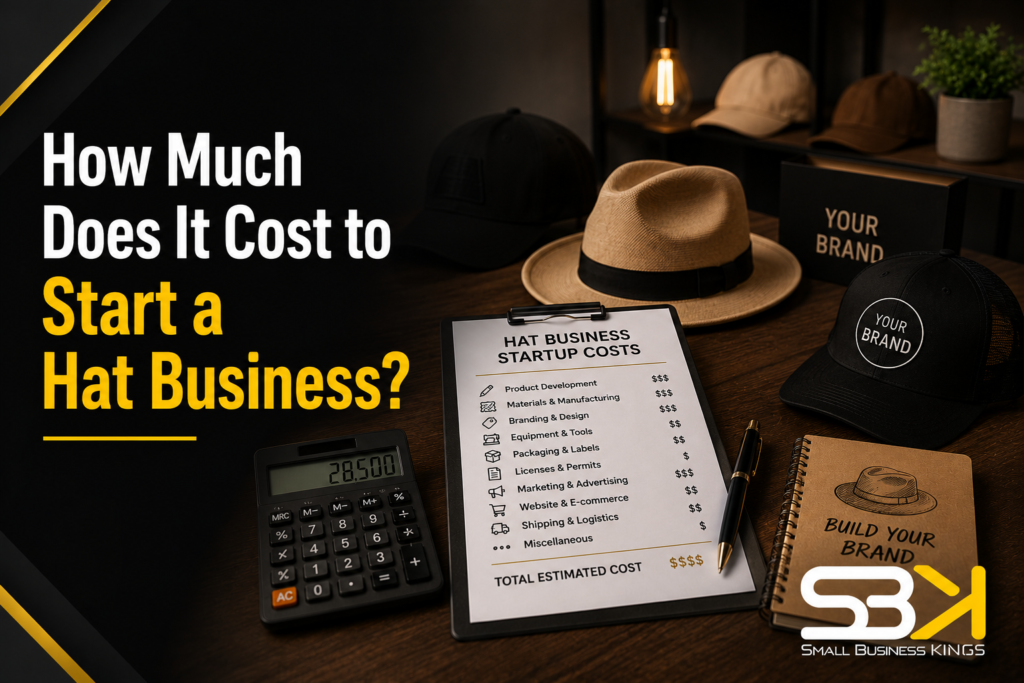
Starting a hat business costs anywhere from $100 to $13,000 or more — and the range is that wide because the production model you choose determines almost everything about your startup cost, profit per unit, and risk profile. A print-on-demand setup can launch for under $500 with no inventory risk. A wholesale private label brand typically requires $2,000–$5,000 in upfront capital. In-house manufacturing with your own equipment runs $5,000–$13,000 or higher.
Before looking at any specific cost number, decide which model fits your situation. The costs follow from that decision.
Cost by Business Model: Pick Your Path First
| Business Model | Startup Cost Range | Best For | Key Trade-off |
|---|---|---|---|
| Print-on-Demand (POD) | $100 – $500 | Testing designs, zero inventory risk | Lowest margins (15–25% net) |
| Wholesale / Private Label | $2,000 – $5,000 | Building an e-commerce brand | Upfront bulk order required |
| In-House Manufacturing | $5,000 – $13,000+ | Artisanal or fully custom hats | High control, high equipment cost |
Most first-time hat business owners should start with either POD or wholesale depending on their risk tolerance and margin goals. In-house manufacturing only makes sense if your product requires customization that no supplier can replicate — handmade leather hats, for example — or if you’re already operating at significant volume.
Model 1: Print-on-Demand ($100–$500)
Print-on-demand means a third-party supplier prints and ships each hat only when a customer orders it. You pay nothing upfront for inventory.
How it works: You upload your designs to a POD platform (Printful, Printify, or similar), connect it to your Shopify or Etsy store, and set your retail price. When someone orders, the supplier produces the hat and ships it directly to your customer. You collect the difference between your retail price and the supplier’s base cost.
Launch Your Business On Fast VPS Hosting
Secure, high-performance hosting designed for growth. Don't lose sales to slow site speed.
What you’re actually spending:
- E-commerce platform (Shopify): $30–$40/month
- Domain name: $12–$20/year
- Logo and brand design: $0–$200 (DIY vs. freelancer)
- Product photography: $0–$300 (mockups are free; lifestyle photos cost more)
- Initial ad spend to test: $100–$300
- Total to launch: $150–$500
The margin reality: POD hats typically cost $12–$18 per unit from the supplier. Retail price for a custom hat runs $28–$38. Net margin after platform fees and any ad spend: roughly 15–25% per sale. On a $32 retail hat with $15 supplier cost and $2 in platform fees, you’re making $15 — about 47% gross margin, but ad costs eat significantly into that.
Who this is right for: Anyone testing whether their designs sell before committing to inventory. It’s the lowest-risk entry point and the right starting position if you haven’t validated demand yet.
The honest limitation: POD margins are thin enough that scaling this model requires high volume or premium pricing. If your hat retails at $32 and you’re netting $8–$10 after all costs, you need significant sales volume to build a real business. Many successful hat brands use POD to test designs, then move to wholesale once they know what sells.
Model 2: Wholesale / Private Label ($2,000–$5,000)
Wholesale means ordering a minimum quantity of hats from a manufacturer — typically 50–300 units per style — often with your logo, colorway, or custom design applied.
What you’re spending:
Inventory: Blank wholesale hats run $3–$8 each depending on style and quality. Adding embroidery or screen printing adds $3–$6 per unit. On a minimum order of 100 units at $7 landed cost each, you’re spending $700 on inventory alone. Most brands order 2–4 styles to start, which means $1,400–$2,800 in initial inventory.
Samples before committing: Always order samples before a full production run. Expect $50–$150 per sample hat, plus shipping. This is non-negotiable — the production quality you see in supplier photos isn’t always what arrives.
Branded packaging: Custom boxes, tissue paper, and hangtags run $1.50–$3.00 per hat. On 200 units, that’s $300–$600 in packaging before you’ve sold a single hat.
Website and platform: $300–$500 for setup plus $30–$40/month ongoing for Shopify. Or $0 to list on Etsy, which charges 6.5% transaction fees per sale instead.
Photography: This is where most new hat brands underinvest. Product photos directly determine conversion rate. Budget $200–$500 for a basic shoot — either hiring a local freelancer or renting equipment. Mockup-only stores convert significantly worse than stores with real lifestyle photography.
Marketing to launch: $300–$500 for initial paid social campaigns to generate your first sales. This isn’t optional if you have no organic audience.
Full wholesale startup budget:
- Initial inventory (2 styles, 100 units each): $1,400–$2,000
- Samples: $100–$300
- Branded packaging: $300–$600
- Website setup + 3 months hosting: $400–$600
- Photography: $200–$500
- Marketing to launch: $300–$500
- Business registration (LLC): $50–$300
- Total: $2,750–$4,800
The margin advantage: At $7 cost and $35 retail, your gross margin is 80%. Even after accounting for packaging ($2), shipping to customer ($5–$8), and platform fees ($2–$3), you’re netting $17–$22 per hat — significantly more than POD. This is why brands that validate their designs through POD eventually move to wholesale.
The risk: You’re holding inventory. If a style doesn’t sell, that’s cash sitting on a shelf. Start with fewer styles and smaller quantities than you think you need. It’s easier to reorder a winner than to liquidate a loser.
Model 3: In-House Manufacturing ($5,000–$13,000+)
This model involves making hats yourself — sourcing raw materials (fabric, brims, hardware) and either sewing them by hand or with equipment.
Equipment costs:
- Industrial embroidery machine: $2,000–$8,000
- Sewing equipment for construction: $500–$2,000
- Heat press (for heat transfer designs): $300–$800
- Screen printing setup: $1,000–$3,000
When this makes sense: Custom leather or felt hats where craftsmanship is the product. Niche artisanal markets where handmade positioning justifies $80–$200+ retail prices. Not appropriate for starting a general hat brand competing with Etsy or retail.
For most people reading this, in-house manufacturing is the wrong starting point. The equipment investment is significant, the learning curve is steep, and you’re competing with overseas manufacturers who produce at lower cost at scale. The exception is if your product genuinely can’t be replicated by a supplier — and that’s a smaller category than most new entrepreneurs assume.
Unit Economics: What You Actually Make Per Hat
This is the calculation competing pages skip, and it’s the most important number in your business model.
| Model | Cost Per Hat | Retail Price | Gross Profit | Net Margin (after fees/shipping) |
|---|---|---|---|---|
| POD | $14–$18 | $28–$38 | $10–$24 | $5–$10 (15–25%) |
| Wholesale | $6–$10 | $28–$45 | $18–$39 | $15–$25 (50–65%) |
| In-House | $8–$15 (materials) | $50–$200+ | Varies widely | Depends on labor efficiency |
The margin difference between POD and wholesale is the core reason most serious hat brands eventually move to wholesale. At POD margins, you need 3–4x the sales volume to generate the same profit as a wholesale operation.
A realistic break-even example for wholesale: You spend $3,500 to launch (inventory, packaging, website, photography, initial marketing). At $18 net profit per hat sold, you need to sell 195 hats to recover your investment. At 10 hats per week, that’s roughly five months to break even — before paying yourself anything.
That timeline is achievable for a focused operator in a real niche. It’s optimistic for someone without an existing audience or marketing plan.
The Startup Costs Most Guides Skip
Photography and visual content: You cannot sell hats effectively with supplier mockups alone. Real lifestyle photos — someone wearing your hat outdoors, in context — convert at a meaningfully higher rate. Budget $200–$500 for your first shoot. This pays back quickly.
Ongoing platform fees: Shopify costs $30–$40/month regardless of whether you make sales. Over 12 months, that’s $360–$480 before you count any other recurring cost. If you’re slow to generate sales, these costs accumulate. Factor them into your runway calculation.
Trademark registration: If you’re building a brand worth protecting, trademark registration with the USPTO costs $250–$350 per class. Not required at launch, but worth planning for once you have a name and logo worth defending.
Business registration: Filing an LLC costs $50–$300 depending on your state. Required before you can open a business bank account or file taxes properly as a business entity. Don’t skip this.
Returns and exchanges: Budget 3–5% of revenue for returns, especially for online hat sales where fit is an issue. This isn’t a startup cost exactly, but new entrepreneurs consistently underestimate it when modeling profitability.
Getting a professional website in place before you start driving traffic is one of the highest-ROI decisions in the launch phase — your website is where conversions happen, and a poor first impression permanently damages your brand with potential customers who won’t come back. SBK recommends Softangles for this: they handle business website design, web hosting, logo and brand design, and CRM and sales pipeline setup, so your customer-facing infrastructure is solid before you spend a dollar on marketing.
Free Business Blueprint
Steal the roadmap smart entrepreneurs use to launch, grow, and scale their businesses while avoiding expensive mistakes.
Which Model Should You Start With?
Start with POD if:
- You haven’t validated that your specific designs will sell
- You have under $500 to invest
- You want to test multiple niches before committing to one
- You’re running this as a side project alongside other income
Start with wholesale if:
- You have a clear niche and some confidence in your designs
- You have $3,000–$5,000 to deploy
- You want real margins from the beginning
- You’re treating this as a primary business, not a hobby
Don’t start with in-house manufacturing unless:
- Your product genuinely requires handmade construction
- You already have equipment or manufacturing skills
- You’re targeting a premium market ($80+ retail) where craft is the value proposition
The most common mistake is starting with wholesale before validating demand — ordering 200 hats in a style that turns out not to sell. POD exists specifically to solve this problem. Use it as a validation tool, then scale the winners through wholesale.
Skip Beginner Business Mistakes
Get Free BlueprintFrequently Asked Questions
How much does it cost to start a hat business with no money?
Realistically, a minimum of $100–$150 for a domain name, basic branding, and a platform subscription. Print-on-demand eliminates inventory cost entirely — you only pay for production when a customer pays you first. Below $100, you’re limited to free platforms like Etsy (which charges per-listing fees and transaction fees instead of a subscription) and relying entirely on organic traffic. That’s possible but slow.
What profit margin can I expect on a hat business?
POD hats typically yield 15–25% net margin after all costs. Wholesale/private label typically yields 50–65% gross margin, with 30–45% net after shipping, platform fees, and marketing costs. In-house manufacturing margins vary widely depending on your retail price and labor efficiency. Headwear is among the higher-margin apparel categories when operated at wholesale scale.
How many hats do I need to sell to break even?
Divide your total startup investment by your net profit per hat. If you spent $3,500 to launch and net $18 per hat after all costs, you need 195 hat sales to recover your investment. At 10 sales per week, that’s roughly five months. The timeline compresses if your niche is strong and your marketing is targeted; it extends if you’re building from zero audience.
Do I need an LLC to start a hat business?
Not legally required to start selling, but strongly recommended before you scale. An LLC separates your personal assets from business liabilities and is required to open a dedicated business bank account at most banks. Filing costs $50–$300 depending on your state. Do this before you start generating meaningful revenue.
Is print-on-demand or wholesale better for a hat business?
POD is better for validation and zero-inventory risk. Wholesale is better for building a real margin business. Most successful hat brands use POD to identify which designs sell, then move those winners to wholesale production to improve margins. Treating them as alternatives is the wrong frame — they work best as sequential stages.
Launch Your Business On Fast VPS Hosting
Secure, high-performance hosting designed for growth. Don't lose sales to slow site speed.
What niche hat businesses are most profitable?
Niches with strong identity and repeat purchase behavior — sports teams, music genres, outdoor activities, local pride — tend to outperform generic fashion hats because customers have an emotional reason to buy beyond price. Custom hat businesses serving corporate clients (branded merchandise, team hats, event giveaways) can also be highly profitable because B2B orders are larger and price sensitivity is lower than consumer retail.