

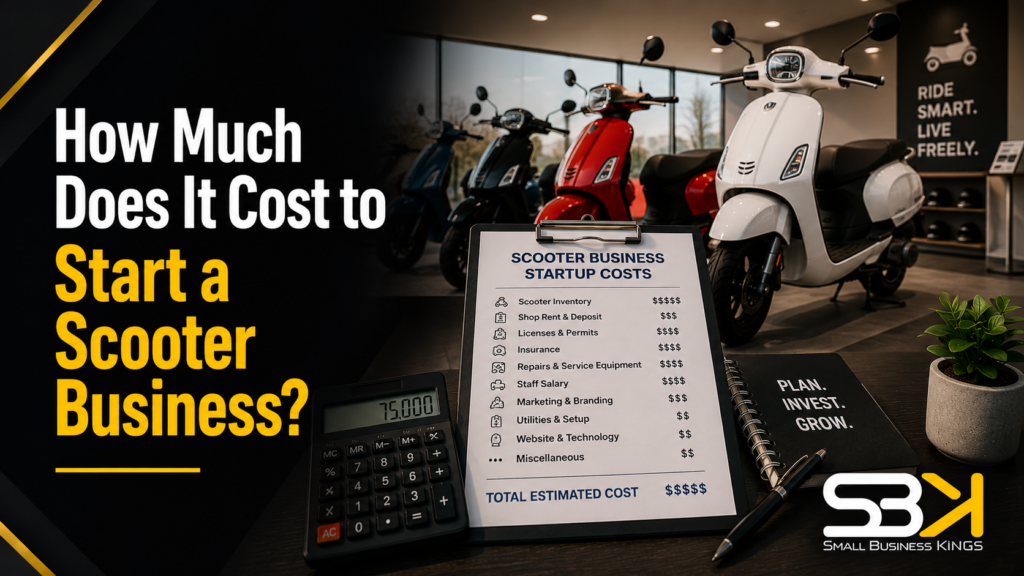
How Much Does It Cost to Start a Scooter Business?
Starting an electric scooter rental business costs $3,000–$6,000 for a micro pilot fleet of 5–10 scooters, $20,000–$75,000 for a small local fleet of 25–40 scooters, and $120,000–$175,000+ for a commercial-scale operation of 100+ scooters. Those ranges assume you’re building a public rental fleet — a B2B property model (hotels, resorts, campuses) can launch for significantly less with lower regulatory risk.
Before any cost discussion makes sense, the most important thing to know: buying scooters before you have city permission is the most common and most expensive mistake new operators make. Many cities ban dockless scooters, cap fleet sizes, or run competitive permit processes. If you’re planning a public fleet, negotiate city access before you spend a dollar on hardware.
Before any cost breakdown makes sense, decide which of these you’re actually building.
The Sequence That Matters More Than the Budget
Most guides list costs first. Here’s the actual sequence that determines whether your business is viable:
Step 1 — City permission: Contact your local Department of Transportation or city hall before anything else. Ask whether shared micromobility operates in your city, whether new operators can apply for permits, and what the fee and process looks like. This call is free and can save you $50,000.
Launch Your Business On Fast VPS Hosting
Secure, high-performance hosting designed for growth. Don't lose sales to slow site speed.
Step 2 — Insurance quote: Get a preliminary general liability quote for a scooter rental operation. In some markets, insurance is unavailable or prohibitively expensive for new operators. High premiums can make unit economics unworkable before you buy a single scooter.
Step 3 — Pilot fleet: Launch 10–15 scooters using a revenue-share software platform (which has no upfront cost) to validate local demand, test your redistribution logistics, and generate real utilization data before scaling.
This sequence — city, insurance, pilot — is not how most guides frame it. But it’s how operators who don’t lose their startup capital actually do it.
Business Model: This Decision Changes Everything
Your model determines your regulatory exposure, startup cost, and risk profile more than any other single decision.
| Model | Startup Cost | Regulatory Risk | Revenue Model |
|---|---|---|---|
| Public fleet (B2C rental) | $20,000–$175,000+ | High — city permits required | Per-minute, hourly, daily |
| B2B property (hotels, resorts, campuses) | $5,000–$30,000 | Low — private property, no city permit | Revenue share with property, or direct rental |
| Retail sales | $15,000–$50,000 | Low — standard business license | Per-unit margin |
| B2B fleet leasing | $30,000–$100,000 | Medium — contracts, insurance | Monthly lease fees |
The B2B property model is significantly underrated as a starting point. Deploy 10–20 scooters at a hotel, resort, apartment complex, or campus. The property provides foot traffic and a captive customer base. You avoid city permit requirements entirely. Operating on private property also simplifies insurance — you’re not dealing with public sidewalk liability exposure.
The trade-off: smaller addressable market and revenue that depends on property partnership quality. But for a first-time operator, starting on private property and proving the model before pursuing city permits is a materially lower-risk path.
Full Startup Cost Breakdown
1. Scooters: $500–$1,500 Per Unit
This is your largest single expense and the decision with the most long-term consequences.
Consumer-grade scooters ($200–$400 each) are not viable for rental operations. They’re not built for multi-user daily use, they lack IoT compatibility, and they break down faster than you can repair them. The maintenance cost savings from cheap scooters evaporate within weeks.
Commercial fleet scooters ($500–$1,500 each) are built for shared use — stronger decks, more durable tires, higher IP ratings for weather resistance, and designed for IoT integration. The upfront premium pays for itself in reduced downtime and longer operational life.
Fleet cost by scale:
- 10 scooters at $800 average: $8,000
- 25 scooters at $800 average: $20,000
- 50 scooters at $900 average: $45,000
- 100 scooters at $1,000 average: $100,000
2. IoT Hardware: $50–$150 Per Scooter
Every scooter needs an IoT module — GPS tracker, cellular connectivity, remote lock/unlock capability, and telemetry. This is what turns a scooter into a rentable asset. Without it, you have no keyless access, no real-time tracking, and no remote immobilization.
Hardware cost adds $500–$1,500 to a 10-scooter fleet and $5,000–$15,000 to a 100-scooter fleet. Some commercial scooters come with IoT pre-installed; others require third-party hardware.
3. Fleet Management Software: $0–$25,000 Upfront
This is where the market has changed significantly. The viable options:
Revenue-share platforms (Levy Fleets, similar): $0 upfront. The platform takes a percentage of your revenue. No risk until you’re generating income. Appropriate for pilots and small fleets.
White-label SaaS: $10,000–$25,000 upfront or $50–$300 per scooter annually. You get a branded customer app and management dashboard. Better for operators building a distinct brand.
Custom development: $20,000–$50,000+. Only justified at significant scale (100+ scooters) or when your business model requires features no existing platform provides. Don’t build custom software in year one.
For most new operators: start with a revenue-share platform, prove the model, then evaluate whether to move to white-label SaaS as your fleet grows.
4. Insurance: $3,000–$15,000/Year
Insurance for scooter rental operations is genuinely difficult to secure. You’re asking a carrier to cover:
- Rider injuries (scooters fall into the same risk category as motorcycles for bodily injury)
- Third-party property damage
- Theft and vandalism of your fleet
- General business liability
General liability: $1,500–$5,000/year for a small fleet. Required by every city permit application and most property partners.
Commercial auto/equipment coverage: $1,500–$8,000/year depending on fleet size. Covers physical damage, theft, and vandalism.
Workers’ compensation: Required if you have W-2 employees handling redistribution and maintenance. Rates vary by state.
The insurance reality check: In dense urban markets or cities with poor scooter safety records, some carriers won’t write this coverage at all. Get insurance quotes before finalizing your business plan — not after. An uninsurable location kills the business model regardless of demand.
5. City Permits and Operating Fees: $500–$25,000+
This is the widest range in the entire cost structure and the one most guides wave past.
Cities that have developed micromobility frameworks charge in various ways:
- Flat application fee: $500–$5,000 to apply for an operator permit
- Annual operating fee: $500–$5,000/year
- Per-scooter fee: $25–$150 per scooter per year (common in cities like San Francisco and Denver)
- Data compliance setup: Cities requiring MDS (Mobility Data Specification) compliance — real-time trip data sharing with the city’s transportation department — may require specific software features that add setup cost
Cities without developed frameworks may have no permit requirement yet — but also no legal clarity, which can result in scooter impoundment. Operating in the gray zone is a real strategy some operators use, but it’s a calculated risk, not an oversight.
Don’t assume your city is scooter-friendly. New York City has had a complicated relationship with e-scooter regulation. San Francisco has competitive permit processes where applicants are selected by scoring criteria. Austin, Denver, and Nashville have more accessible frameworks. Research your specific city before spending anything.
6. Charging Infrastructure: $0–$15,000
Three approaches with different cost profiles:
Manual charging: Bring scooters back to a central location, charge overnight, redeploy in the morning. Cost: $0 beyond your storage facility and electricity. Time-intensive but appropriate for small fleets.
Battery swapping: Remove depleted batteries in the field, replace with charged ones. Requires a battery inventory (add $50–$100 per spare battery) and a charging facility. Faster turnaround, more labor.
Docking stations: Fixed infrastructure where scooters charge in place. Cost: $1,000–$5,000 per station. Reduces redistribution labor but requires real estate and electrical infrastructure. Most appropriate for B2B property deployments where you have a fixed location.
For a public fleet under 30 scooters, manual charging is the most cost-effective starting point.
7. Storage and Maintenance Facility: $1,000–$3,000/Month
You need somewhere to store, repair, and charge your fleet. This is often overlooked as a startup cost because it’s a monthly expense, but it’s a real pre-launch requirement — you need the space before you can receive scooter deliveries.
For a small fleet (under 30 scooters), a rented garage or small warehouse unit suffices. For a 100-scooter fleet, you need 1,500–3,000 square feet with adequate electrical capacity for simultaneous charging.
8. Redistribution: The Hidden Recurring Cost
Scooters don’t stay where you put them. They drift to low-demand areas — downhill, to residential neighborhoods, away from transit hubs. Every night, you need to move them back to high-demand zones for the next morning’s deployment.
What redistribution actually costs:
- A cargo van or truck for moving scooters: $400–$600/month in payments if leasing, or $15,000–$25,000 to purchase
- Labor: 2–4 hours per night for a small fleet at $15–$20/hour = $900–$2,400/month for a dedicated redistribution employee
- Fuel: $150–$400/month
New operators consistently underestimate this. On a 30-scooter fleet, redistribution labor can run $1,500–$2,500/month — more than your insurance cost.
9. Vandalism and Theft: Budget 5–10% of Fleet Value Annually
This is the most honest number in this article and the one most guides skip. A meaningful percentage of your fleet will be:
- Thrown into rivers, dumpsters, or restricted areas
- Stripped for parts (batteries are frequently targeted)
- Damaged beyond economical repair from accidents or deliberate abuse
- Outright stolen
On a 50-scooter fleet at $900 average value ($45,000 total), budgeting 7% for annual attrition means $3,150/year in replacement costs — just from vandalism and theft, before normal wear and maintenance. Higher in dense urban environments; lower in B2B property deployments where scooters are more controlled.
Factor this into your unit economics from day one.
Free Business Blueprint
Steal the roadmap smart entrepreneurs use to launch, grow, and scale their businesses while avoiding expensive mistakes.
Complete First-Year Cost Summary
| Cost Category | 10-Scooter Micro Fleet | 25-Scooter Small Fleet | 50-Scooter Commercial |
|---|---|---|---|
| Scooters | $8,000 | $20,000 | $45,000 |
| IoT hardware | $1,000 | $2,500 | $7,500 |
| Software (revenue-share) | $0 | $0 | $0 |
| Insurance (year one) | $3,000 | $6,000 | $12,000 |
| City permits | $500 | $2,000 | $5,000 |
| Business registration | $200 | $200 | $500 |
| Storage facility (6 months) | $3,000 | $6,000 | $12,000 |
| Marketing/branding | $500 | $1,500 | $3,000 |
| Redistribution vehicle | $0 (manual) | $5,000 | $15,000 |
| Spare parts and tools | $500 | $1,500 | $3,000 |
| Total | $16,700 | $44,700 | $103,000 |
Revenue and Break-Even: Realistic Numbers
The utilization reality check: Several guides project 3–4 rides per scooter per day as a baseline. In well-established markets with strong foot traffic, that’s achievable. For a new operator in a new market, 1–2 rides per scooter per day in the first 60–90 days is a more honest assumption.
Revenue per ride: $1.00 unlock fee + $0.25/minute average × 15-minute average ride = $4.75 per ride.
Break-even calculation for a 25-scooter fleet:
Monthly fixed costs: $5,500 (insurance, storage, redistribution labor, software, maintenance)
At 2 rides/scooter/day × 25 scooters × 30 days × $4.75 = $7,125/month in revenue.
Monthly profit: $1,625. Against $44,700 in startup costs, break-even takes roughly 27 months at this utilization rate.
At 3 rides/scooter/day: $10,687/month revenue, $5,187 monthly profit, break-even at ~9 months.
The utilization rate is everything. The difference between 2 and 3 rides per scooter per day is the difference between a 27-month payback and a 9-month payback. Your location, marketing, and operational excellence determine which scenario you’re in.
The B2B Property Model: Lower Cost, Lower Risk
If the permitting complexity and redistribution cost of a public fleet gives you pause, the B2B property model deserves serious consideration as a first step.
Deploy 10–20 scooters at a hotel, resort, apartment complex, or campus. The property provides:
- A captive customer base (guests, residents, students)
- A controlled operating area that eliminates redistribution
- No city permit requirement (you’re on private property)
- A marketing channel (front desk, welcome packets, property app)
Your costs compress significantly:
- No redistribution vehicle or labor needed
- No city permit fees
- Lower insurance premiums (controlled environment vs. public streets)
- Smaller fleet needed to serve the property
Revenue split is typically negotiated with the property — either you keep 100% of ride fees (and pay a location fee) or share revenue in exchange for the property handling customer relationships.
This model is not a consolation prize — it’s a legitimate, often more profitable business than public fleet operations, particularly for operators in markets where city permits are unavailable or competitive.
Getting your website, brand, and customer systems in place before launch matters more in this industry than most guides acknowledge — property partners and city permitting offices both evaluate your professionalism before agreeing to work with you. SBK recommends Softangles for this: they handle business website design, web hosting, logo and brand design, and CRM and sales pipeline setup, so your operational infrastructure is credible from your first partner conversation.
Frequently Asked Questions
How much does it cost to start a small scooter rental business?
A micro pilot fleet of 5–10 scooters using a revenue-share software platform can launch for $10,000–$20,000 including scooters, IoT hardware, insurance, and business registration. A small local fleet of 25 scooters runs $40,000–$75,000 including redistribution infrastructure. These figures assume you’ve already secured city permission or are operating on private property.
Do I need a city permit to start a scooter rental business?
For a public dockless fleet operating on city streets and sidewalks, yes — in most US cities with any regulatory framework. Operating without a permit risks scooter impoundment, fines, and loss of your entire fleet investment. For a B2B property model on private land (hotels, campuses, resorts), you typically don’t need a city micromobility permit, though you still need standard business registration and insurance.
What is the biggest hidden cost in a scooter rental business?
Two costs consistently surprise new operators: redistribution (moving scooters from low-demand to high-demand areas nightly) and vandalism/theft (which can destroy 5–10% of fleet value annually). Both are largely absent from startup cost guides. Redistribution alone can run $1,500–$2,500/month for a 25-scooter fleet in labor and vehicle costs.
How many rides per day per scooter should I project?
Be conservative: 1–2 rides per scooter per day for a new operator in a new market. Well-established operators in high-traffic locations achieve 3–5 rides per scooter per day. The difference between these scenarios dramatically changes your break-even timeline — projecting 4 rides when your market produces 1.5 is the most common financial planning mistake in this business.
Is the B2B property model or public fleet more profitable?
It depends on execution and market. B2B property operations have lower startup costs, lower regulatory risk, lower redistribution costs, and more predictable demand — making them more profitable per scooter for many operators. Public fleet operations have larger addressable markets and higher revenue potential at scale, but higher operational complexity. Most successful operators start with a property partnership and add public fleet operations as a second phase.
Launch Your Business On Fast VPS Hosting
Secure, high-performance hosting designed for growth. Don't lose sales to slow site speed.
What insurance do I need for a scooter rental business?
At minimum: general liability ($1M–$2M coverage), property and equipment coverage for the scooters themselves, and commercial auto coverage for your redistribution vehicle. Some cities require specific coverage minimums as part of their permit applications. Workers’ compensation is required if you have W-2 employees. Get insurance quotes from brokers who specialize in micromobility or recreational vehicle businesses — general commercial insurance brokers often misclassify scooter rentals.