

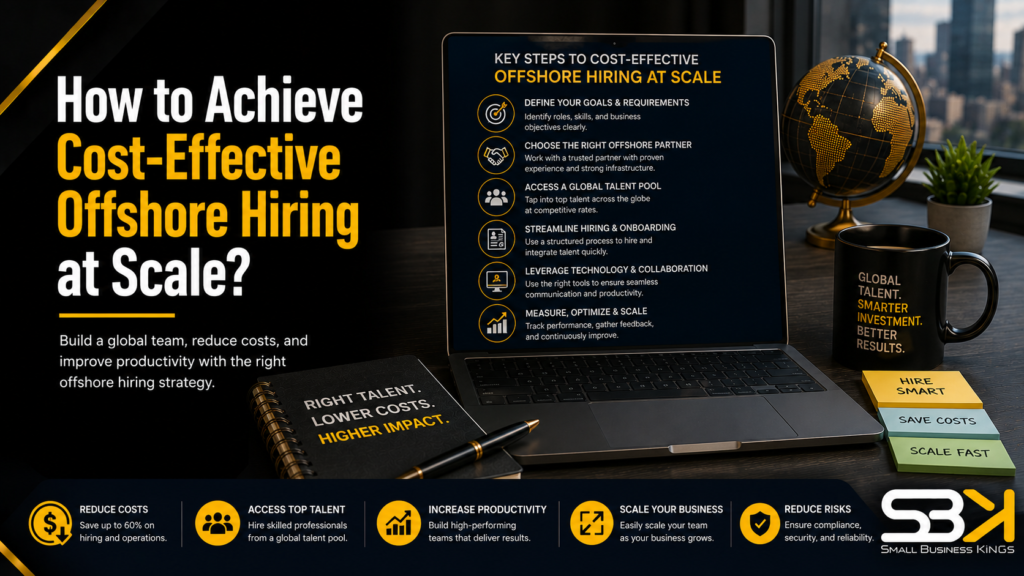
How to Achieve Cost-Effective Offshore Hiring at Scale?
Cost-effective offshore hiring comes down to matching the right engagement model to your actual workload, getting full visibility into what you’re really paying before you sign anything, and treating offshore hires like real employees from day one rather than an afterthought. Businesses that get burned by offshore hiring almost always skipped one of these three steps — not because offshore talent underperformed, but because the structure around it was never built properly.
What Does "Cost-Effective" Actually Mean Here?
Cost-effective doesn’t mean cheapest. A $6-an-hour hire who needs constant rework, quits after two months, or exposes you to a compliance problem isn’t cost-effective — it’s expensive in ways that don’t show up on the invoice. Real cost-effectiveness means your total cost per unit of output — not your hourly rate — is lower than hiring locally, once you account for turnover, management overhead, and the time it takes someone to reach full productivity.
This distinction matters because most of the pricing comparisons you’ll see online only show the headline hourly rate. The businesses that actually save money long-term are the ones who evaluate offshore hiring the same way they’d evaluate any other capital decision: total cost of ownership, not sticker price.
Choosing the Right Engagement Model for Your Budget
This is the single biggest lever on cost-effectiveness, and it’s also where most small businesses guess wrong. Three models dominate offshore hiring, and each has a different cost structure and risk profile.
Staff Augmentation
You hire individuals who work exclusively for you, embedded in your existing team and workflows, usually through a staffing partner who handles local payroll and compliance. This tends to be the most cost-predictable model for ongoing, defined roles — you know roughly what you’re paying per person per month, and there’s no long-term severance or entity-setup cost if you need to scale down.
Launch Your Business On Fast VPS Hosting
Secure, high-performance hosting designed for growth. Don't lose sales to slow site speed.
Best for: roles with clear, repeatable responsibilities — bookkeeping, customer support, data processing, development work with a defined scope.
Dedicated Offshore Teams
Similar to staff augmentation but built around a long-term, stable team rather than filling individual seats. The offshore partner invests more in retention and continuity, which usually costs slightly more per head but reduces the turnover-driven costs that quietly erode “cheap” hourly rates.
Best for: functions you expect to run indefinitely and want deep institutional knowledge to build up over time, like a recurring finance or accounting operation.
Employer of Record (EOR)
An EOR is a third-party company that legally employs the offshore worker on your behalf in their home country, handling local labor law, tax withholding, and benefits compliance, while the person works day-to-day as part of your team. This is the model most likely to prevent an expensive compliance mistake, since misclassifying a foreign worker as a contractor when local law treats them as an employee can trigger back taxes and penalties in that country.
Best for: businesses hiring individuals directly (rather than through a staffing agency) in a country where they don’t have a legal entity.
Comparing the Models
| Model | Typical Cost Structure | Compliance Handled By | Best Fit |
|---|---|---|---|
| Staff augmentation | Predictable monthly fee per person, set by staffing partner | Staffing partner | Defined, ongoing roles needing quick scale up/down |
| Dedicated offshore team | Slightly higher per-head cost, lower turnover cost over time | Staffing partner | Long-term functions needing institutional knowledge |
| Employer of Record (EOR) | Per-employee fee plus local statutory costs (varies by country) | The EOR provider | Direct hires in countries where you lack a legal entity |
| Freelance/independent contractor | Lowest headline cost, highest turnover and compliance risk | You, or not at all | Short-term, narrowly scoped projects only |
Rates, statutory costs, and typical fee structures vary significantly by country and change over time, so treat any specific dollar figure you see for a given model as a starting point for research, not a number to build a budget around — verify current pricing directly with providers you’re evaluating.
The Pricing Transparency Test
Before you sign with any offshore staffing partner, ask them to walk you through exactly what’s included in their quoted rate. This is where “cost-effective” hiring quietly turns expensive for businesses that don’t ask upfront.
Specifically, find out:
- Is local payroll tax, insurance, and statutory benefits included, or billed separately? A rate that looks lower than a competitor’s may simply be excluding costs the other provider bundles in.
- Is there a markup on top of the worker’s actual pay, and how much? Some providers are transparent about this; others aren’t, and you won’t know unless you ask directly.
- What happens to cost if the hire doesn’t work out in the first 30-60 days? Some partners offer replacement guarantees at no extra cost; others charge you to restart the search.
- Are there minimum contract terms or termination fees? A model that looks flexible on paper can carry hidden penalties for scaling down early.
A provider that answers these questions clearly and in writing is a good sign. One that gives vague answers or pushes you to “just get started” first is a red flag regardless of how attractive the headline rate looks.
Free Business Blueprint
Steal the roadmap smart entrepreneurs use to launch, grow, and scale their businesses while avoiding expensive mistakes.
A Worked Example: Scaling a 5-Person Team to 15
Say you run a small accounting firm with five in-house staff, and seasonal demand means you need ten more people for four months a year — but you don’t want to carry that headcount permanently.
- Define the work, not the headcount. Instead of “we need ten accountants,” specify the actual task volume: how many client files, what kind of work (bookkeeping vs. tax prep vs. reconciliation), and which tasks follow a documented process versus require judgment calls only your in-house team should make.
- Match the model to the commitment. Since this is seasonal, staff augmentation is likely a better fit than a dedicated team or EOR — you want the ability to scale down cleanly once the season ends without severance obligations or unwinding a legal employment relationship.
- Get pricing in writing before you commit. Ask the staffing partner for an all-in monthly cost per person, confirm what’s included, and get their replacement policy in writing in case a hire doesn’t work out mid-season.
- Build a 30-60-90 day onboarding plan before day one. Document your current workflows (even messy ones), set up daily check-ins for the first two weeks, move to weekly syncs by day 30, and expect the offshore team to be running at full integration by day 90.
- Track leading indicators early, not just output. In the first 30 days, track training completion and first-time accuracy rather than pure volume — a team that’s accurate early costs you far less in rework than one that’s fast but sloppy.
This structure is what separates a seasonal offshore hire that pays for itself from one that becomes a cleanup project in month two.
Setting Up Offshore Hires to Actually Succeed
Even the most cost-effective engagement model falls apart without real onboarding. Offshore hires who are handed a login and left to “figure it out” cost you far more in rework, missed deadlines, and turnover than the hourly rate ever saved you.
At minimum:
- Document your current processes clearly enough that someone unfamiliar with your business could follow them
- Set specific, measurable expectations for the first 30, 60, and 90 days
- Use the same collaboration tools your in-house team already relies on (project management software, video conferencing, shared messaging)
- Schedule frequent check-ins early — daily for the first two weeks is standard — and taper down as the person proves reliable
Skipping structured onboarding is the single most common reason offshore hiring looks cheap on paper and expensive in practice.
Managing the Business Side While You Scale
While you’re building out an offshore team, don’t neglect the systems that keep the rest of your business running — especially your online presence and how you track customer relationships as you grow. A business scaling its team often needs to scale its customer-facing operations at the same time, and trying to patch that together with spreadsheets and email threads gets messy fast once you’re managing more people and more clients. SBK works with Softangles for exactly this: they handle business website design and hosting, logo and brand/media design, and CRM/sales pipeline setup, so your growing team has a real system to work from instead of improvising one.
Common Mistakes That Make Offshore Hiring More Expensive
- Hiring on hourly rate alone. The cheapest quoted rate often has the least included, meaning you pay for compliance, replacement, or management support separately later.
- Skipping documentation. If your own team can’t explain a process clearly, an offshore hire can’t execute it consistently — expect errors and rework until you fix this.
- No defined escalation path. When offshore staff don’t know who to ask when something’s unclear, they either guess (creating errors) or wait (creating delays) — both cost you.
- Treating offshore hires as temporary. Partners who are onboarded and managed like long-term team members have lower turnover, and turnover is one of the biggest hidden costs in offshore hiring.
Frequently Asked Questions
Is offshore hiring actually cheaper than hiring locally?
It can be significantly cheaper on a like-for-like basis, but only if you account for the full cost — recruitment, onboarding, management time, and turnover — rather than just comparing hourly rates. A lower rate with high turnover or heavy rework can end up costing more than a slightly higher rate from a well-vetted, well-managed hire.
What’s the difference between staff augmentation and an Employer of Record?
Staff augmentation typically means a staffing partner handles recruitment and local employment logistics while the person works as an extension of your team, whereas an Employer of Record legally employs the worker on your behalf in their home country and manages compliance directly. Both can achieve similar day-to-day integration; the difference is mainly in how the legal employment relationship and compliance risk are structured.
How do I know if an offshore staffing quote has hidden costs?
Ask directly whether local payroll taxes, statutory benefits, insurance, and any markup are included in the quoted rate, and get the answer in writing. A provider that can’t clearly explain what’s bundled into their pricing is a warning sign, regardless of how competitive the number looks.
How long does it take for an offshore hire to become fully productive?
Most structured onboarding plans expect a new offshore hire to reach full integration by around 90 days, with daily check-ins in the first two weeks tapering to weekly syncs by day 30. Roles with more complexity or less documentation typically take longer to ramp up.
What roles are best suited to offshore hiring?
Roles with clearly definable, repeatable processes — bookkeeping, customer support, data entry, software development with defined scope — tend to transition offshore most successfully. Roles requiring constant judgment calls or deep, undocumented institutional knowledge are harder to hand off until your processes are well documented.
Launch Your Business On Fast VPS Hosting
Secure, high-performance hosting designed for growth. Don't lose sales to slow site speed.
Can I scale an offshore team down without penalty?
It depends heavily on the engagement model and contract terms — staff augmentation arrangements are often more flexible for scaling down than an Employer of Record relationship with statutory notice requirements. Confirm minimum contract terms and any termination fees in writing before you sign, since these vary by provider and by the local labor laws in the worker’s country.