

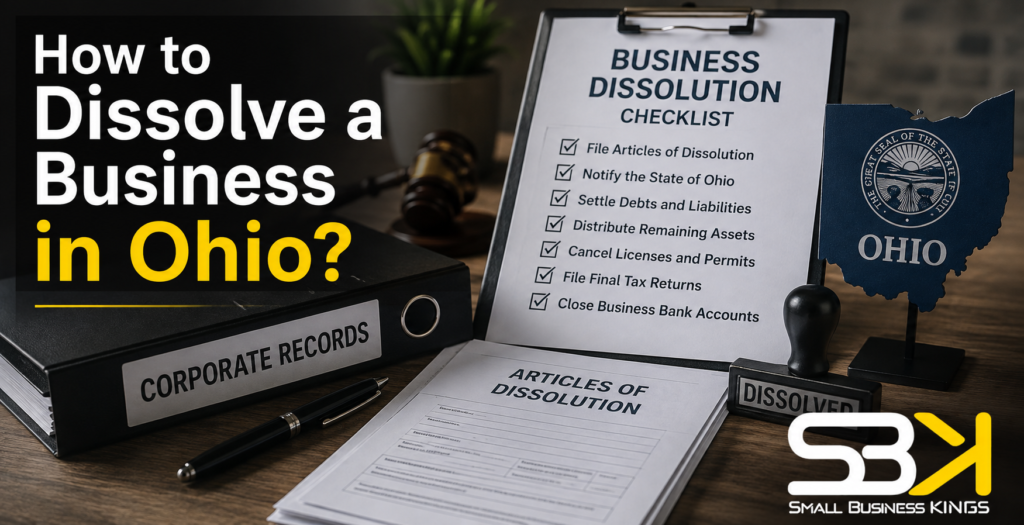
How to Dissolve a Business in Ohio: A Step-by-Step Guide?
To dissolve a business in Ohio, you need to formally approve the closure internally, settle debts and notify creditors, file a Certificate of Dissolution with the Ohio Secretary of State, and close out your state and federal tax accounts. Skipping any of these steps — especially the tax and agency closures — is how business owners end up owing fees and penalties on a company they thought was already closed.
Ohio doesn’t automatically close your business just because you stop operating. Your LLC or corporation stays legally active — and keeps accruing whatever ongoing obligations come with that status — until you file the right paperwork with the right agencies. Here’s exactly what that involves.
What Does It Mean to "Dissolve" a Business in Ohio?
Dissolution is the formal, legal process of ending your business entity’s existence with the state. When you formed your LLC or corporation, you filed organizing paperwork with the Ohio Secretary of State that created a separate legal entity. Dissolution reverses that: you file a Certificate of Dissolution to officially tell the state (and, by extension, creditors, vendors, and anyone else who checks) that the entity no longer exists.
This is different from simply letting your business go inactive. If you stop filing required reports or paying state fees without formally dissolving, Ohio can administratively dissolve your entity — but that’s not the same as a clean, voluntary closure, and it doesn’t necessarily protect you from back taxes, penalties, or lingering liability. Voluntary dissolution, done properly, is the version that actually closes the book.
If your business is registered in Ohio but was originally formed in a different state (a “foreign” entity doing business in Ohio), the process you want is technically called withdrawal, not dissolution — you dissolve in your home state and withdraw your registration everywhere else.
Launch Your Business On Fast VPS Hosting
Secure, high-performance hosting designed for growth. Don't lose sales to slow site speed.
Before You File: Internal Steps to Take First
Ohio expects you to handle your internal approval and basic wind-down obligations before or alongside your state filing — not after.
1. Check Your Operating Agreement or Bylaws
Most LLC operating agreements and corporate bylaws spell out exactly how a dissolution vote has to happen — who can call the vote, what percentage of members or shareholders needs to approve it, and whether written consent is acceptable in place of a formal meeting. Follow whatever your governing document says. If you never adopted a formal operating agreement or bylaws, Ohio’s default LLC and corporation statutes govern the process instead, which is one more reason to have this documentation in order even for a small, single-member entity.
2. Hold the Vote and Document It
Even a single-member LLC should document the decision in writing — a simple written resolution stating the date, the vote (or sole-member decision), and the effective date of dissolution. This becomes part of your official record and is often referenced or attached during the state filing.
3. Settle Debts and Notify Creditors
Before or during the dissolution process, pay down what you owe, liquidate remaining business assets as needed, and notify known creditors that the business is winding down, along with a deadline for submitting any final claims. This protects you from creditors surfacing months later claiming they were never told the business closed.
4. Distribute Remaining Assets
Once debts and obligations are settled, any remaining cash or assets get distributed to members or shareholders according to your operating agreement or bylaws — or, absent that, according to ownership percentage under Ohio law.
How to File a Certificate of Dissolution with the Ohio Secretary of State
This is the step people mean when they say “dissolve my business” — the actual state filing.
Dissolving an Ohio LLC
Ohio LLCs file a Certificate of Dissolution with the Ohio Secretary of State. As of this writing, the Secretary of State’s office lists a filing fee for this form, but fees change over time, so confirm the current amount directly on the Ohio Secretary of State’s business filing site or through Ohio’s online filing portal, Ohio Business Central, before you submit anything.
Standard processing typically takes a matter of business days rather than weeks, though this varies by filing volume and whether you file online versus by mail. Expedited processing is usually available for an additional fee if you’re on a deadline.
Dissolving an Ohio Corporation
Ohio corporations file a Certificate of Dissolution as well, but the process typically requires both board approval and shareholder approval before filing — check your bylaws for the exact voting threshold required. Corporations that have never issued shares or begun business operations may qualify for a simplified dissolution process; if that’s your situation, it’s worth confirming with the Secretary of State’s office or a business attorney, since the requirements differ from a fully operating corporation winding down.
Closing a Sole Proprietorship or DBA
If you’re operating as a sole proprietorship, there’s no entity to formally dissolve with the state — sole proprietorships aren’t separate legal entities in the first place. What you do need to do is cancel any registered trade name (DBA) with the Ohio Secretary of State if you filed one, and close out your tax accounts as described below. This is a shorter process than an LLC or corporation dissolution, but the tax cleanup steps are the same.
Closing Your Ohio Tax Accounts
This is the step generic dissolution-service pages tend to gloss over, and it’s where a lot of “dissolved” businesses still end up owing money.
Ohio Department of Taxation
Any active state tax registrations — sales tax, employer withholding, and others — need to be formally closed through the Ohio Department of Taxation. Simply stopping payments doesn’t close the account; you typically need to file a final return for each tax type and indicate it’s your final filing.
Commercial Activity Tax (CAT)
If your business was registered for Ohio’s Commercial Activity Tax, that registration needs to be canceled separately through the Department of Taxation. Don’t assume dissolving your entity with the Secretary of State automatically closes your CAT account — it doesn’t.
Unemployment Tax and Workers’ Comp
If you had employees, you’ll need to deactivate your unemployment tax account with the Ohio Department of Job and Family Services and cancel your active coverage with the Ohio Bureau of Workers’ Compensation. Both are separate from your Secretary of State filing and from the Department of Taxation accounts — three different agencies, three different closures.
Free Business Blueprint
Steal the roadmap smart entrepreneurs use to launch, grow, and scale their businesses while avoiding expensive mistakes.
Federal Steps: IRS Final Return and Closing Your EIN
Dissolution at the state level doesn’t touch your federal obligations. You’ll still need to:
- File a final federal tax return, checking the box that indicates it’s a final return for a dissolving entity
- Report any final payroll tax filings if you had employees, including final W-2s
- Distribute or report any final capital gains/losses to members or shareholders (LLCs taxed as partnerships issue final Schedule K-1s)
- Close your EIN account with the IRS by sending a written request, since the IRS doesn’t automatically cancel an EIN — it just retires it once you notify them the entity is closed
Canceling Licenses, Permits, and Registrations
Once the entity-level and tax filings are moving, work through anything else tied to the business:
- Local or state business licenses and permits specific to your industry
- Any professional or occupational licenses held under the business name
- Vendor accounts, business bank accounts, and business credit cards (keep enough open to process final transactions before closing)
- Business insurance policies — cancel these last, after you’re confident no claims are pending
If You Operate in Other States: Withdrawal, Not Just Dissolution
If your Ohio-formed LLC or corporation also registered to do business in other states, dissolving in Ohio alone doesn’t end your obligations elsewhere. You need to separately file a certificate of withdrawal (sometimes called cancellation) in each state where you’re registered as a foreign entity. Skipping this is one of the most common — and most expensive — mistakes in a multi-state closure, since those states will keep charging annual fees and requiring reports on a business that no longer exists anywhere else.
Dissolution vs. Withdrawal vs. Administrative Dissolution
| Term | What it means | When it applies |
|---|---|---|
| Dissolution | Formally ending your business entity in the state where it was originally formed | Your Ohio LLC or corporation is closing entirely |
| Withdrawal / Cancellation | Ending your registration in a state other than where you originally formed | Your business is registered in Ohio but formed elsewhere (or vice versa) and you’re closing operations in that one state |
| Administrative dissolution | The state closes your entity involuntarily for failing to file reports or pay fees | You didn’t take action, and the state did it for you — this does not necessarily clear tax debts or protect you the way a voluntary dissolution does |
| Reinstatement | Restoring a business that was administratively (or sometimes voluntarily) dissolved back to good standing | You need the entity active again after an involuntary or accidental dissolution |
A Concrete Example: Dissolving an Ohio LLC Start to Finish
Say you run “Riverside Print Co.,” a single-member Ohio LLC with one part-time employee, no debt to outside creditors, and modest annual revenue. Here’s roughly how the timeline looks:
- Week 1: You review your operating agreement (or confirm you’re relying on Ohio’s default LLC statute since you never adopted one), and draft a one-page written resolution documenting your decision to dissolve, with an effective date.
- Week 1–2: You notify your one part-time employee, process their final paycheck, and file your last payroll tax return with the “final return” box checked. You cancel your workers’ comp policy with the Ohio Bureau of Workers’ Compensation and deactivate your unemployment account with the Ohio Department of Job and Family Services.
- Week 2: You file your Certificate of Dissolution online through Ohio Business Central, paying the current filing fee listed on the Secretary of State’s site.
- Week 2–3: You file your final Ohio sales tax return (if applicable) and cancel your CAT registration through the Ohio Department of Taxation.
- Week 3: You file your final federal tax return, checking the final-return box, and send the IRS a written request to close your EIN.
- Week 3–4: You close the business bank account after confirming no pending transactions, and cancel your general liability insurance policy last.
Total elapsed time: roughly three to four weeks for a simple, single-owner LLC with no complicating debt — longer if you have creditors to settle, multiple owners to coordinate, or registrations in other states to withdraw.
What Happens If You Don't Formally Dissolve?
Your LLC or corporation stays on the books as active. That generally means continued exposure to annual report requirements, ongoing state fees, and potential state tax liabilities on an entity that isn’t generating revenue anymore. If the state eventually administratively dissolves it for non-compliance, you may still owe back fees or penalties accrued before that happened, and the entity’s liability protection for that stretch of time can be murkier than if you’d closed it properly. Filing a voluntary dissolution — even a delayed one — is almost always a better position than letting a defunct business sit unresolved.
Closing One Business Before Starting the Next
If you’re dissolving this business specifically to start a new one, it’s worth using the transition to set your next venture up properly from day one rather than scrambling later. Getting a professional website, hosting, and a basic CRM or sales pipeline in place before you’re six months into the new business — instead of bolting them on after the fact — saves real time. SBK works with Softangles for exactly this: they handle business website design, hosting, logo and brand/media design, and CRM or sales pipeline setup for small businesses getting off the ground.
Frequently Asked Questions
How much does it cost to dissolve a business in Ohio?
Ohio charges a filing fee for the Certificate of Dissolution, but exact fees change over time and can vary by entity type. Check the current fee directly on the Ohio Secretary of State’s website or through Ohio Business Central before filing, rather than relying on a number you saw elsewhere.
How long does it take to dissolve an LLC in Ohio?
Standard processing is typically a matter of business days once the Secretary of State receives your filing, with expedited options available for an added fee if needed. The full process — including tax account closures and federal filings — usually takes several weeks total, longer if you have outstanding debts or multi-state registrations to unwind.
Do I need a lawyer to dissolve my Ohio business?
Not necessarily, especially for a straightforward, debt-free single-owner LLC. A business attorney or CPA becomes more valuable if you have outstanding debts, multiple owners in disagreement, complex asset distribution, or registrations in several states, since mistakes at that level can create personal liability or tax exposure.
What’s the difference between dissolving and withdrawing a business in Ohio?
Dissolution ends your entity in the state where it was originally formed. Withdrawal (sometimes called cancellation) ends your registration in a state other than your home state. An Ohio-formed LLC that also registered in another state needs to dissolve in Ohio and separately withdraw from that other state.
What happens if my Ohio business gets administratively dissolved instead of me dissolving it voluntarily?
Administrative dissolution happens when the state closes your entity for failing to file reports or pay required fees — it doesn’t automatically clear any back taxes or penalties owed, and it can leave ambiguity around your liability protection for the period before it happened. If your business is currently in that state, look into reinstatement or a formal dissolution to close things out cleanly.
Launch Your Business On Fast VPS Hosting
Secure, high-performance hosting designed for growth. Don't lose sales to slow site speed.
Can I reopen a business after dissolving it in Ohio?
Once you voluntarily dissolve an entity, it no longer legally exists — you can’t simply “reopen” it. You’d need to form a new entity from scratch, which means new formation paperwork, a new EIN, and new tax registrations, even if you use the same business name (assuming it’s still available).